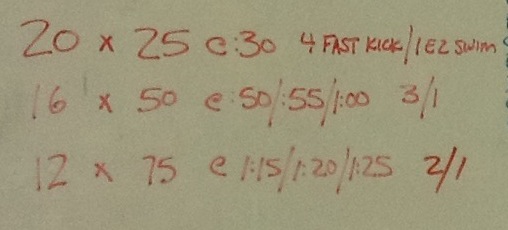
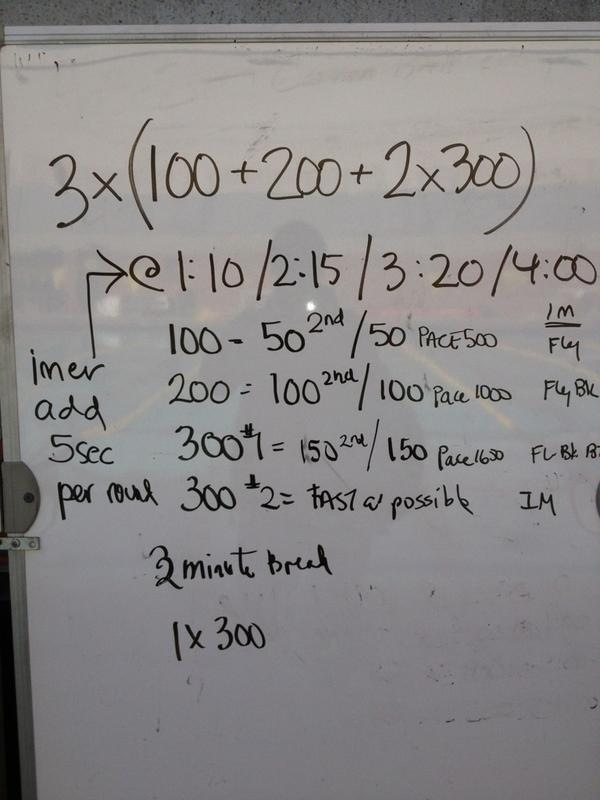
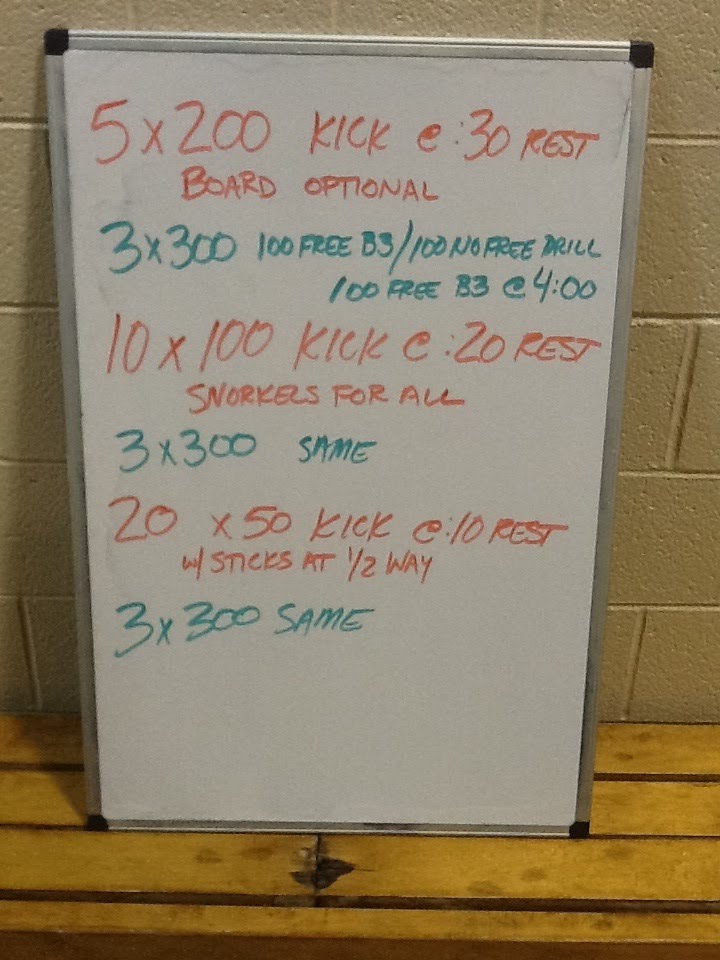
I really enjoy your site and have really found quite a few of the workouts inspirational and thought I would try to contribute. Thanks for all the sharing.
3-part Sprint Challenge Circuit with @GAswim
Rob Bond
Head Senior Swim Coach
Glenbrook Aquatics
Follow @GAswim
!function(d,s,id){var js,fjs=d.getElementsByTagName(s)[0];if(!d.getElementById(id)){js=d.createElement(s);js.id=id;js.src=”//platform.twitter.com/widgets.js”;fjs.parentNode.insertBefore(js,fjs);}}(document,”script”,”twitter-wjs”);
We also do a Sprint Challenge Circuit. Each part of the challenge is about a month apart. No intervals – swimmers go when they are ready. A pre-meet warm-up precedes the set. Active recovery is encouraged, but not required. Swimmers get 5 failures at any step before the set is cut off. If a swimmer tries 5 times without meeting goal, the set is over and they are out of the set – send them to a different training group…
Part 1:
Pre-Meet Warm-up then
3 x 50 Off The Block @BT +2.5
3 x 50 Running Start @BT +1.5
3 x 50 Fins @BT +.5
Part 2 (approximately one month later):
Pre-Meet Warm-up then
2 x 50 Off the Block @BT +2.0
2 x 50 Running Start @BT +1.0
2 x 50 Fins @BT
Part 3 (another month apart):
Pre-Meet Warm-up then
1 x 50 Off the Block @BT +1.5
1 x 50 Running Start @BT .5
1 x 50 Fins @BT -.5
Running start sprints – begin the stopwatch when the final foot leaves the deck. Fins can be from a push or dive – your call.
!function(d,s,id){var js,fjs=d.getElementsByTagName(s)[0];if(!d.getElementById(id)){js=d.createElement(s);js.id=id;js.src=”//platform.twitter.com/widgets.js”;fjs.parentNode.insertBefore(js,fjs);}}(document,”script”,”twitter-wjs”);
"Texas A&M Kick Set" with Coach Rob Bond @GAswim
Rob Bond
Head Senior Swim Coach
Glenbrook Aquatics
Follow @GAswim
Editor’s Note: This is the second of four submissions from Coach Bond. Please kick on the “Bond” tag below to see his other sets.
Texas A&M Kick Set (completely stolen – not my set, but I love it)
4-6 x
{75 @1:45 Kick
{100 @1:45 Kick Faster
{125 @1:45 Kick ALL OUT!!
Have you checked out the Swimming Wizard reading list?
!function(d,s,id){var js,fjs=d.getElementsByTagName(s)[0];if(!d.getElementById(id)){js=d.createElement(s);js.id=id;js.src=”//platform.twitter.com/widgets.js”;fjs.parentNode.insertBefore(js,fjs);}}(document,”script”,”twitter-wjs”);
The Glenbrook Broken Mile Set
Rob Bond
Head Senior Swim Coach
Glenbrook Aquatics
Follow @GAswim
Broken Mile
11 x
{100 @1:00
{50@1:00
Set interval at best average 100 pace. They should get no more than 2-3 seconds rest on the 100s. It should provide a quick reset and then go. The rest should come on the 50s.
The Pyramid of Pain
Ryan Woodruff
Follow @WoodruffRyan
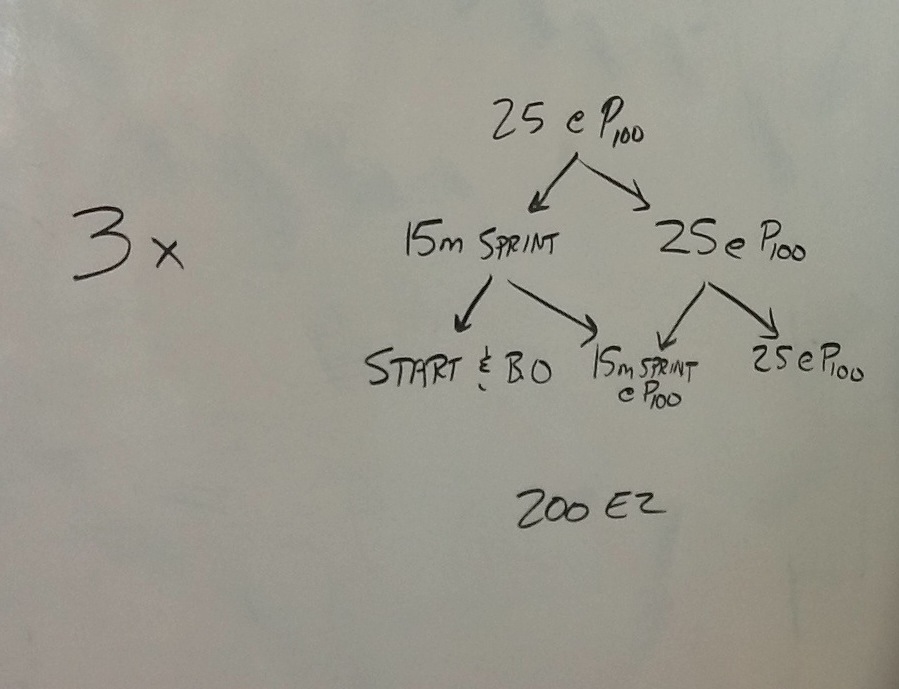
This set provides some incentives for fast swimming. The picture below explains the process of the Pyramid. All swimmers begin with a 200 for time with the goal of being within 6 seconds of lifetime best (girls) or 8 seconds (boys). 100 easy for all, and then those that failed will do a broken 200 (75-50-50-25 @:10 rest) while those that succeeded in reaching the goal will do a broken 100 (50-50@:10rest). The goal on the broken 200 is a lifetime best. The goal on the broken 100 is within 2 seconds of lifetime best. The second swim is followed by another 100 easy, and based on a swimmer’s success or failure he then completes either a broken 200 (75-50-50-25@:20 rest), a broken 100 (50-50@:10 rest), or an all-out dive 50. The goals are a lifetime best, a best +3 or faster, and the starting 50 split for a lifetime best 100, respectively. Success or failure on the 3rd swim leads to 10 push-ups or a “Hooray!”
We performed two rounds and saw many season-best practice swims.
!function(d,s,id){var js,fjs=d.getElementsByTagName(s)[0];if(!d.getElementById(id)){js=d.createElement(s);js.id=id;js.src=”//platform.twitter.com/widgets.js”;fjs.parentNode.insertBefore(js,fjs);}}(document,”script”,”twitter-wjs”);
Freestyle with the Northern Kentucky Clippers
Jason Roberts
Everyone Swims Butterfly: A Beautiful Thing
Ryan Woodruff
Follow @WoodruffRyan
!function(d,s,id){var js,fjs=d.getElementsByTagName(s)[0];if(!d.getElementById(id)){js=d.createElement(s);js.id=id;js.src=”//platform.twitter.com/widgets.js”;fjs.parentNode.insertBefore(js,fjs);}}(document,”script”,”twitter-wjs”);
Each week we make sure that every swimmer gets to train at least a small amount of butterfly. This past week’s Friday Fly Day set had our entire crew doing the same general set (reps, distance, and intervals), with adjustments made for three different ability levels within the group.
Level 1 = Our 200 butterfly specialists who simply can’t get enough.
Level 2 = Reluctant but capable butterflyers (who just can’t do it all day long).
Level 3 = “Coach, butterfly… it ain’t my thang”
It turned out to be a great set, and one easily manageable for one coach alone on deck
!function(d,s,id){var js,fjs=d.getElementsByTagName(s)[0];if(!d.getElementById(id)){js=d.createElement(s);js.id=id;js.src=”//platform.twitter.com/widgets.js”;fjs.parentNode.insertBefore(js,fjs);}}(document,”script”,”twitter-wjs”);
Sunday’s Super Set
Ryan Woodruff
Follow @WoodruffRyan
!function(d,s,id){var js,fjs=d.getElementsByTagName(s)[0];if(!d.getElementById(id)){js=d.createElement(s);js.id=id;js.src=”//platform.twitter.com/widgets.js”;fjs.parentNode.insertBefore(js,fjs);}}(document,”script”,”twitter-wjs”);
12 x 100 no free descend 1-4 to best 100 + 10 seconds @ 1:25/1:30
6 x 50 kick @ :55
#1 – 25 fast/25 ez
#2 – 25 ez/25 fast
#3 – all fast
400 same
12 x 75 no free descend 1-4 to best 100 – 7 seconds @ 1:05/1:10
6 x 50 same
400 same
12 x 50 no free descend 1-4 to 1/2 of best 100 +2 seconds @ :45
6 x 50 same
400 same
12 x 25 no free RACE!!! @ :30
6 x 50 same
!function(d,s,id){var js,fjs=d.getElementsByTagName(s)[0];if(!d.getElementById(id)){js=d.createElement(s);js.id=id;js.src=”//platform.twitter.com/widgets.js”;fjs.parentNode.insertBefore(js,fjs);}}(document,”script”,”twitter-wjs”);
Training in Florida with Western Kentucky University
Danielle Grobmyer
Follow @Dgrobmyer
!function(d,s,id){var js,fjs=d.getElementsByTagName(s)[0];if(!d.getElementById(id)){js=d.createElement(s);js.id=id;js.src=”//platform.twitter.com/widgets.js”;fjs.parentNode.insertBefore(js,fjs);}}(document,”script”,”twitter-wjs”);
@CSCSwimcoach ‘s 150s Set
Chris Plumb
Editor’s Note: This set was previously published here at The Swimming Wizard. It uses Streamline Sticks at a distance of about 5 yards.
2 x 7 x 150
The 150 is always on a total of 2:00
Dolphin Kicking and Race Pace Set
Ryan Woodruff
Follow @WoodruffRyan
!function(d,s,id){var js,fjs=d.getElementsByTagName(s)[0];if(!d.getElementById(id)){js=d.createElement(s);js.id=id;js.src=”//platform.twitter.com/widgets.js”;fjs.parentNode.insertBefore(js,fjs);}}(document,”script”,”twitter-wjs”); For this progression, we used 10 Streamline Sticks and 6 lanes. The streamline sticks were set up for circle swimming as follows:
Lane 1 – no streamline sticks
Lane 2 – sticks at 5yd from each wall
Lane 3 – sticks at 6yd from each wall
Lane 4 – sticks at 8yd from each wall
Lane 5 – sticks at 10yd from each wall
Lane 6 – sticks at 12.5yd from each wall
We performed the following set:
60 x 50 @ 1:00 (2 sets of 30)
#1-6: Smooth swim
#7-12: descend 1-3 and 4-6
#13-18: 25 fast/25 ez
#19 – 24: 25 ez/25 fast
#25-30: at P200 (Goal 200 pace)
In each set of 6, each athlete will do #1, in lane 1, #2 in lane 2 and so on. By using the Streamline Sticks, you control the distance UW. Makes for a significant challenge on the 5th and 6th 50 of each set. Additionally, this set can be used as an experiment to test an athletes capability to swim at P200 while kicking increasing distances. Most athletes can make it while kicking further than they do habitually.
Double Underwater 50s for short course kicking power
Ryan Woodruff
Follow @WoodruffRyan
!function(d,s,id){var js,fjs=d.getElementsByTagName(s)[0];if(!d.getElementById(id)){js=d.createElement(s);js.id=id;js.src=”//platform.twitter.com/widgets.js”;fjs.parentNode.insertBefore(js,fjs);}}(document,”script”,”twitter-wjs”);
Use Streamline Sticks at 7yd distance from each wall. Put two at each location, effectively blocking off the entire lane. Swimmers have to kick out 7yd off the wall, swim 11yd, and then kick the final 7 yd underwater, do an open turn and do it again! Feel free to change up the underwater distance for a more or less challenging set.
!function(d,s,id){var js,fjs=d.getElementsByTagName(s)[0];if(!d.getElementById(id)){js=d.createElement(s);js.id=id;js.src=”//platform.twitter.com/widgets.js”;fjs.parentNode.insertBefore(js,fjs);}}(document,”script”,”twitter-wjs”);
How to Build Your Own Streamline Sticks (and dominate your competition underwater)
Ryan Woodruff
Follow @WoodruffRyan
Last week, I wrote a post about Streamline Sticks, one tool I use to help my swimmers develop faster underwater dolphin kicking skills. Naively, I thought I might make a few for 2 or 3 readers who were interested. Instead, I was overwhelmed with responses from coaches and swimmers who wanted to get their hands on one.
Click here to find out more about how you can build your own Streamline Sticks.
!function(d,s,id){var js,fjs=d.getElementsByTagName(s)[0];if(!d.getElementById(id)){js=d.createElement(s);js.id=id;js.src=”//platform.twitter.com/widgets.js”;fjs.parentNode.insertBefore(js,fjs);}}(document,”script”,”twitter-wjs”);
Today’s Breaststroke Set
Ryan Woodruff
Follow @WoodruffRyan
We performed the set below with our sectional-level breaststroke group. There are essentially two parts to the set. The first part (above the dotted line) stresses technique with a LONG stroke and gradually builds to an up-tempo stroke at the end of the 100s. During this first part, “TT” stands for the Finis Tempo Trainer Pro which we use on a regular basis. Using mode 1, we have it set at 4.00, meaning the swimmer initiates a stroke once every 4 seconds. This is usually an uncomfortably long time to glide for our swimmers (a good thing!). We bring the TT down to 3.00 for the 2 x 150 and then to 2.00 on the 100s and have the swimmers shoot for 2 strokes during the 2.00 seconds in the last 10-15 yards of each 100. This combination of technique and tempo sets them up well for the second part of the set.
In the second part (below the dotted line), we are essentially challenging our swimmers in two ways on two sets of 6 x 100s. The first set challenges the efficiency of their underwater pullouts and breath-holding ability. The second set of 6 x 100 just challenges their endurance and the integrity of their stroke. The goal is simply to make all of the intervals and maintain stroke technique.
From @SprintSalo: USC Long Sprint Workout Saturday, December 22
Get In Yo Face Race Pace
Ryan Woodruff
Follow @WoodruffRyan
After an extended warmup, we performed the following set to work on maintaining our race pace under fatigue. We are quite skilled at repeating race-pace swimming for repeat 50s. Throwing in the 100 fast swim (where we asked swimmers to approach P200) more closely mimicked actual race-like fatigue. We saw some excellent results, particularly on the third round.
SCY
12 Fascinating Things I Read in 2012
Ryan Woodruff
Follow @WoodruffRyan
Not a workout, but some resources especially for coaches that I came across this year…
1. Former Texas A & M Football Coach Mike Sherman’s Letter To Texas High School Football Coaches by Chris Brown This is an incredible piece of writing that makes me think about why I coach.
2. The Surfer’s Guide to Taking Risks by Srinivas Rao Some great advice in the context of a beautiful sport.
3. Quantum Thinking When Coaching Swimmers by Jonty Skinner, Beijing Blog. Skinner might be on the frontier (fringe?) of modern thought on swim training and I find his ideas curiously stimulating.
4. The Toughest Coach There Ever Was by Frank Deford, Sports Illustrated A must-read for coaches in any sport.
5. The Greatest Assistant Coaching Article Ever Written by Wayne Goldsmith. This boldly titled article delivers on its promise. I wish I had read this 10 years ago.
6. High Volume or High Velocity by Paul Yetter, Developing The Champion Within Blog. Yetter answers one of swimming’s longest-standing debates with the best answer I have heard yet.
7. Did You See The Gorilla? An Interview with Psychologist Daniel Simons by David DiSalvo: The psychology behind this is fascinating.
8. The Fifty-Nine Story Crisis: A Lesson in Professional Behavior: A powerful lesson on admitting your mistakes.
9. Standing Near Greatness by Ashley Harrell: Find out what it is like to be Tim Tebow’s teammate and Urban Meyer’s doormat.
10. Marathon Man Kip Litton is a Fraud by Mark Singer: You won’t believe the lengths this guy went to…
11. You are Not Lazy, and Still You Are an Idler by Abraham Lincoln from Letters-of-Note blog: Strong words of advice from our nation’s greatest President.
12. Rich Thompson’s Pact With Baseball by Johnette Howard, ESPN.com: An inspiring story of faith, persistence, and dreams come true.
And one last memorable tidbit, from the “Faces In the Crowd: Coaches’ Edition” in Sports Illustrated:
Distance Kicking Test Set
Ryan Woodruff
Follow @WoodruffRyan
SCY
We performed the following kick set last night in order to test our kicking ability and fitness coming off a recent taper meet. It is essentially three broken 1,000s with some easy swim and drill mixed in between.
In the first 1,000, swimmers could use a board if they liked or could kick in any of our standard body positions. Typically when given this option, many of our swimmers prefer to kick on their backs. For the second 1,000, no boards were allowed and swimmers had to wear a snorkel, meaning that they had to kick either face down or on their side (which we do for free and fly kick). The third 1,000 used Streamline Sticks at the 12.5 yard mark and emphasized underwater dolphin kicking (in any body position) and the swimmers could choose the body position to continue kicking in once they surfaced. We recorded total times for each 1,000 and will use this information to develop kicking intervals for the next few months of training.
!function(d,s,id){var js,fjs=d.getElementsByTagName(s)[0];if(!d.getElementById(id)){js=d.createElement(s);js.id=id;js.src=”//platform.twitter.com/widgets.js”;fjs.parentNode.insertBefore(js,fjs);}}(document,”script”,”twitter-wjs”);
Streamline Sticks
Ryan Woodruff
Follow @WoodruffRyan
!function(d,s,id){var js,fjs=d.getElementsByTagName(s)[0];if(!d.getElementById(id)){js=d.createElement(s);js.id=id;js.src=”//platform.twitter.com/widgets.js”;fjs.parentNode.insertBefore(js,fjs);}}(document,”script”,”twitter-wjs”);
Streamline Sticks are easily among the best pieces of training equipment I have seen in my 13 years of club coaching. We use them weekly to develop the habits and skills to produce consistent underwater dolphin kicking. They force swimmers to kick a set distance off the wall and allow for circle swimming within the lane. Send me an email at swimmingwizard@gmail.com or just leave your e-mail in the comments below if you are interested in getting your hands on a Streamline Stick and maybe I’ll make a few for Swimming Wizard readers.
UPDATE: The Swimming Wizard has been overwhelmed with responses about these streamline sticks. I am planning to post a video soon that explains how they may be constructed. Thanks! – Ryan
Distance Swimmers’ Delight: The Followup
Ryan Woodruff
Follow @WoodruffRyan
!function(d,s,id){var js,fjs=d.getElementsByTagName(s)[0];if(!d.getElementById(id)){js=d.createElement(s);js.id=id;js.src=”//platform.twitter.com/widgets.js”;fjs.parentNode.insertBefore(js,fjs);}}(document,”script”,”twitter-wjs”);
Last week I posted the Distance Swimmer’s Delight workout on this blog. It was one of our most viewed workouts ever. This past weekend, several of the swimmers who completed that set competed in a meet. I thought it would be interesting to compare the results from the practice with results from the meet.
Broken Mile Meet Broken 1000 Meet Broken 500 Meet
Swimmer 1 15:47 15:55 9:50 9:26 4:31 4:36
Swimmer 2 16:14 16:29 10:04 9:42 4:41 4:45
I should also mention that all of the times at the meet for these two swimmers were best times except Swimmer 2’s mile (missed best by .03)
Tweet!function(d,s,id){var js,fjs=d.getElementsByTagName(s)[0];if(!d.getElementById(id)){js=d.createElement(s);js.id=id;js.src=”//platform.twitter.com/widgets.js”;fjs.parentNode.insertBefore(js,fjs);}}(document,”script”,”twitter-wjs”);
Swim Workout of the Day: Lionville Riptide
Head Coach- Lionville Riptide Swim Team
Follow @SwimmingWizrd
!function(d,s,id){var js,fjs=d.getElementsByTagName(s)[0];if(!d.getElementById(id)){js=d.createElement(s);js.id=id;js.src=”//platform.twitter.com/widgets.js”;fjs.parentNode.insertBefore(js,fjs);}}(document,”script”,”twitter-wjs”);
Saturday at USC Trojans’ Practice
Dave Salo
Follow @SprintSalo
Saturday morning final set.
(also notice the interesting reflection)
!function(d,s,id){var js,fjs=d.getElementsByTagName(s)[0];if(!d.getElementById(id)){js=d.createElement(s);js.id=id;js.src=”//platform.twitter.com/widgets.js”;fjs.parentNode.insertBefore(js,fjs);}}(document,”script”,”twitter-wjs”);
How To Finish Like a Champ
Ryan Woodruff
The finish is among the least frequently practiced skills in our sport, in my observation. This drill serves as a mini-progression to help swimmers adjust to the presence of the wall appropriately during a finish, thus practicing for that gold medal moment.
We did this as a set of 16 x 50, 6 done like phase 1, 6 in phase 2, and the final 4 in phase 3. Here’s the progression.
Phase 1
At the conclusion of the 50, the swimmer takes his last stroke at the backstroke flags and then positions his body for the finish, kicking strong all the way to an extended touch.
Phase 2
Same idea as the first phase, just move everything closer to the wall. Take the last stroke halfway between the flags and the wall. Make sure the swimmer is paying close attention to the spacing with the wall.
Phase 3
Now do an all-out finish, touching with the body at maximum length. The swimmer should touch with the fingertips. With the wall-judging ability honed in phases 1 and 2, the swimmer should be able to time his finish very precisely.
Try this progression for any stroke. You never know when your finish will make the difference between gold and silver!
Thank you to Heath Hudgins (the swimmer in the videos) for being a willing example.
Distance Swimmer’s Delight
Ryan Woodruff
Follow @WoodruffRyan
We did the following set after about 3,000 yards of warmup, breathing pattern, and technique work. The efforts were excellent, with swimmers totaling times that were 20-30 seconds faster than their best mile, 10-20 seconds faster than their best 1,000 and 5-10 seconds faster than their best 500. Enjoy!
Part 1: Broken Mile (all swims finish with a turn or “foot-touch”)
25 @:10 rest
50 @:10 rest
75 @:10 rest
100 @:10 rest
125 @:20 rest
150 @:20 rest
175 @:20 rest
200 @:20 rest
175 @:20 rest
150 @:20 rest
125 @:20 rest
100 @:10 rest
75 @:10 rest
50 @:10 rest
25 @:30 rest
Dive 50 to a hand touch
Take overall time and subtract 4:00 to get total swimming time for the broken 1,650 free
500 easy swim @ 8:00
Broken 1,000 free (all swims finish with a turn or “foot-touch”)
50 @:10 rest
100 @:10 rest
150 @:10 rest
200 @:20 rest
200 @:20 rest
150 @:20 rest
100 @:30 rest
Dive 50 to a hand touch
Take overall time and subtract 2:00 to get total swimming time for the broken 1,000
500 easy swim @ 8:00
Broken 500 free
Dive 25 @:10 rest
50 @:10 rest
75 @:10 rest
100 @:10 rest
100 @:20 rest
75 @:20 rest
50 @:20 rest
25
Take overall time and subtract 1:30 to get total swimming time for the broken 500
500 easy swim @ 8:00
See the follow-up to this set here.
Sprint Freestyle Set with Kicking and Breath Control
Ryan Woodruff
Follow @WoodruffRyan
!function(d,s,id){var js,fjs=d.getElementsByTagName(s)[0];if(!d.getElementById(id)){js=d.createElement(s);js.id=id;js.src=”//platform.twitter.com/widgets.js”;fjs.parentNode.insertBefore(js,fjs);}}(document,”script”,”twitter-wjs”);
4 rounds (Round 1 no equipment, round 2 paddles only, round 3 fins only, round 4 fins and paddles);
Tweet!function(d,s,id){var js,fjs=d.getElementsByTagName(s)[0];if(!d.getElementById(id)){js=d.createElement(s);js.id=id;js.src=”//platform.twitter.com/widgets.js”;fjs.parentNode.insertBefore(js,fjs);}}(document,”script”,”twitter-wjs”);
Mix-It-Up Monday with @ErinQuinn11
Erin Quinn
Follow @ErinQuinn11!function(d,s,id){var js,fjs=d.getElementsByTagName(s)[0];if(!d.getElementById(id)){js=d.createElement(s);js.id=id;js.src=”//platform.twitter.com/widgets.js”;fjs.parentNode.insertBefore(js,fjs);}}(document,”script”,”twitter-wjs”);
Mix-It-Up #Monday should have been titled #MoshPitMonday! Pool Jam-Packed with #Hawks Dreaming Big Working #Harder 🙂
Cougar Aquatic Club Workout
Here’s a set I did with our Senior 1 (National) Group. I thought it went real well, kids loved it, but were dead tired.
A Kick Set That Burns
Ryan Woodruff
Follow @WoodruffRyan
I like having our athletes kick for maximum distance in a specified amount of time. Like most teams, our range of kicking speeds is greater than our range of swimming speeds, so kicking for distance becomes an effective way to challenge each athlete when we don’t have the ability to go on 6 different intervals. When we kick for distance, I like to put markers on the edge of the pool every 5 yards so that the athletes can determine their disance kicked to the nearest yard.
5 x 3:00 kick for distance @ 4:00 (descend 1-5)
100 easy swim @ 2:00
4 x 2:00 kick for distance @ 3:00 (descend 1-4)
100 easy swim @ 2:00
3 x 1:00 kick all out @ 2:00
"Sneaky "400IMs
1 x 100 Bk @ 1:30
1 x 100 Fr @ 120
"VO 2sdays" with Rochester Aquatic Club
Follow @SwimOrcas!function(d,s,id){var js,fjs=d.getElementsByTagName(s)[0];if(!d.getElementById(id)){js=d.createElement(s);js.id=id;js.src=”//platform.twitter.com/widgets.js”;fjs.parentNode.insertBefore(js,fjs);}}(document,”script”,”twitter-wjs”);
We did this set the other day – my kids call our Tuesday VO2 Max practices “VO Tuesdays.”
!function(d,s,id){var js,fjs=d.getElementsByTagName(s)[0];if(!d.getElementById(id)){js=d.createElement(s);js.id=id;js.src=”//platform.twitter.com/widgets.js”;fjs.parentNode.insertBefore(js,fjs);}}(document,”script”,”twitter-wjs”);