Dueling Kick Sets

Ryan Woodruff, Lynchburg YMCA

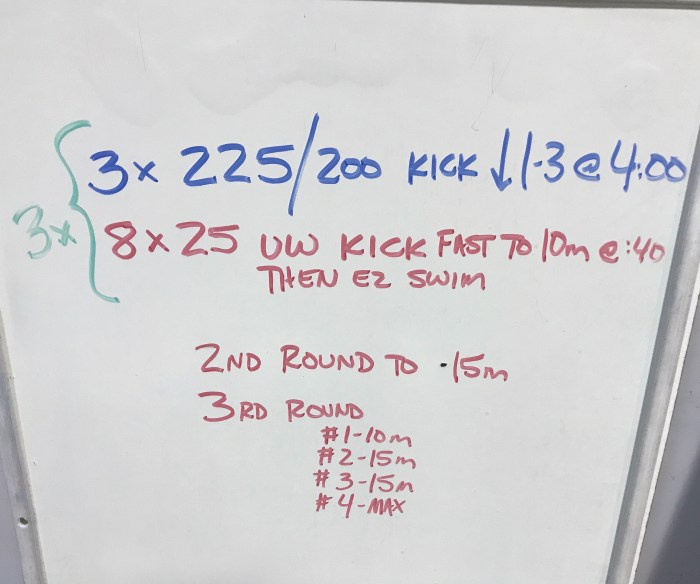
We did these two parallel kick sets recently because we only have enough Drag Sox for 1/2 of my group to wear at one time. Prior to this, we had mostly used the Sox for short bouts of underwater kicking and sprint swimming. I loved this set — it was something a little different that really made them push themselves. We were in a 25m pool.

Group A did:

9 x 50 flutter kick with Drag Sox and board @ 1:40.

While Group B did:

10 x 75 flutter kick with board Descend 1-5 and 6-10 @1:30

Then switch sets.

One of our favorite ways to start practice is w/ a good quote. Here’s a bunch to try, conveniently divided by the occasion in which you might want to use them: https://swimmingwizard.com/e-books/

All Stroke Technique Workout with the Makos

Mike Cook, Mason Makos

This was a technique workout to build off of later in the week. Works all 4 strokes and underwater dolphins

———

WARM UP

200 swim SR

200 kick 50 board 50 no board

today focus is all technique in the 4 strokes for thursday and saturday practice RULES

1 focus on underwater (not how many kicks but how far can you get off every wall in 5 seconds EVERY WALL TODAY

2. focus on the drill not your speed 3 IMX AROUND THE CORNER

WARM UP

200 swim SR (smooth and relax)

200 kick 50 boards 50 no boards

12×25 fast dolphin kicks @40 (not how many but how far can you get in 5 seconds. Push

each one. break out into fly back free 4 each

8×25 fast dolphin kicks @40 with fins (same as above 4 on stomach 4 on back can you get

further in 5 seconds) MAIN SET

FLY

4×50 fly kick @1:00 (odds board evens no board)

8×25 drill flyy chest press need breath pull and land forward@35 4×50 fly /free fast @45 fins

easy 50 choice

BACK

8×25 back kick fins @45 (5 second dolphin under water)

4×50 drill back (25 right arm/25 left arm) @1:00 good rotation from hips and core 4×50 fast back@55

Easy 50 choice

BREAST

8×25 breast kick (on back palms at side) @40

8×25 drill breast @40 (1 pull 2 kicks ) shoot forward and hold 4×50 back to breast fast @55 (cross over turns)

Easy 50 choice

FREE

4×50 kick with snorkels @1:00 (streamlines)

8×25 drill free @45 (paddle on forhead nice and controlled) 4×50 free des to fast @55

Easy 50 choice

WARM DOWN

8 minutes social treading water

Steady Free and Some Fly & Kick

Ryan Woodruff, Lynchburg YMCA

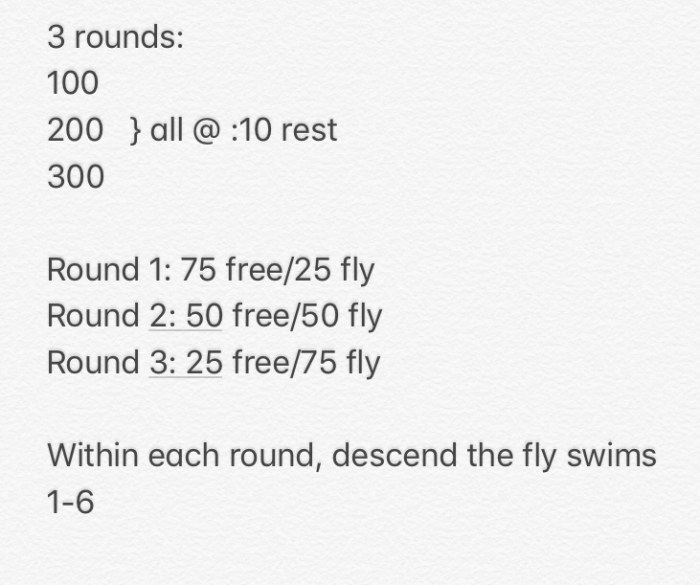
SCM. We needed some steady swimming at a moderate pace after a few days of intensity and racing at meets. Also wanted to get some fly in but wanted to make sure they didn’t have to “dodge” or take one-arm strokes thus the 25 swim/25 KOB (kick on back).

Have you seen our FREE new e-book, “The Quotable Swimming Coach?” Get it here: https://swimmingwizard.com/e-books/

Max Underwater Average Set

Ryan Woodruff, Lynchburg YMCA

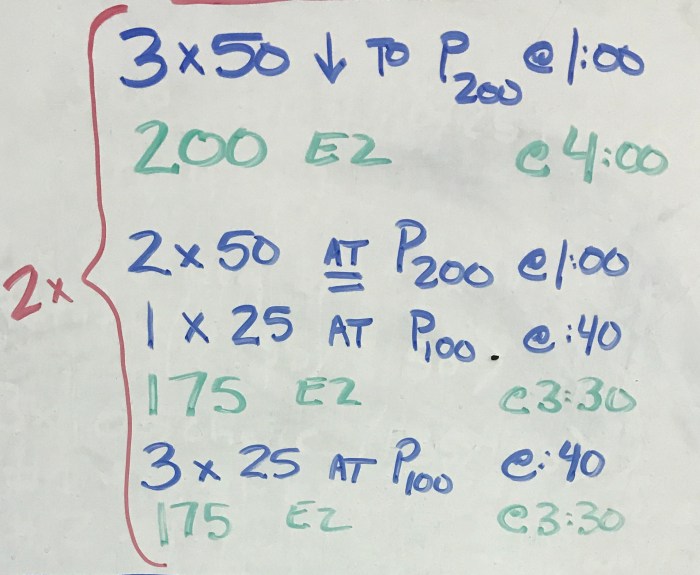
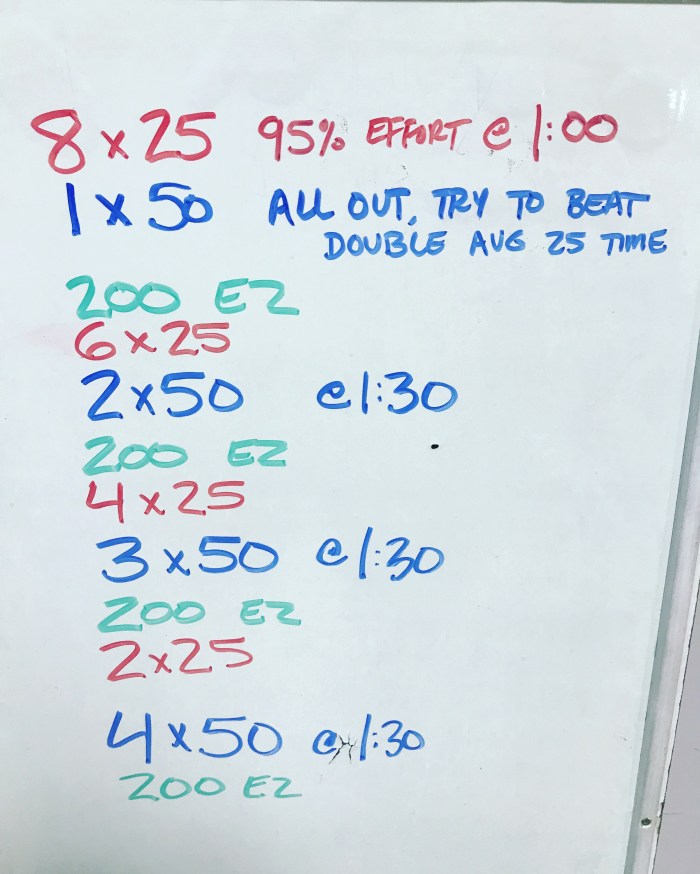
On the 25s, the goal was to hold the farthest possible average distance (with some pretty good speed) on each set.

The 225/200/175 was an A/B/C distance dependent on swimmer’s kicking speed. Swimmers chose the appropriate distance for themselves individually.

It’s free, it’s useful, and can help with your coaching today: https://swimmingwizard.com/e-books/

Broken Bucket Challenge Set

Ryan Woodruff, Lynchburg YMCA

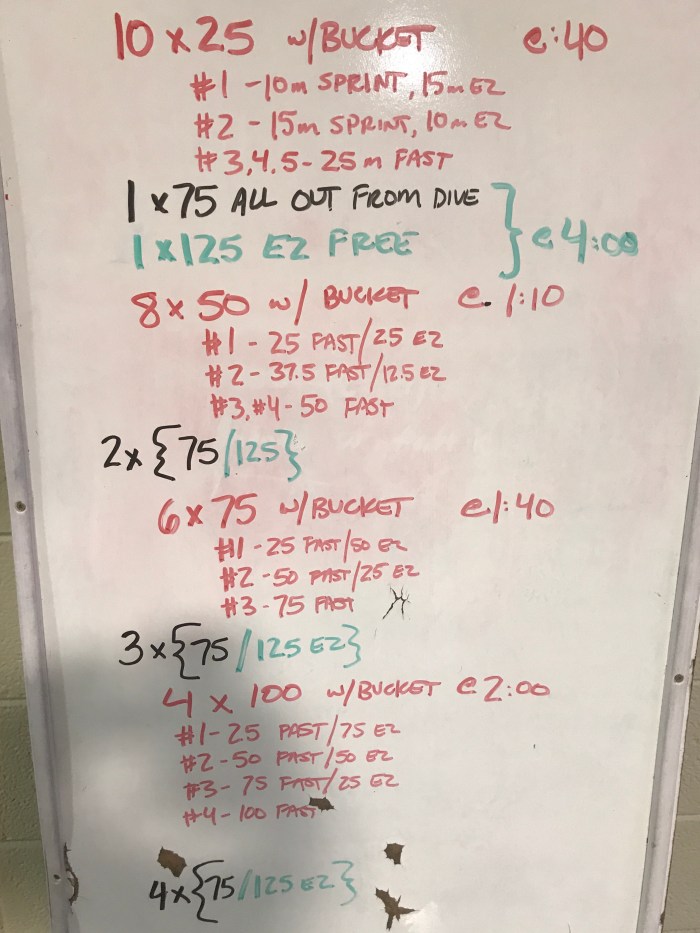
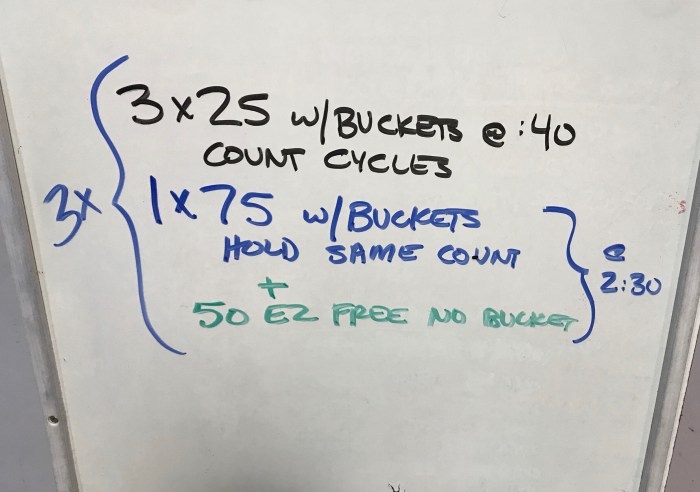
I frequently post sets where we use buckets and I get some questions about what kinds of buckets we are using. Here is what we use:

It is a simple 1-gallon “paint bucket” from Home Depot. We string some paracord through the handle holes and then connect the bucket to a belt by a rope about 6 feet in length. The beats we use are recycled from old stretch cords.

This set worked well today. The broken 200 was challenging but the :10 rest allowed them to hold their stroke technique. The interval on the broken 200 and 100 allowed them to really get up and go on the 3 x 25. We cycled through 2 rotations of this station and some drag sox work.

The next issue of “the wake-up swim” is coming soon. Sign up here.

Racing for Points and Prizes with WEST Express and Coach Heidi Miler

Heidi Miler, West Express Swim Team

We did this Saturday to simulate some racing as we have a big meet in two weeks and many of our kids haven’t swam a meet yet coming out of HS season.

I think it went well as it raised the racing level more than we normally see doing “regular off the block sprints”

—-

Saturday, January 5, 2019

Sprints off blocks – simulate racing with Winter Classic Meet in two weeks

1000 Meet warm up

6 x 50 @ 50 – build through a fast turn

300 kick build by 100

6 x 50  @ 50 – build to a fast finish

300 pull

1200/ 2200

2 x 100  @ 1:40 – 50 drill/50 free – technique focus

4 x 25 @ 30   Sprint free

100 easy

2 x 100 @ 1:50 – Non free 50 drill/50 – technique focus

4 x 25 @ 30 Sprint non free

200 easy

900/3100

Point System:

Winner of each heat gets 10 points, 2nd place 5

Best time 20 points

Best time –within 1 second 10 points

Best time within 2 seconds 5 points

Best time within 3 seconds 3 points

We set up in heats of similar speed – did each of these swims on approx. 5 min with some easy swimming and point calculating in between swims

All Swims AFAP

2 x 100 Free

1 x 100 Non Free (did not score this for heat winners with too many different strokes going on)

1 x 100 IM

At end choose between 2 x 100 broken swims or 1 x 200/500 broken swim

Cool Down

Highest point scorer won a won a TYR Prize (t-shirt, goggles etc)

I printed out a sheet with each swimmers best time sheet and attached it to the table – in between rounds the swimmers calculated their points

–—————-

If you are a coach who loves good quotes, you’ll want to check this out: https://swimmingwizard.com/e-books/

Article for Parents: The Phenom and the Climber

by Ryan Woodruff

Ours is a competitive sport and one that easily lends itself to comparison.  Whereas in basketball or soccer for example we could have endless debates about who is a better player, in swimming we have the most black and white tool for comparison that exists: THE CLOCK.  This is awesome because it allows to us to know exactly where we stand versus the competition at any meet or season of a swimmer’s career.  This knowledge can be motivating but it ignores one critical truth: that swimmers mature, grow, and improve at vastly different rates.  Every swimmer follows his or her own path.

Here is an example: Caeleb Dressel and Ryan Held both made the US Olympic team in 2016 — Dressel in the individual 100 free and both men as part of the 400 freestyle relay.  But they took different paths to get there. Dressel was an age group phenom at St. John’s Country Day School, later the Bolles School, and eventually the University of Florida.  Held grew up swimming for the Springfield (Illinois) YMCA team and swam collegiately at NC State, steadily climbing the ranks.

Here are their career progressions, by the numbers:

100 Free (LCM) Dressel Held
Age 11 59.76
Age 15 50.85 58.67
Age 20 47.17 48.26


At age 11, Caeleb Dressel was already a National Age Group record holder.  Held wouldn’t even record an official time in the long course 100 free until age 15.  Held at 15 was only 1.10 seconds faster than 11 year-old Dressel.

A closer look at their short course times is even more revealing.

100 Free (SCY) Dressel Held
Age 9 1:03.12
Age 11 54.08 1:06.78
Age 13 49.85 51.97
Age 15 44.27 45.83
Age 17 42.85 43.31
Age 21 39.90 41.05


At age 9, Caeleb Dressel was already putting up very good times in Florida, and by age 11 he was a certified phenom.  At age 11, Held had posted a time that would be 9 seconds slower than the current age group champs qualifying time in Illinois.

Both of these athletes have impressive progressions of steady improvement over time.  I remember watching Caeleb Dressel at age 10 in Florida – it was clear he was headed for big things.  If 11 year-old Ryan Held was at a meet I attended, I would have never even noticed him.  Held just kept climbing.

My point is that no two swimmers follow the same path.  Every swimmer is judged by the clock, but some swimmers will show promise early, and others won’t.  It is folly to suggest that elite senior performance can be accurately predicted.

For parents, it important to support the swimmer in his or her quest to continually improve without making comparisons.  What other swimmers are or are not achieving is simply not relevant.  Johnny being faster than Jimmy at age 10 is meaningless as evidence of who will be faster at 16. Parents can help by promoting commitment, hard work, and being a good teammate – the results will come, however fast they may be.