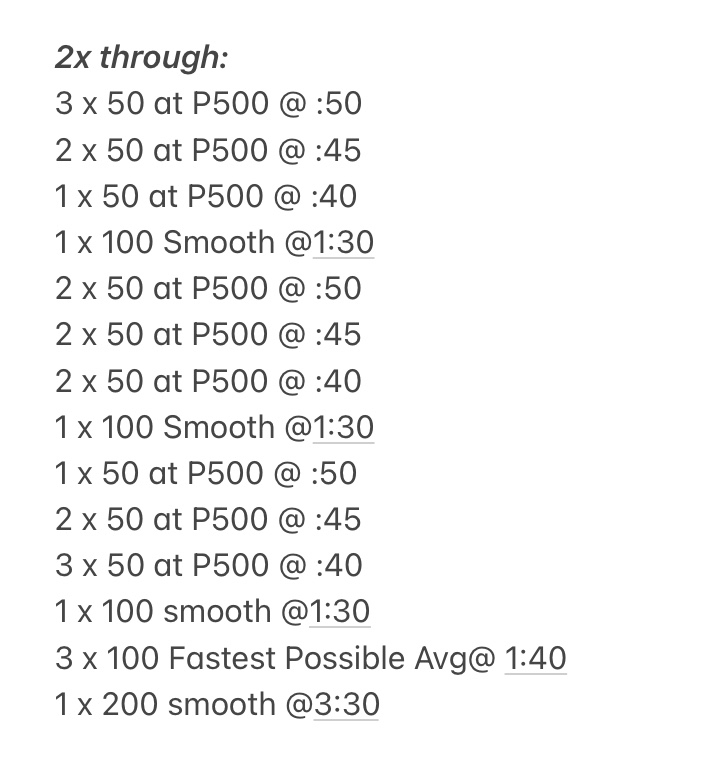
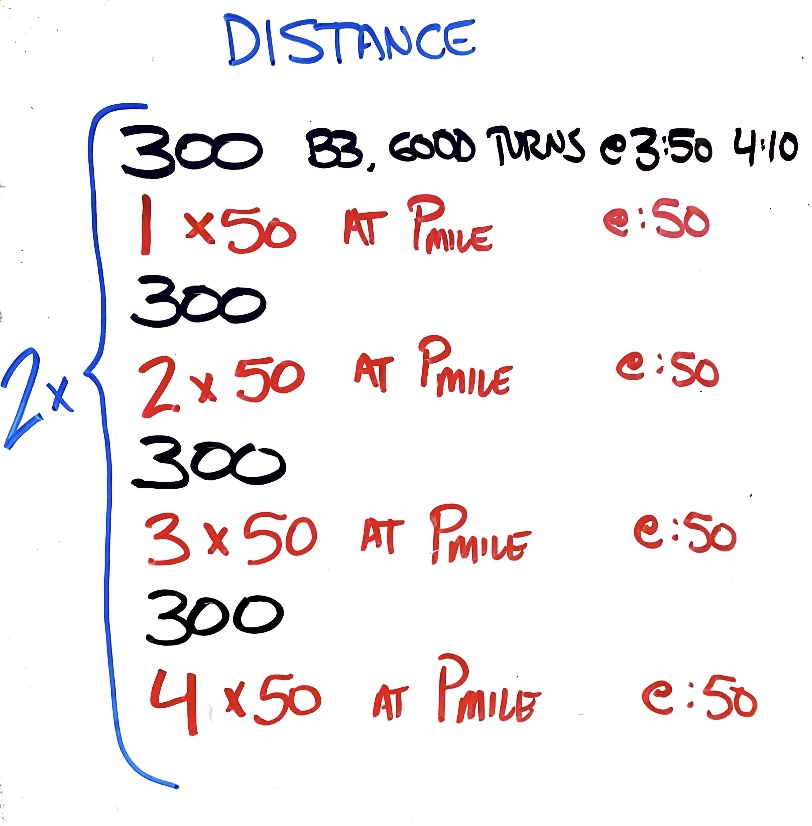
I like doing sets like this for our middle-distance races. Doing just a few 50s at 500 pace doesn’t do much, but when you add some real quantity and change up the interval with short rest, you start mimicking the burn of that 4th 100 of the race. Warning: this one hurts!
Coach Molly Hebzynski, University of Northern Colorado
We’ve done set variations of this set, but the one below is my favorite, and our swimmers too! We focus on maintaining a good body line and maximizing every catch without breathing. LB = Low buoy, NB = No Breath, the strap is a band around the ankles. On the 25s, our ultimate goal is to see how fast they can move across the pool in a 25 with no out-of-water arm recovery to check their catch efficiency.
SCY
2x
2×150 @ 2:30 50 Strap/50 Reg/50 LB (The switch at the walls is intended to be quick)
6×25 @ 1:00 NB Long Dog (Long Dog is the UW catch & pull)
R1: + LB
R2: + Strap
2×25 @ :45 Free NB @ 20 BB (20 Beats below Max HR)
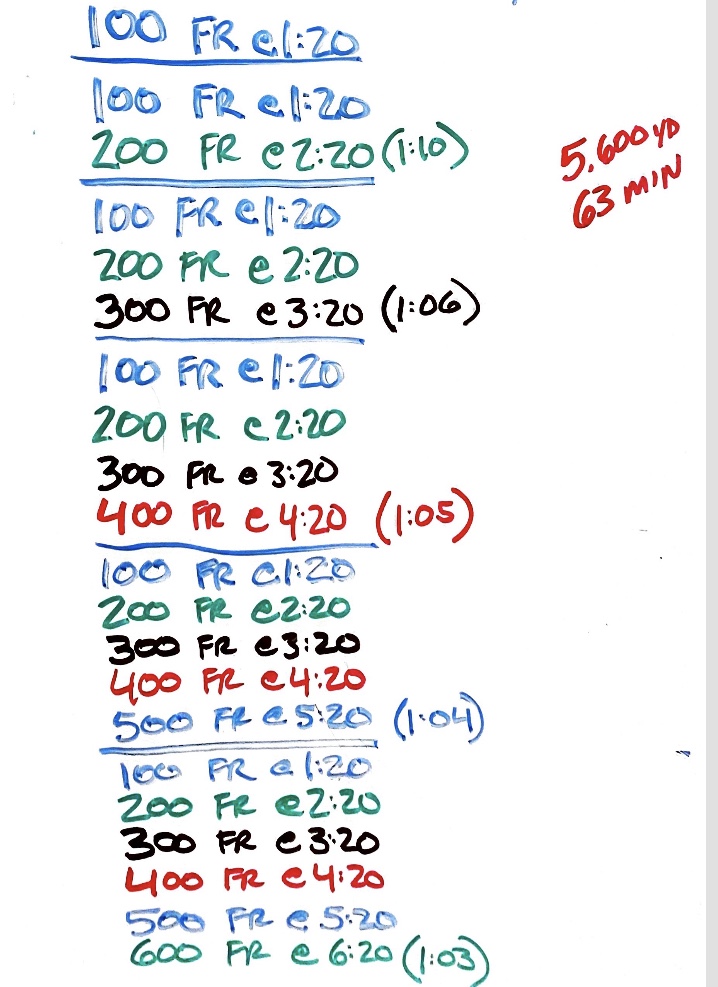
SCY. Intervals remain the same all the way down the set. 50s are at about 200 pace +:03, 100s free need to make the interval by :05. This was a tough one.
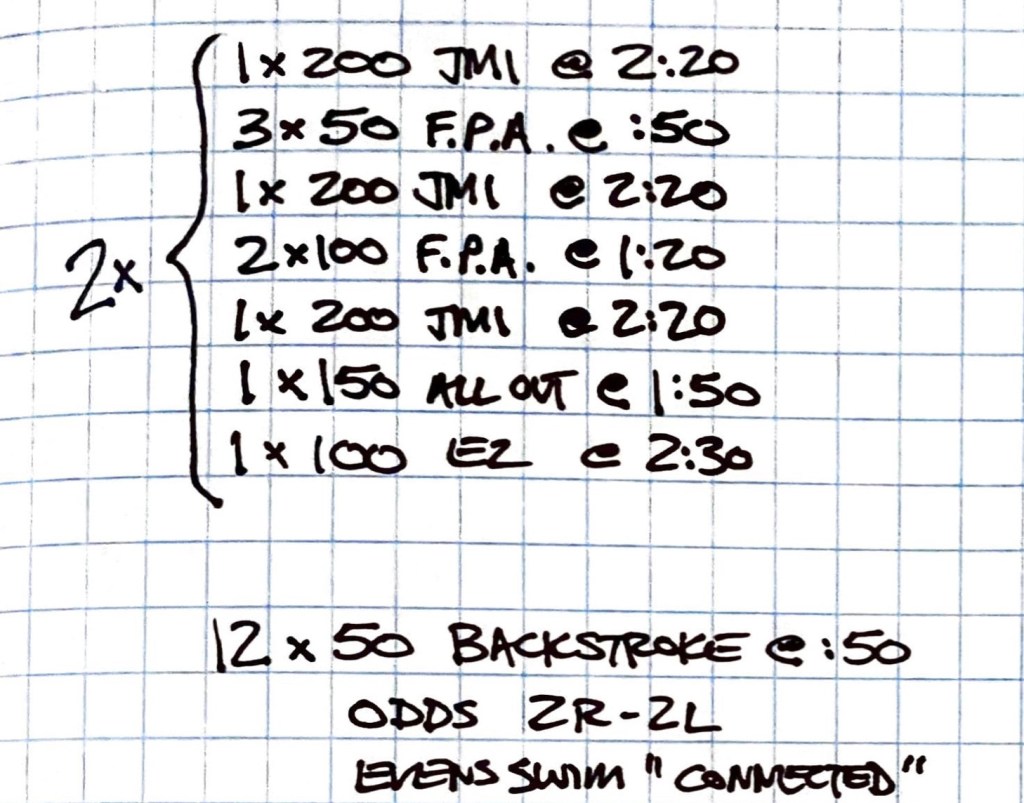
The basic concept here is to ramp up the challenge by adding a constant amount to the interval with each increasing 100 so that the average pace gets progressively harder. In this case, we added 1:00 each time so that all of the intervals ended in :20. Maybe for your swimmer the way to keep the set challenging but doable would be to add :55 or 1:05 or 1:15, but I like the symmetry of this set-up.
In this case, the lines are there to highlight the pattern. You could certainly insert brief breaks or recovery swims if needed.
The way the set is written, the swimmer does 5,600 yards in 63 minutes, an average of 1:07.5 for the interval.
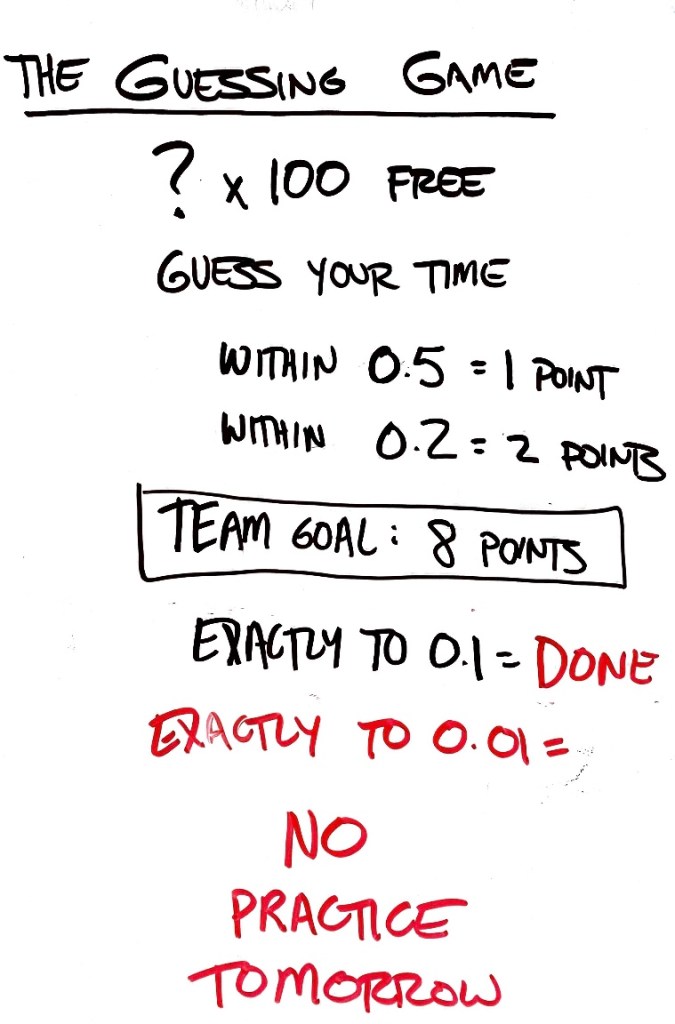
A favorite way to end practice: The Guessing Game. Turn off the pace clocks and swim 100s at any pace based on feel. The group is one team, with the goal to get out of practice as soon as possible with a few fun incentive possibilities. Yes, we still had practice the next day.
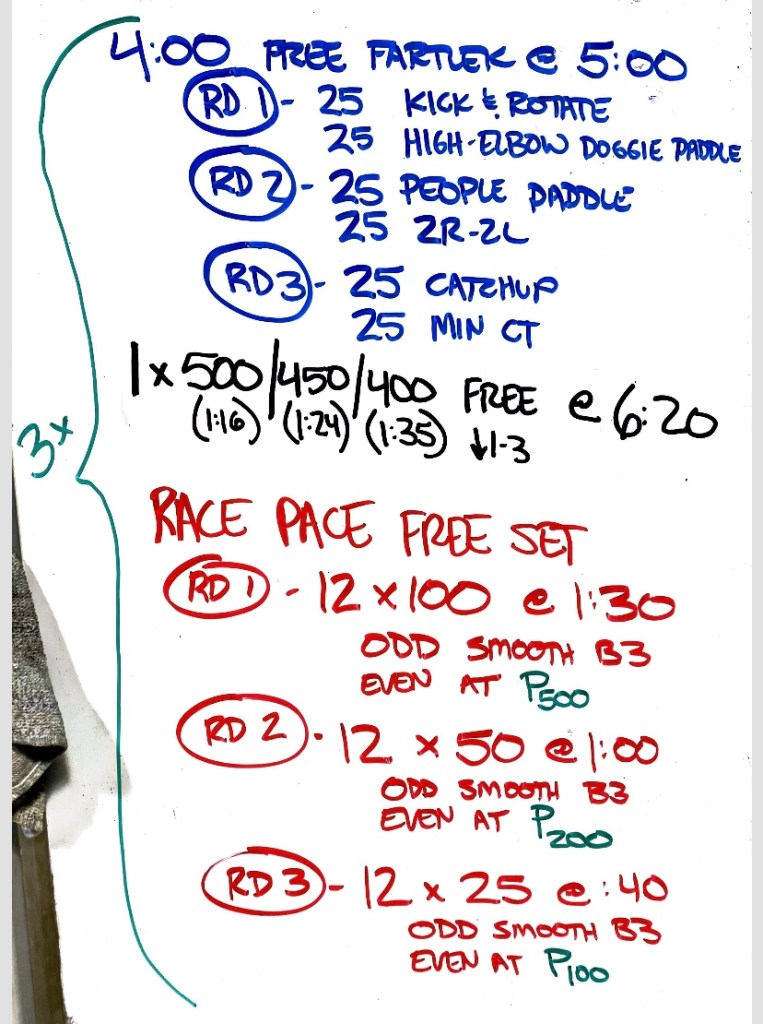
A handful of our swimmers are preparing for an open water swim, so I included some “sighting” practice in the first part of this set. The race portion flowed well from that first part.
Some days I write the entire practice out for our group to see before we begin. Other days, I like to give it to them step by step or in parts. I firmly believe there is an enormous mental difference between these two methods of presentation, and each has its pros and cons.
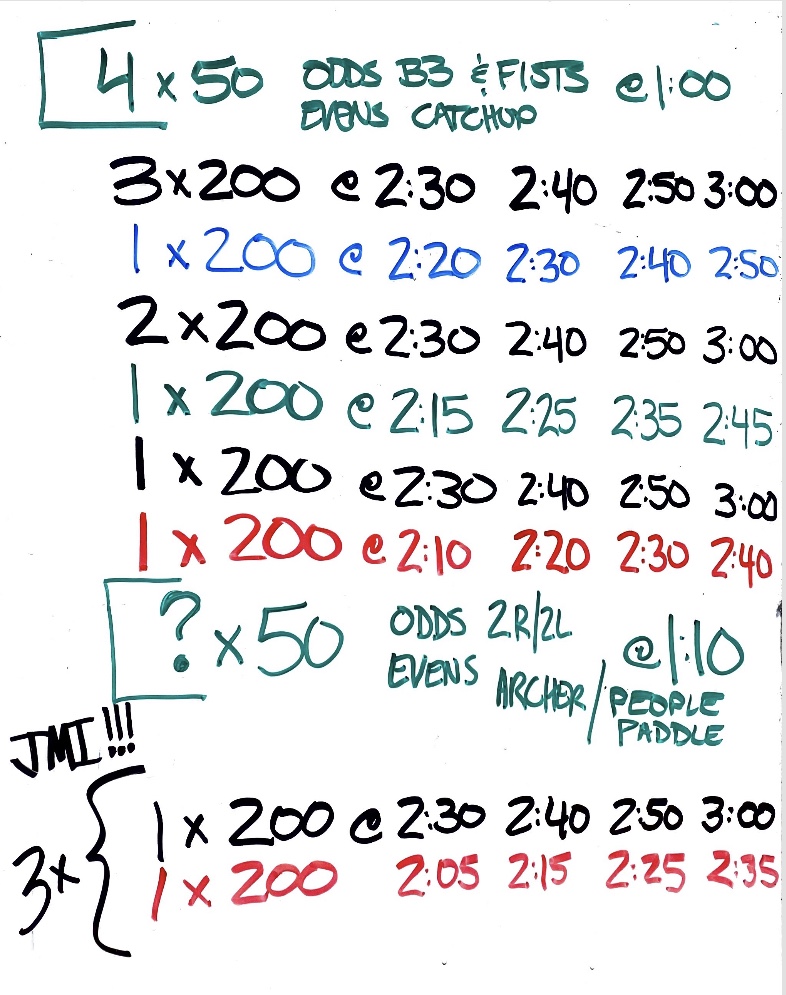
This set was presented to the swimmers in parts. The first part was written on the board with the instructions to hold a consistent pace at each step and that we would be doing a total of four rounds, erasing one line from the set with each subsequent round and possibly changing the instructions. (JMI = Just Make It)
Round went well, so we upped the ante significantly for round 2:
Part 2 was a significant increase in challenge, leaving them wondering/guessing what part 3 would bring. Well, here it is. Not what they might have expected, but they could pretty well guess what Part 4 would be once they saw Part 3. And they stepped up with some great swims! OTB = Off the blocks (dive). FPA = Fastest Possible Average
Context: We are at the beginning of our third week of training and thus far we have done very little high intensity work for any significant distance. The swimmers who performed the set on the intervals listed have best 100-yard free times ranging from :43.8 to :47.3. We had a few other athletes with slightly slower best times performing the same set on intervals that were :05 slower for Part 1 and Part 2.
We ended up with many lifetime-best practice times and a challenging practice with a motivated group.
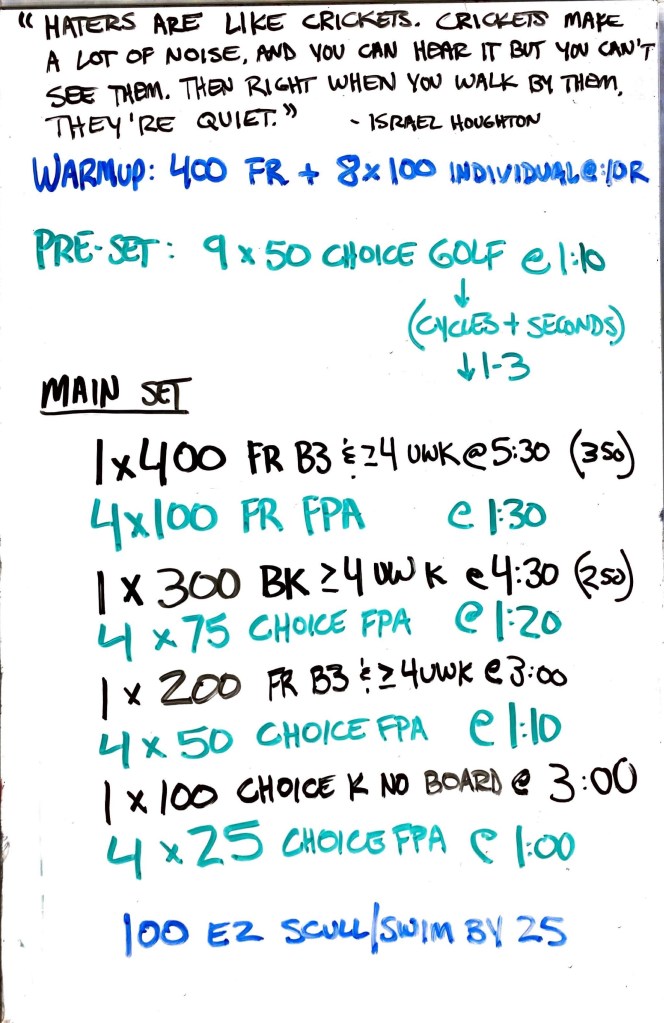
SCM. On the “fast” freestyle 150, I wanted the swimmers to push themselves but with a sharper focus on the technical aspects we have been working on than usual. “Don’t just give it a good physical effort, give it a good mental effort.”
We have days where the whole group does one workout. Other times, we split by strokes. On this day, we split along distance lines. Part of the group worked around their distance race pace, while the other group did a small number of intense 50s from a dive. The sprinters also watched their 50s back on video and did some active recovery during the 6:00 interval. This workout was in LCM.
We did this set the other day with a few of our 13-14 year-olds in SCY. It proved to be a motivating and challenging set.
In each 8:00 part, the goal was to do as many repeats of the given distance and stroke as possible. We recorded the total distance covered, which allowed us to calculate average pace and set goals for possible future sets.
The purpose of this set was for us to get some medium-intensity butterfly reps in during some aerobic freestyle. We interspersed that with some brief fly sprints on large rest. Performance was solid on this one, but not amazing probably due to a difficult practice the day before. SCM.
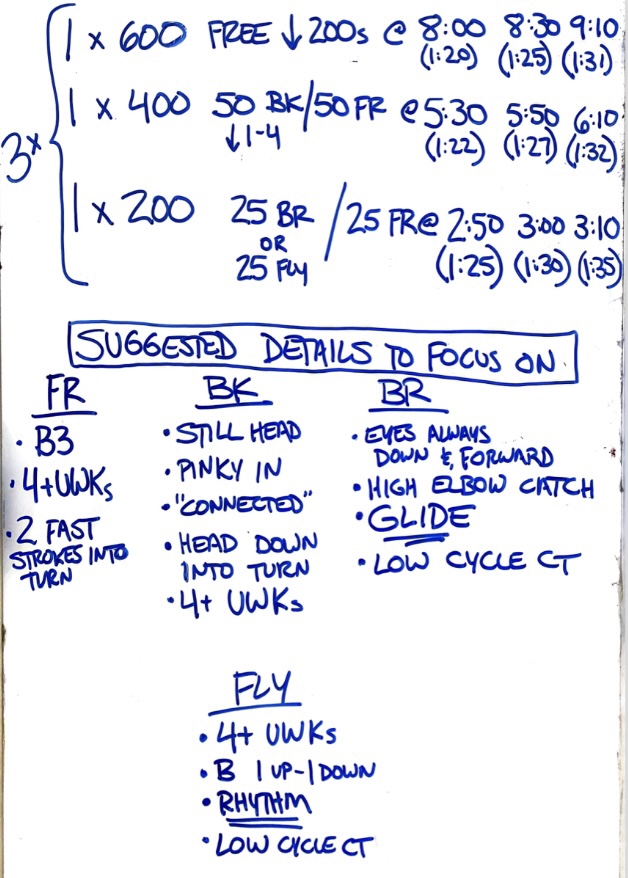
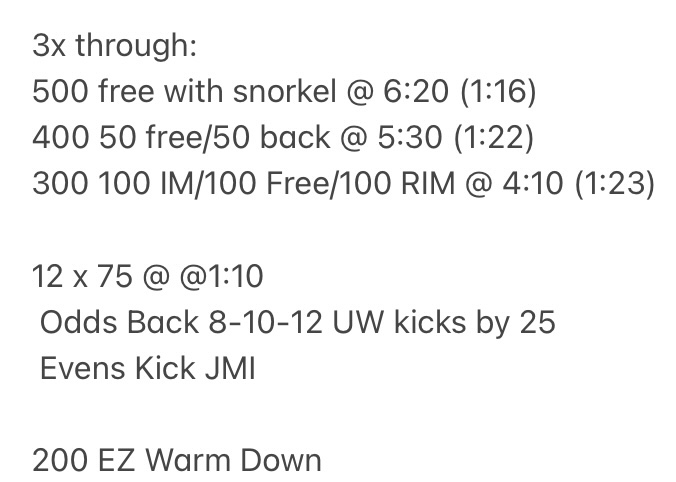
This set was done a day after a very intense quality set of 50s. The aim was to be a bit less intense while covering some distance, then hitting a leg-heavy backstroke set. SCY.
This set was seeking a very specific pattern of pacing on each 600, as indicated by the line graph for each one. Failure to split it correctly meant repeating that 600. To interpret…
#1 – 300 at a consistent pace, 300 at a faster pace, also consistent
#2 – 3 x 200 descend, each one at a consistent pace
#3 – 2 sets of 3 x 100 descending
#4 – 4 x 100 descend + 200 fast and consistent
#5 – 3 x 100 descend + 300 fast and consistent
#6 – 2 x 100 descend + 400 fast and consistent
Here is how it turned out for our swimmer, with splits written next to each graph:
We had to do the first 600 twice due to some early set rusty-ness. Splits for the first of those two are not included.
Start at 200 and see how many 200’s you can hit at MILE PACE :30 RI (keep doing until you miss pace. If you miss, go 50 easy, then see how many 175’s you can hit at Mile PACE :30RI. Continue all the way down (with the 50 easy after each ‘miss):
150: 25 RI
125: 20 RI
100: 15 RI
75: 15 RI
50: :10 RI
25: :5 RI
The first time I did this set in the fall, the swimmers enjoyed the concept, but it was chaotic. The second time this week it was fantastic, with a few tweaks. Kids need a printout of each goal time and they need to be prepared to honestly keep track of their own made yardage. It also helps to have no more than 3 swimmers to a lane if possible (or start at opposite ends). It forces swimmers who never lead to take ownership of their own set, so they need to start with that fact in mind. Swimmers will go different yardage amounts in this set. When swimmers have completed their 1650, they then must actively cheer for those still finishing. It was a good galvanizing set for our distance group – and a confidence builder!
We did this set in SCM. We wore fins for the first 16 and then took them off for the last 4. Swimmers were encouraged to push themselves on the underwater 25s, but could take a breath and go back under if needed.
Coming off a 3.5-day championship meet that was pretty successful for us, the main part of our top group took a day off and then did this set on the first day back. Lots of kicking and freestyle to swim the meet out and get our legs behind us again.









 The Swimming Wizard