Lukas Mundelsee
SG Schwimmen Muenster
Germany

Free Swimming Workouts, Sets, Ideas, and Dryland Exercises from Professional Coaches Around the World
Lukas Mundelsee
SG Schwimmen Muenster
Germany
Ryan Woodruff
Follow @WoodruffRyan
It has been a great year here at the Swimming Wizard blog. We have had record readership (close to 400,000 visitors this year) and have enjoyed reading and posting ideas and workouts from coaches all around the world. Below is a selection of our top posts of the year.
Send us your set at swimmingwizard@gmail.com and maybe it will make next year’s top 10!
Have a Happy New Year!
Bonus: 11 Creative Ways to Spice Up Your Swim Practice and my top 10 Best Things I Read, Watched, and Listened to this Year.
Ryan Woodruff
Head Coach
Lynchburg YMCA
Follow @WoodruffRyan
As a coach who is interested in personal improvement and being the best coach that I can be for my athletes, I am constantly on the lookout for ideas, motivation, and knowledge that can help me. Here are a few of the best things I came across this year.
You are missing out if you aren’t part of the (1) Swim Coaches Idea Exchange on Facebook. With nearly 5,000 members, there is nearly always a pithy discussion of technique and tons of fresh ideas. Be sure to check out posts from Jonty Skinner to be the at the tip of the spear when it comes to freestyle technique especially.
On my drive to and from practice, I love to listen to podcasts on a variety of subjects. By far the best podcast I listened to this year was (2) Michael Gervais’ interview with former swim coach Sean Hutchison. Interesting, inspiring, and thought-provoking.
I got my start coaching with Gregg Troy at Florida, and reading (3) SwimmingScience.net’s Notes on his talk “Garbage Yards and Other Things that Work” was a reminder of the power of commitment that he always emphasized to the Gator teams that I was around.
If you have been paying attention on the club scene, then you know about the recent success of the York YMCA and Coach Michael Brooks’ swimmers. I found this (4) great summary of his philosophy from his time at Brophy Prep. He took many somewhat-formed thoughts right out of my head and put them down on paper in a clear, succinct, and firm way.
Here is my (5) favorite new drill of the year from Eagle Swim Team’s Scott Ward. Swimmers love it, and it helps them with a critical skill in freestyle.
I have no idea if (6) this is a superior way to break out, but I love it as an example of outside-the-box thinking by the coaches at Tennessee.
My favorite passage I came across in my reading this year is from “The Olympian” by Brian Glanville written in 1969 (7):

I always enjoy reading Paul Yetter’s thoughts on his Create Performance blog. This post was particularly insightful: (8) The Road to Greatness has Dips and Turns.
It has been interesting following along with Glenn Mills and Rachel Stratton-Mills as they have been on their Quest. This article really hit home with me – (9) “Unreal Expectations.”
Jake Shellenberger wrote (10) “My 5 Top Drills for Sprint Freestyle,” a very helpful and informative post with more detail than your typical “listicle.”
What great resources did I miss?
Here is my list from 2013 and my list from 2012
Ryan Woodruff
Follow @WoodruffRyan
Head Coach
Lynchburg YMCA
This set combines elements of dryland with a normal swimming set. I like this as a change-of-pace and a way to challenge our athletes that they don’t see every day. The dryland exercise comes mid-swim and throws in a bit of fatigue. We timed the 100 all out and really got some excellent efforts.
“In & Outs” – athlete must climb completely out of the pool (both feet onto the gutter) and then climb back in.
“Press-outs”- athlete lifts himself vertically up and down parallel to the wall. At highest point, waist is at water level. At lowest point, water level is at mid-chest.

Ryan Woodruff
Head Coach
Lynchburg YMCA
We don’t do a lot of isolated kicking sets. Instead, I prefer sets like this one that use kicking as a means to generate fatigue/stress to simulate racing conditions for demanding fast swims.

Ryan Woodruff, Lynchburg YMCA
This is a fun idea to try at practice someday just for variety. Write a set that can be done in any quantities like the one below. Start a stopwatch and hand it to a swimmer. The swimmer stops the watch randomly and whatever digit is in the hundredths place is the quantity for the first part. Repeat for as many times as you need.

Ryan Woodruff
Follow @WoodruffRyan
Head Coach
Lynchburg YMCA
The purpose of this set was to get our swimmers “in a groove” for their distance freestyle swims at an upcoming meet. The 600/550 swims were just steady aerobic swims, and the main emphasis was placed on descending to race pace on the 100s.

Ryan Woodruff
Head Coach
Lynchburg YMCA
Follow @WoodruffRyan
Brian Ruffles
Head Coach & Aquatics Director
Coe College Swimming and Diving
Three Rounds of:
7 x 100 @1:10/1:05/1:00
7 x 50 @:30/:35/:40
In each round the 100s interval decrease by :05 and the 50s increase by :05. The 50s starting interval should be challenging while the 100s are more manageable. You can customize it in many ways. I have done the 100s free with the 50s specially, the 100s specialty with the 50s kick, or really whatever fits the group with the time of year. I would make sure that the last round of 100s is not the interval that is too fast for them to make as the first two rounds will take a lot out of them. If they make the set they join the prestigious 21 club!
This set got great reviews at practice and awesome efforts. Intervals should be kept so that the set stays Aerobic, but enough rest to really get moving fast.
Please share if you like!
Ryan Woodruff
Follow @WoodruffRyan
I have written before on this blog about using Pace Cards at practice to help swimmers accurately and consistently train at “race pace.” Today I am sharing the Pace Cards that we use for training. Simply type in your best times and goal times in each event and the Pace Card will show you how fast to swim for different training distances in order to be swimming at actual “race pace.” Try it out, and if you have any questions, let me know how I can help.
Click here to download the Excel file to easily create your own SCY Pace Card.
Click here for the LCM version.
Click here to download brief instructions on how to use your Pace Card.
We use these cards frequently at practice. Click on the “race pace” label at right to see workouts that put this powerful knowledge to use.

!function(d,s,id){var js,fjs=d.getElementsByTagName(s)[0];if(!d.getElementById(id)){js=d.createElement(s);js.id=id;js.src=”//platform.twitter.com/widgets.js”;fjs.parentNode.insertBefore(js,fjs);}}(document,”script”,”twitter-wjs”);
Ryan Woodruff
Head Coach
Lynchburg YMCA

Submitted by reader Greg Friedlander
Ryan Woodruff
Follow @WoodruffRyan
You have worked hard this season and don’t want your well-earned improvement to go to waste. What can you do to get better even though the pool is closed?
Make sure you have signed up for our weekly e-newsletter to keep up with the best and most interesting workouts and much, much more from the Swimming Wizard blog, delivered straight to your inbox every Tuesday morning.
Ryan Woodruff
Follow @WoodruffRyan
One topic that has garnered much attention this year is safety in football. Thomas Lake’s The Ghost of Speedy Cannon (1) provided a riveting tale probing a long-ago death on the field. Though I have long enjoyed Rick Reilly’s writing, he can get under the skin of some readers. His piece about the NFL Becoming a Guilty Pleasure (2) is hard to argue with.
I love reading about legendary coaches. Perhaps none are more legendary in his sport than Dan Gable. Wright Thompson’s incredible piece The Losses of Dan Gable (3) is even more poignant now that wrestling has won reinstatement into the Olympics. The Book of a Coach (4) tells the story of Bill Walsh and the legacy of a coaching legend. Soccer fan or not, if you are a coach you will find some wisdom in Eight Coaching Keys from Sir Alex Ferguson (5).
Unless you are still using dial-up internet service, you have probably heard of Seth Godin. I highly recommend a few posts of his from this year: The Merchants of Average (6), Choosing To Be Formidable (7), and All Boats Leak (8). All three inspire me to be a better coach.
Just read this article: Two Enemies Discovering a Higher Call in Battle (9). It will renew your faith in humanity.
This article got me thinking about the technological frontiers of swimming: Mobile Athlete Monitoring – The Next Big Thing (10). Coaches of all sports should be keeping up with Vern Gambetta and his Functional Path Training blog. He hit the mark in Pay the Piper (11).
How Great Teachers See (12) made me ponder how I perceive my swimmers’ talents and how powerful that perception really might be.
On a personal level, a few things I came across this year made a difference in my life. Leo Babuata inspired me to aim for Living the Quiet Life (13) and Dr. Michael Greger’s powerful video Uprooting the Causes of Death convinced me to make my most profound personal change this year.
I hope you enjoyed the list. Have a happy, healthy, and successful 2014!
Erin Quinn
Follow @ErinQuinn11
!function(d,s,id){var js,fjs=d.getElementsByTagName(s)[0];if(!d.getElementById(id)){js=d.createElement(s);js.id=id;js.src=”//platform.twitter.com/widgets.js”;fjs.parentNode.insertBefore(js,fjs);}}(document,”script”,”twitter-wjs”);
Our Hawks Team of 125 has to contend with 10 hours in a 6-lane pool that we rent out from a college.
With that constraint, we turn and obstacle into a challenge.
For instance—A crowded Monday night, and I propose a “Swim Up the Ladder” set for our Golds/Senior group.
Here’s the workout for anyone who has crowded lanes, a ton of potential and not as much time as they’d prefer!
1200 Warm-Up (Swim, Kick, Drill)
4×25 Catch-Quick Freestyle Drill
4×25 Over-the-barrel Freestyle drill
4×25 Straight-arm finishes flags-to-wall free.
6×25 free sprints with only one breath :20 seconds
6×50 FR (1-3) on :35 (4-6) on :30
3×100 FR on 1:05
100 EZ
2×25 active-balance backstroke drill
6×25 Spin-Drill (odds) Streamline BD Kick evens
6×50 BK (1-3) :40 (4-6) :35
3x100BK on 1:10
100EZ
4×75 Breaststroke Drill— Fast Hands/UnderWater/Scull/Streamline Kick
6×50 BreastStroke (1-3) :45 (4-6) :40
3×100 Breast on 1:30
100EZ
2×25 one-arm fly.
2×25 3,3,3 Fly
6×25 Fly Sprints on :40 sec only one breath
2x100FLY from the blocks in heats.
100EZ
Relays!
Tweet

!function(d,s,id){var js,fjs=d.getElementsByTagName(s)[0];if(!d.getElementById(id)){js=d.createElement(s);js.id=id;js.src=”//platform.twitter.com/widgets.js”;fjs.parentNode.insertBefore(js,fjs);}}(document,”script”,”twitter-wjs”);
Erin Quinn
Hawks Swimming
Plate, NY
Follow @ErinQuinn11
!function(d,s,id){var js,fjs=d.getElementsByTagName(s)[0];if(!d.getElementById(id)){js=d.createElement(s);js.id=id;js.src=”//platform.twitter.com/widgets.js”;fjs.parentNode.insertBefore(js,fjs);}}(document,”script”,”twitter-wjs”);
After returning from a 3-day District Championship Meet, swimmers were given a recovery practice Monday. Today, Tuesday 7/23 it was Beast-Mode On as we have less than one-half weeks to Speedoes and 2 weeks until Eastern Zones. Before the taper begins, I wanted one last, hard practice. Let’s just say there wasn’t much talking. There was a lot of heavy-breathing and mumbling. I was proud of how hard they worked. #HAWKSNATION
1300 meter warm-up
300FR
200IM kick
200BK (100 one-arm 100 whole stroke)
100 skull no kick
100 three strokes of breast under water, 2 above
4×50 Breast stroke (1 pullout, 2 pullouts, 3 pullouts 4 pullouts)
4×50 five strokes of Butterfly no breath, 10 strokes of free–repeat
400IM under 6 minutes
150 cool-down
3x100FR on 1:20
3x100BK on 1:30
400IM faster than first
150 cool-down
3×100 Breast on 1:45
3x100IM on 1:30
400IM all out
200 cool down
Total Meters: 4200
!function(d,s,id){var js,fjs=d.getElementsByTagName(s)[0];if(!d.getElementById(id)){js=d.createElement(s);js.id=id;js.src=”//platform.twitter.com/widgets.js”;fjs.parentNode.insertBefore(js,fjs);}}(document,”script”,”twitter-wjs”);
Follow @ErinQuinn11
There is not TGIF for Hawks Swimmers. Gearing up for LCM I went for Friday, #BeastDay and put our swimmers to work with a lot of race-paced swimming. They threw it down.
1400 yrd Warm-up (Swim, Kick, Drill all strokes)
800FR for time (Goal: go under the time assigned and negative split)
200EZ recovery swim
8×25 sprint body dolphin kick on back in streamline :30 sec
6×100 BK Descend 1-3 (1:15) 4-6 (1:10) the last three under 1:05 and descending!
3x200IM Descend on 2:20
Challenge: If 2 of our Hawks Backstrokers could swim within 4 seconds of their PB we would scrap the 200IMs
They did it!
6x50FR 1-3 descend :35 4-6 descend :30
8×75 IM Order Under/Kick/Sprint + 15 sec of vertical kick
Cool down–Relays!
Happy Friday!
@ErinQuinn11
Ryan Woodruff
Follow @WoodruffRyan
We have limited long course practice time until school gets out, so we tend to make the most out of the time we get in LCM. Here is what we did today.
LCM
!function(d,s,id){var js,fjs=d.getElementsByTagName(s)[0];if(!d.getElementById(id)){js=d.createElement(s);js.id=id;js.src=”//platform.twitter.com/widgets.js”;fjs.parentNode.insertBefore(js,fjs);}}(document,”script”,”twitter-wjs”);
!function(d,s,id){var js,fjs=d.getElementsByTagName(s)[0];if(!d.getElementById(id)){js=d.createElement(s);js.id=id;js.src=”//platform.twitter.com/widgets.js”;fjs.parentNode.insertBefore(js,fjs);}}(document,”script”,”twitter-wjs”);
Ryan Woodruff, Lynchburg YMCA
This set is useful for helping distance freestylers refine a sense of pace.
? x 100 freestyle @ coach’s send off
Continue until you achieve 3 points.
Earn 1 point by guessing your time correctly within .5 seconds
Earn 2 points by guessing your time exactly to the tenth of a second
Earn 3 points by guessing your time exactly to the hundredth of a second
Swimmers may swim whatever speed they wish.
I like to use the Guessing Game during taper, typically at the end of practice. Once a swimmer achieves his three points, he warms down and is done with practice.
Tip: Be sure to turn off your pace clock or have the swimmers turn away from the clock when you send them off. You don’t want them looking at it – there won’t be a pace clock at the meet!
This set was originally published here 12/3/2009. Visit our archives for more excellent training sets and ideas.
Ryan Woodruff
Follow @WoodruffRyan
LCM
18 x 15 meter sprint @ 2:00
#1 – from a start
#2 – 7.5m in and out of a turn
#3 – from mid-pool into a finish
All start and turn sprints are timed to the head crossing the line. Swim easy between the repeats.
Use this chart to give your athletes goal times for each of these 15m Chunks
I really enjoy your site and have really found quite a few of the workouts inspirational and thought I would try to contribute. Thanks for all the sharing.
Rob Bond
Head Senior Swim Coach
Glenbrook Aquatics
Follow @GAswim
Broken Mile
11 x
{100 @1:00
{50@1:00
Set interval at best average 100 pace. They should get no more than 2-3 seconds rest on the 100s. It should provide a quick reset and then go. The rest should come on the 50s.
Chris Plumb
Editor’s Note: This set was previously published here at The Swimming Wizard. It uses Streamline Sticks at a distance of about 5 yards.
2 x 7 x 150
The 150 is always on a total of 2:00
Ryan Woodruff
Follow @WoodruffRyan
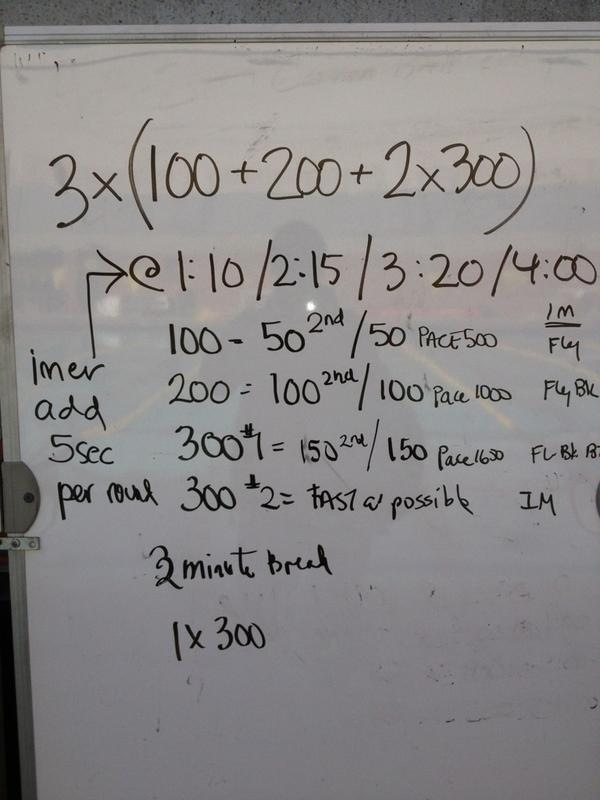
We performed the set below with our sectional-level breaststroke group. There are essentially two parts to the set. The first part (above the dotted line) stresses technique with a LONG stroke and gradually builds to an up-tempo stroke at the end of the 100s. During this first part, “TT” stands for the Finis Tempo Trainer Pro which we use on a regular basis. Using mode 1, we have it set at 4.00, meaning the swimmer initiates a stroke once every 4 seconds. This is usually an uncomfortably long time to glide for our swimmers (a good thing!). We bring the TT down to 3.00 for the 2 x 150 and then to 2.00 on the 100s and have the swimmers shoot for 2 strokes during the 2.00 seconds in the last 10-15 yards of each 100. This combination of technique and tempo sets them up well for the second part of the set.
In the second part (below the dotted line), we are essentially challenging our swimmers in two ways on two sets of 6 x 100s. The first set challenges the efficiency of their underwater pullouts and breath-holding ability. The second set of 6 x 100 just challenges their endurance and the integrity of their stroke. The goal is simply to make all of the intervals and maintain stroke technique.
Dave Salo
Ryan Woodruff
Follow @WoodruffRyan
After an extended warmup, we performed the following set to work on maintaining our race pace under fatigue. We are quite skilled at repeating race-pace swimming for repeat 50s. Throwing in the 100 fast swim (where we asked swimmers to approach P200) more closely mimicked actual race-like fatigue. We saw some excellent results, particularly on the third round.
SCY
Ryan Woodruff
Follow @WoodruffRyan
Not a workout, but some resources especially for coaches that I came across this year…
1. Former Texas A & M Football Coach Mike Sherman’s Letter To Texas High School Football Coaches by Chris Brown This is an incredible piece of writing that makes me think about why I coach.
2. The Surfer’s Guide to Taking Risks by Srinivas Rao Some great advice in the context of a beautiful sport.
3. Quantum Thinking When Coaching Swimmers by Jonty Skinner, Beijing Blog. Skinner might be on the frontier (fringe?) of modern thought on swim training and I find his ideas curiously stimulating.
4. The Toughest Coach There Ever Was by Frank Deford, Sports Illustrated A must-read for coaches in any sport.
5. The Greatest Assistant Coaching Article Ever Written by Wayne Goldsmith. This boldly titled article delivers on its promise. I wish I had read this 10 years ago.
6. High Volume or High Velocity by Paul Yetter, Developing The Champion Within Blog. Yetter answers one of swimming’s longest-standing debates with the best answer I have heard yet.
7. Did You See The Gorilla? An Interview with Psychologist Daniel Simons by David DiSalvo: The psychology behind this is fascinating.
8. The Fifty-Nine Story Crisis: A Lesson in Professional Behavior: A powerful lesson on admitting your mistakes.
9. Standing Near Greatness by Ashley Harrell: Find out what it is like to be Tim Tebow’s teammate and Urban Meyer’s doormat.
10. Marathon Man Kip Litton is a Fraud by Mark Singer: You won’t believe the lengths this guy went to…
11. You are Not Lazy, and Still You Are an Idler by Abraham Lincoln from Letters-of-Note blog: Strong words of advice from our nation’s greatest President.
12. Rich Thompson’s Pact With Baseball by Johnette Howard, ESPN.com: An inspiring story of faith, persistence, and dreams come true.
And one last memorable tidbit, from the “Faces In the Crowd: Coaches’ Edition” in Sports Illustrated:

Ryan Woodruff
The finish is among the least frequently practiced skills in our sport, in my observation. This drill serves as a mini-progression to help swimmers adjust to the presence of the wall appropriately during a finish, thus practicing for that gold medal moment.
We did this as a set of 16 x 50, 6 done like phase 1, 6 in phase 2, and the final 4 in phase 3. Here’s the progression.
Phase 1
At the conclusion of the 50, the swimmer takes his last stroke at the backstroke flags and then positions his body for the finish, kicking strong all the way to an extended touch.
Phase 2
Same idea as the first phase, just move everything closer to the wall. Take the last stroke halfway between the flags and the wall. Make sure the swimmer is paying close attention to the spacing with the wall.
Phase 3
Now do an all-out finish, touching with the body at maximum length. The swimmer should touch with the fingertips. With the wall-judging ability honed in phases 1 and 2, the swimmer should be able to time his finish very precisely.
Try this progression for any stroke. You never know when your finish will make the difference between gold and silver!
Thank you to Heath Hudgins (the swimmer in the videos) for being a willing example.
Ryan Woodruff
Follow @WoodruffRyan
We did the following set after about 3,000 yards of warmup, breathing pattern, and technique work. The efforts were excellent, with swimmers totaling times that were 20-30 seconds faster than their best mile, 10-20 seconds faster than their best 1,000 and 5-10 seconds faster than their best 500. Enjoy!
Part 1: Broken Mile (all swims finish with a turn or “foot-touch”)
25 @:10 rest
50 @:10 rest
75 @:10 rest
100 @:10 rest
125 @:20 rest
150 @:20 rest
175 @:20 rest
200 @:20 rest
175 @:20 rest
150 @:20 rest
125 @:20 rest
100 @:10 rest
75 @:10 rest
50 @:10 rest
25 @:30 rest
Dive 50 to a hand touch
Take overall time and subtract 4:00 to get total swimming time for the broken 1,650 free
500 easy swim @ 8:00
Broken 1,000 free (all swims finish with a turn or “foot-touch”)
50 @:10 rest
100 @:10 rest
150 @:10 rest
200 @:20 rest
200 @:20 rest
150 @:20 rest
100 @:30 rest
Dive 50 to a hand touch
Take overall time and subtract 2:00 to get total swimming time for the broken 1,000
500 easy swim @ 8:00
Broken 500 free
Dive 25 @:10 rest
50 @:10 rest
75 @:10 rest
100 @:10 rest
100 @:20 rest
75 @:20 rest
50 @:20 rest
25
Take overall time and subtract 1:30 to get total swimming time for the broken 500
500 easy swim @ 8:00
See the follow-up to this set here.
 The Swimming Wizard