Ryan Woodruff, Lynchburg YMCA Swim Team
We did this IM workout recently, getting in some good aerobic work for some of our 400 IMers. The 600s were descend to 90+% effort.
SCY

Free Swimming Workouts, Sets, Ideas, and Dryland Exercises from Professional Coaches Around the World
Ryan Woodruff, Lynchburg YMCA Swim Team
We did this IM workout recently, getting in some good aerobic work for some of our 400 IMers. The 600s were descend to 90+% effort.
SCY
Ryan Woodruff, Lynchburg YMCA
SCY
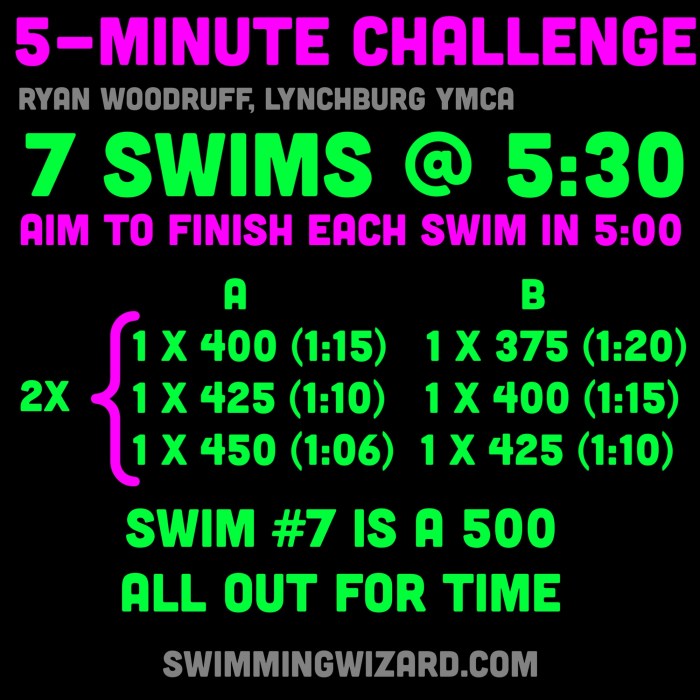
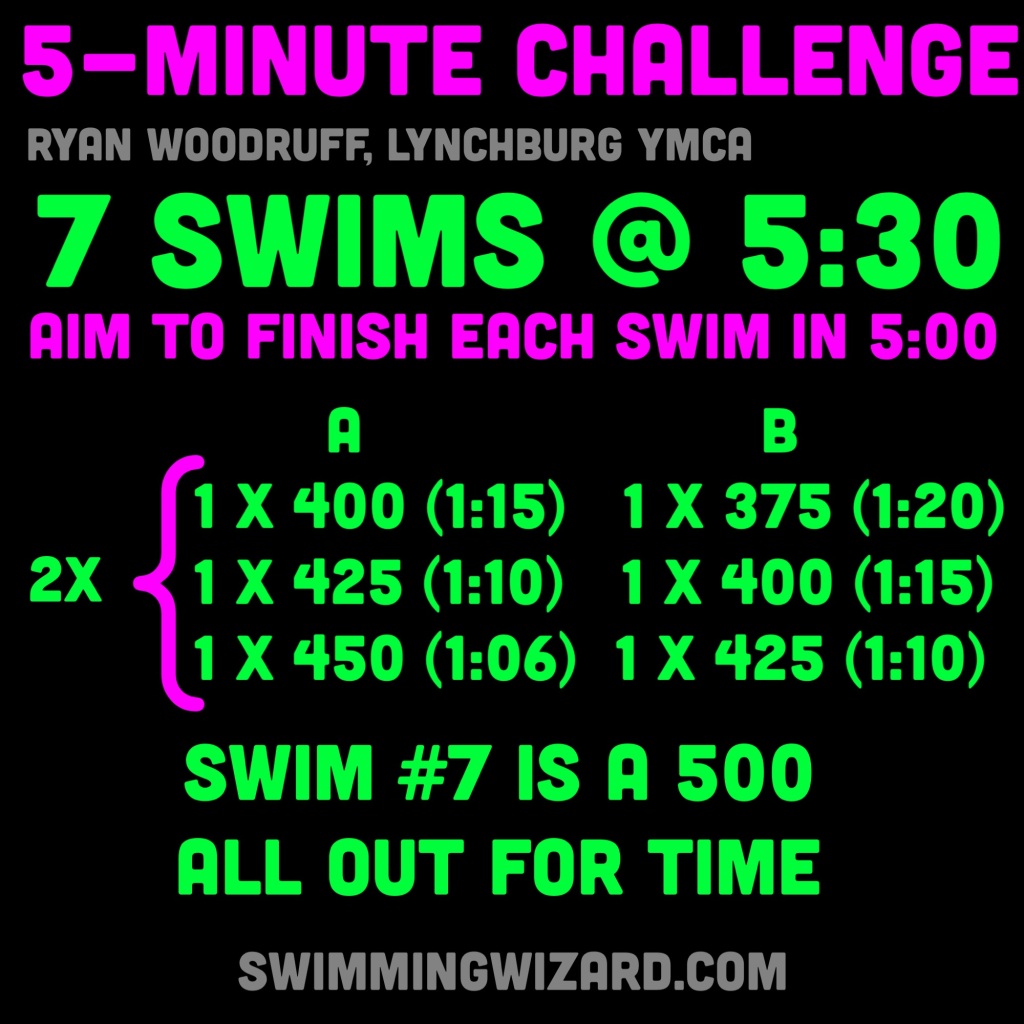
7 total swims. Aim to finish each the first 6 swims under 5:00 so that you get :30 rest. Last swim is a 500 for time!!!
For faster or slower swimmers, you can increase or decrease the distances. I chose these distances to be appropriate for our group today.
Coach Jennifer Ward, Alamance County Community YMCA, North Carolina
Ryan Woodruff, Lynchburg YMCA.
SCY.
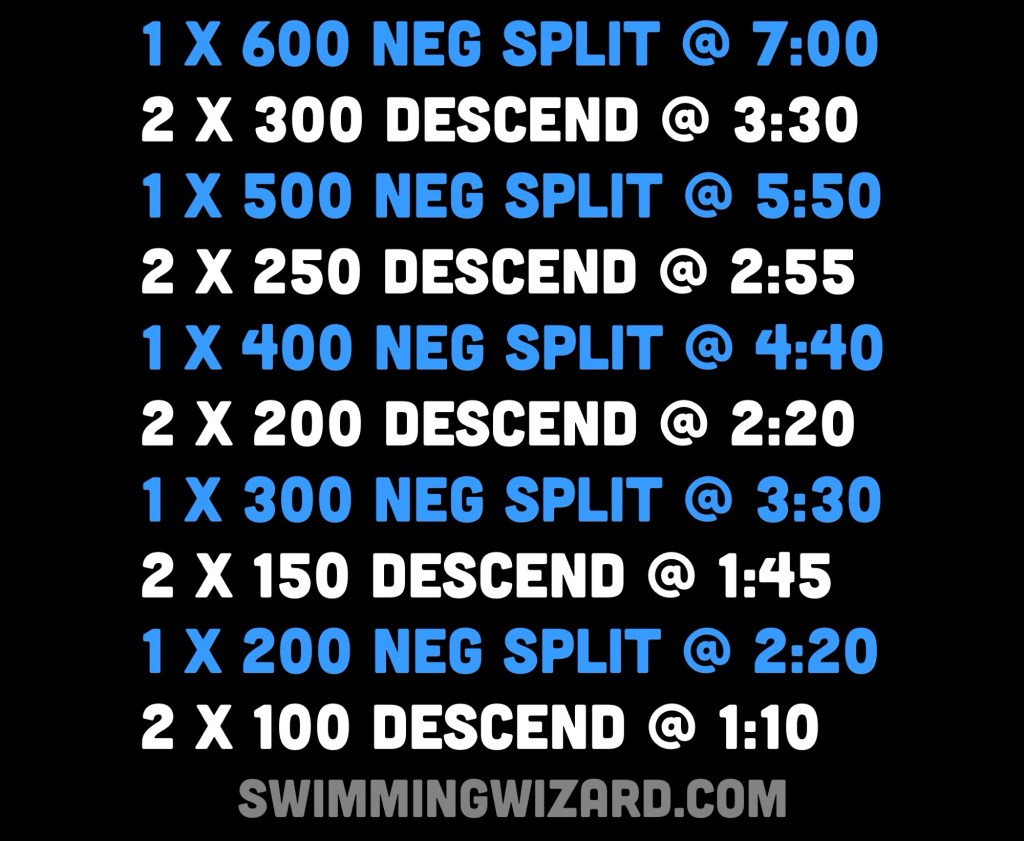
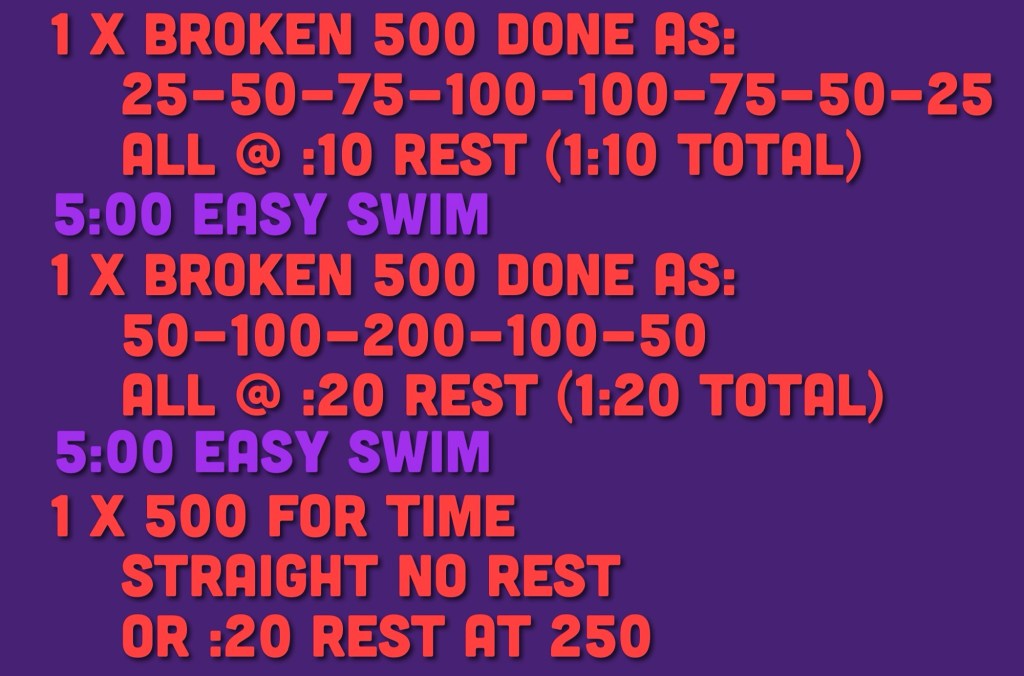
This isn’t the most creative set ever, but it gets the job done for a cool 4,000 yds of aerobic work. The instructions for our crew were to negative split the long swim, and then make both of the shorter swims faster than half of the long swim. The intervals listed represent the A interval for our group, on a 1:10 per 100 base.
Ryan Woodruff, Lynchburg YMCA
Coach Ryan Woodruff, Lynchburg YMCA
SCY
This set was seeking a very specific pattern of pacing on each 600, as indicated by the line graph for each one. Failure to split it correctly meant repeating that 600. To interpret…
1 – 300 at a consistent pace, 300 at a faster pace, also consistent
2 – 3 x 200 descend, each one at a consistent pace
3 – 2 sets of 3 x 100 descending
4 – 4 x 100 descend + 200 fast and consistent
5 – 3 x 100 descend + 300 fast and consistent
6 – 2 x 100 descend + 400 fast and consistent
The second picture shows how it turned out for our swimmer, with splits written next to each graph. We had to do the first 600 twice due to some early set rusty-ness. Splits for the first of those two are not included.


Ryan Woodruff, Lynchburg YMCA
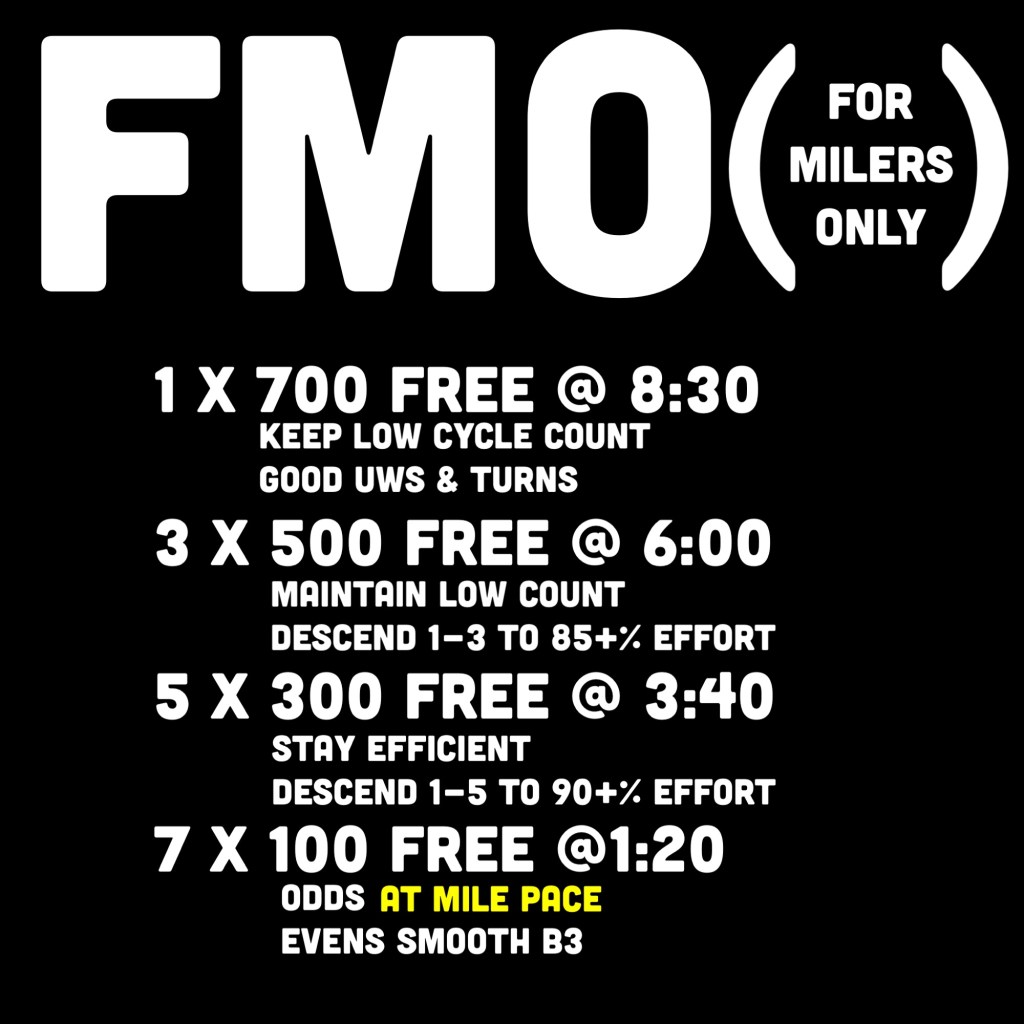
Set for just the distance squad. SCY. Intervals are for a group that is sub-17:00 for the 1650.
Ryan Woodruff, Lynchburg YMCA
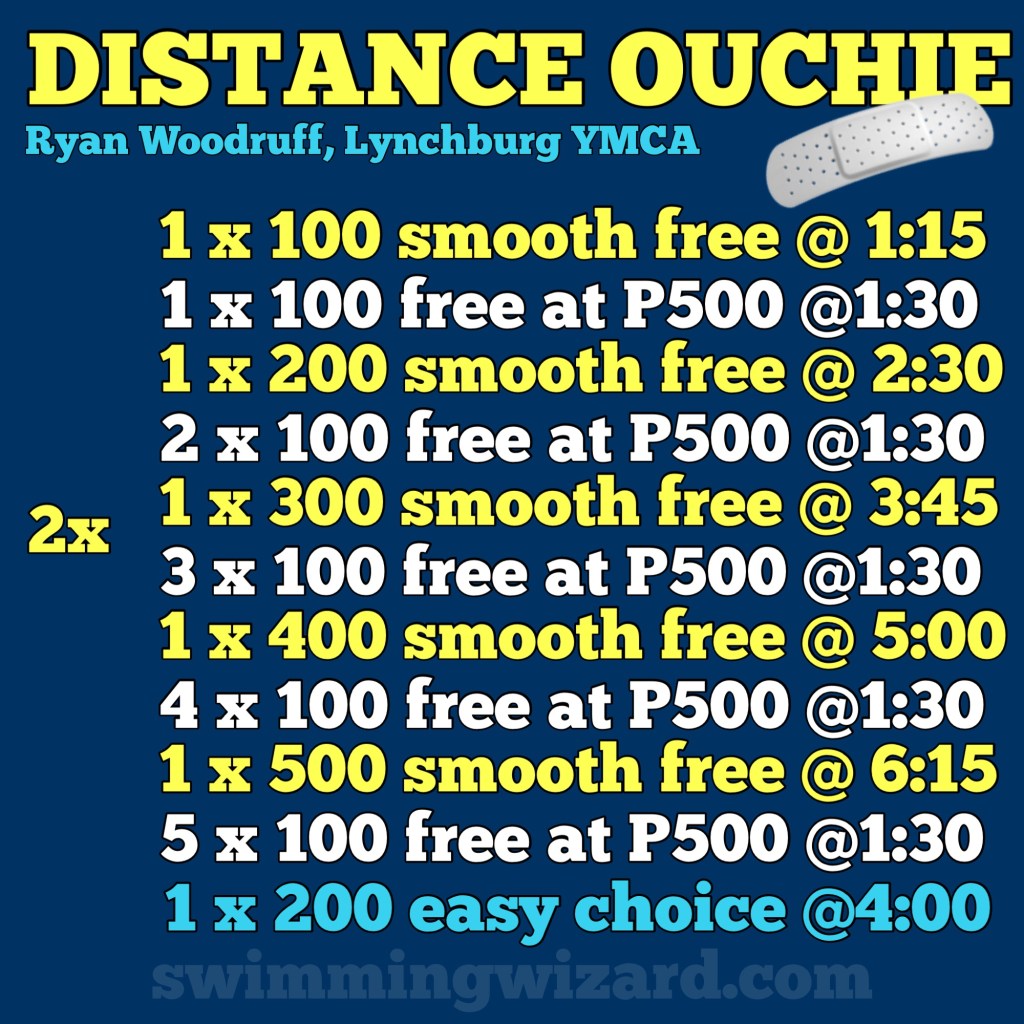
This one hurts. A meat-and-potatoes kind of distance set. SCY.
P500 = 500 pace
Our crew that went on this interval has best 500 times ranging from ~4:40 to ~5:00. We didn’t make P500 the whole way, but several came close.
Ryan Woodruff, Lynchburg YMCA
SCY
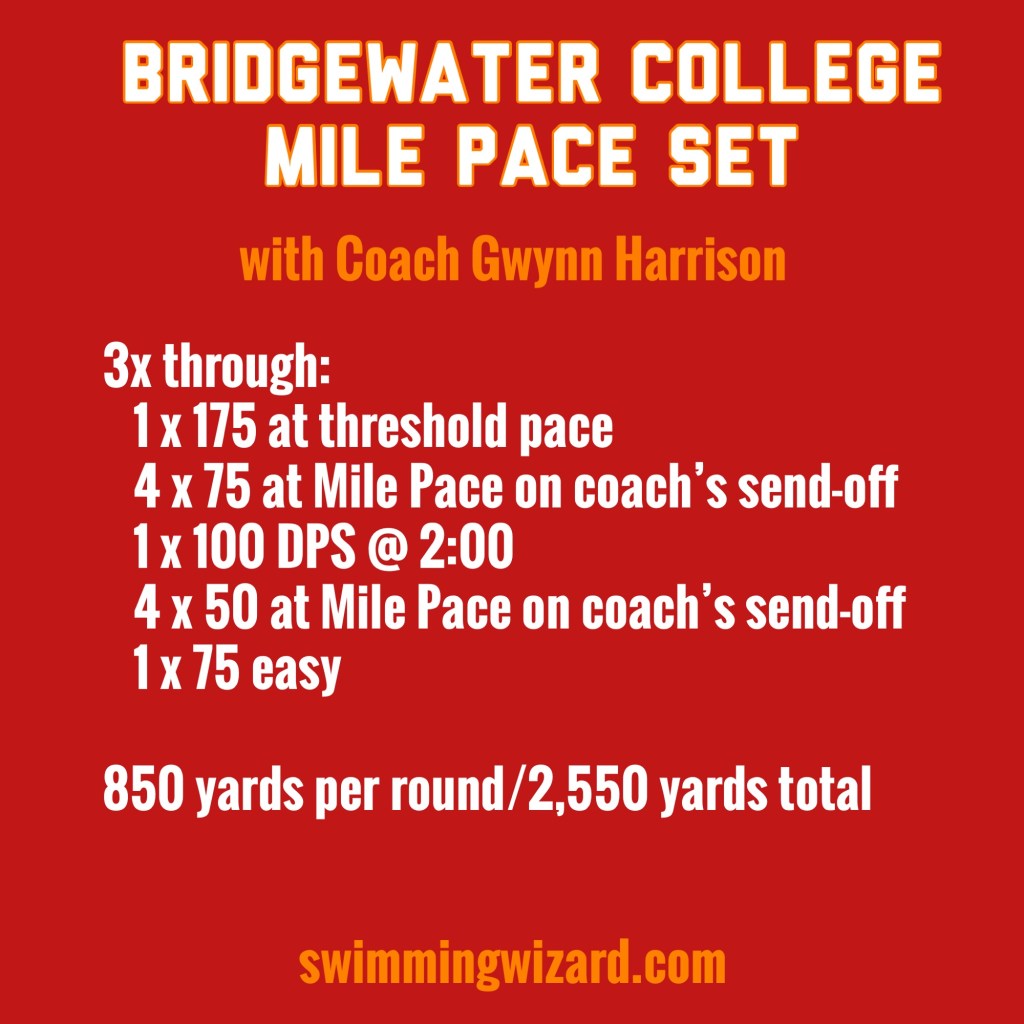
Each part of the set is 1,650 yards

Ryan Woodruff, Lynchburg YMCA
SCM
Within each descend set, we aimed to descend to a slightly faster time each time.

Ryan Woodruff, Lynchburg YMCA
The broad aim of this set was to give our group (that has a wide range of speeds for middle-distance swims) a challenge to push themselves on the 400 while still getting some recovery/drill/technique work in. We timed the 400s and then swimmers would start right into the fartlek (continuous swimming). After 5-7 minutes of the fartlek, I would verbally stop the group and we would rest a minute before starting the next 400. FPA = fastest possible average. K.O.S. = Kick on Side

Ryan Woodruff, Lynchburg YMCA
SCM
The 400s here got down to a challenging interval by the last one. The sets of 4 x 100s in between were on moderate interval. Just getting good work in. The two columns represent an A and B interval within our group.

Ryan Woodruff, Lynchburg YMCA
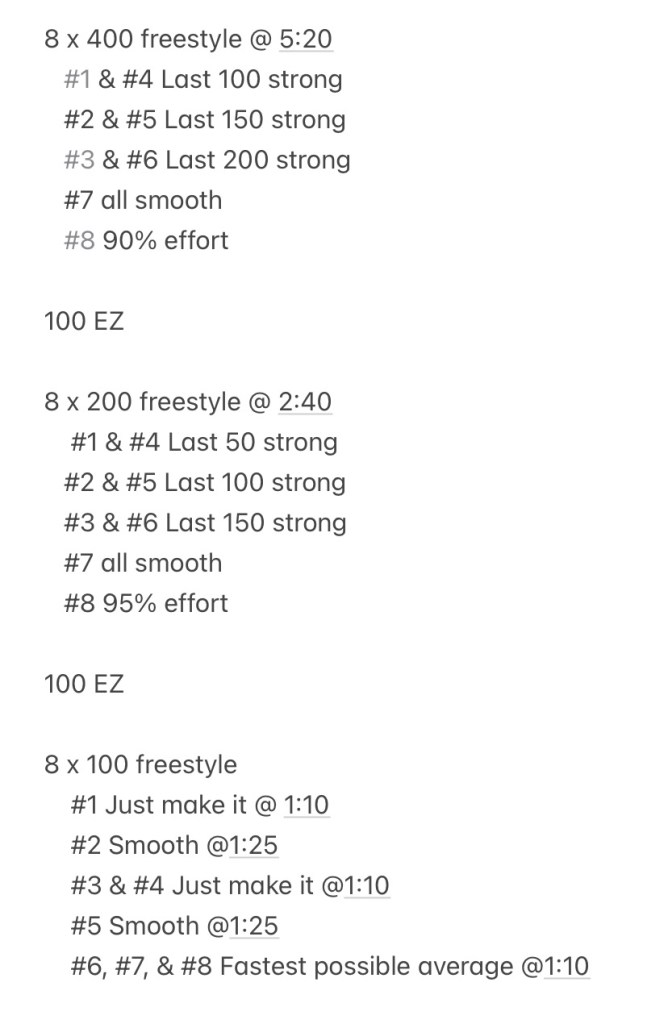
SCM. For the 400s and 200s, swimmers were instructed to do an open turn before the “strong” part to check the clock and get their split. The emphasis is always on being fast at the end of each repeat and the end of the set.
Ryan Woodruff, Lynchburg YMCA
SCY
Ryan Woodruff, Lynchburg YMCA
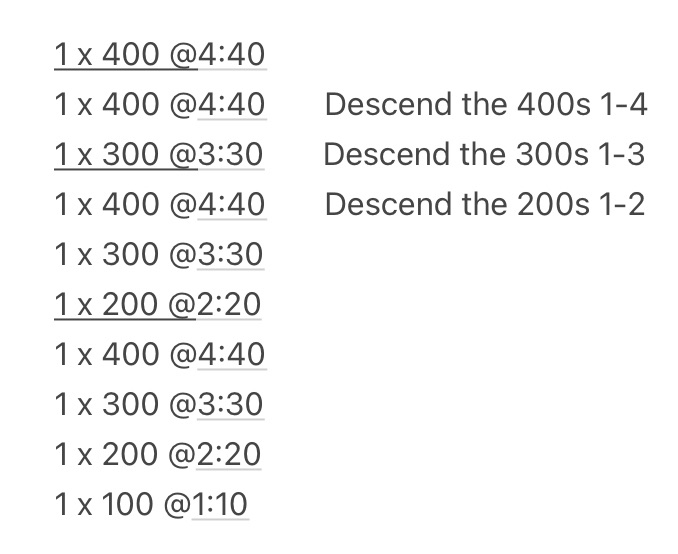
Some old-fashioned distance work today. This was for two of our distance swimmers who are about 30 seconds apart in their best times. One went 500s and the other went 450s. Worked out pretty well for both on this set. Base paces for each distance are in parentheses.

Ryan Woodruff, Lynchburg YMCA
SCM. We aimed to hit a range of speeds and improve our self-awareness of our pacing.

Ryan Woodruff, Lynchburg YMCA
SCY
Progress through the sets 1 through 6 in order with the extra :30 rest after each set. The interval pattern in this set is suitable for an athlete with a threshold pace around 1:00.

Ryan Woodruff, Lynchburg YMCA
SCY

Ryan Woodruff, Lynchburg YMCA
SCM
At the beginning of my career (20+ years ago), I would have my team do a T-30 test multiple times per season. Since that time, I have gradually moved away from long steady paced swims such as that. The set below is the kind of thing I am more likely to do now. Each of the timed sets is “As Many Rounds As Possible” (AMRAP) with a set distance and rest to repeat. The amount of rest scales down with the distances, which allows for a pretty direct comparison of pace as the times decrease. We recorded each swimmer’s distances (to the nearest meter) on a dry erase board for all to see. As the time was cut in half, swimmers were urged to exceed 1/2 of their previous distance on the next swim. The 5:00 swims in between allowed for recovery and emphasis on technical reminders. Overall, it was a successful set with high levels of effort and engagement!

Ryan Woodruff, Lynchburg YMCA
SCY

Ryan Woodruff, Lynchburg YMCA
SCM
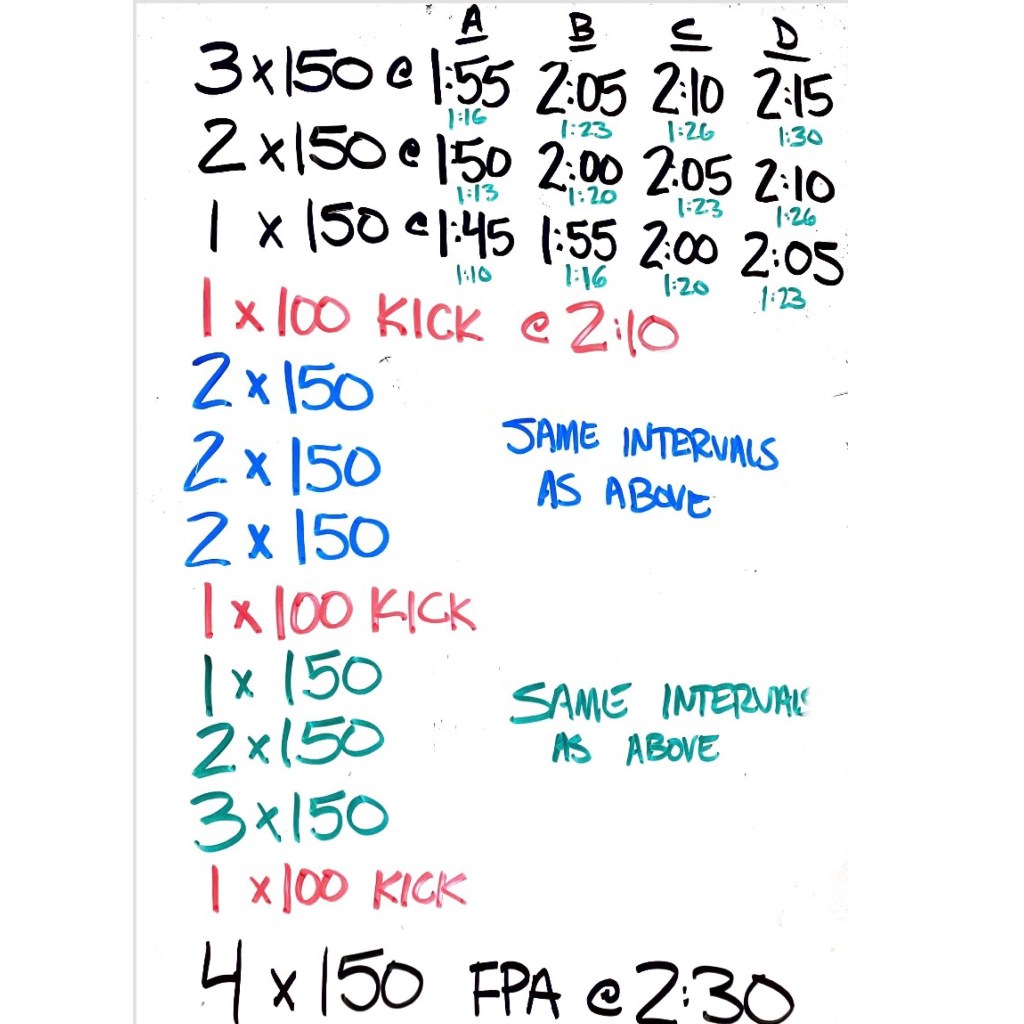
The format is similar to my most recent other post, with a more aerobic focus. The intervals stay the same for each part, with the quantities at each interval shifting slightly. The effect is a set that gets steadily a bit harder, with the peak intensity coming in the final 4 x 150 at the end. FPA = Fastest Possible Average.
Ryan Woodruff, Lynchburg YMCA
SCY

Ryan Woodruff, Lynchburg YMCA
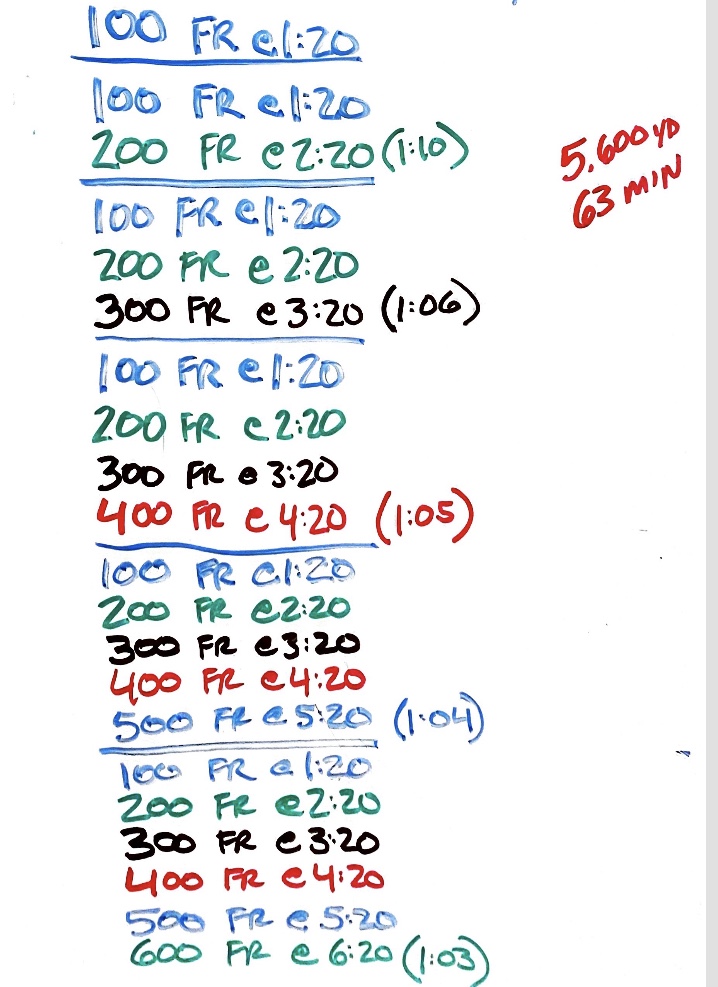
The basic concept here is to ramp up the challenge by adding a constant amount to the interval with each increasing 100 so that the average pace gets progressively harder. In this case, we added 1:00 each time so that all of the intervals ended in :20. Maybe for your swimmer the way to keep the set challenging but doable would be to add :55 or 1:05 or 1:15, but I like the symmetry of this set-up.
In this case, the lines are there to highlight the pattern. You could certainly insert brief breaks or recovery swims if needed.
The way the set is written, the swimmer does 5,600 yards in 63 minutes, an average of 1:07.5 for the interval.
SCY
Ryan Woodruff, Lynchburg YMCA
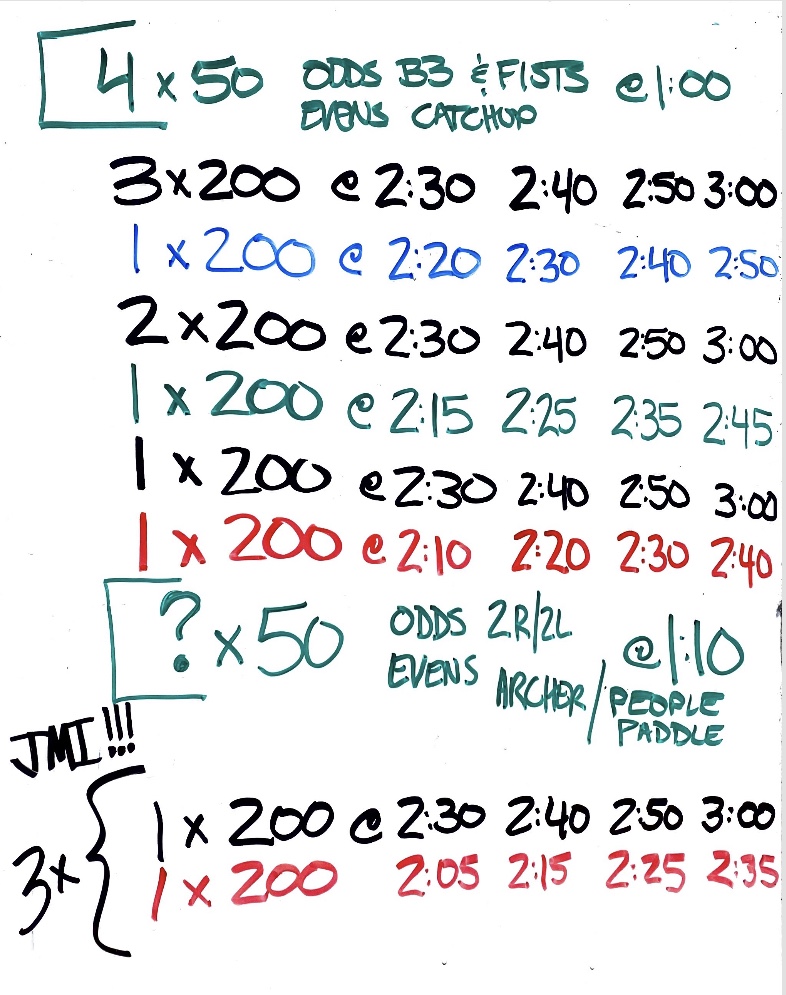
Ryan Woodruff, Lynchburg YMCA
SCM
On the 300s, the focus was on breathing every 3 strokes and executing good turns. On the 50s, the goal was simply to be at 1650 free pace (PMile).
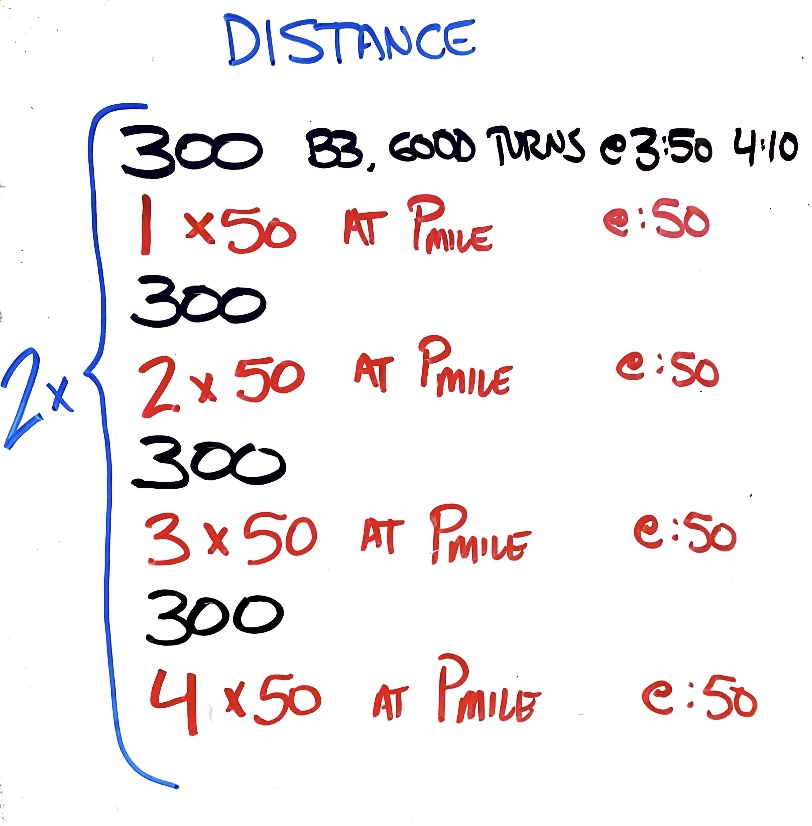
Ryan Woodruff, Lynchburg YMCA
SCM

Ryan Woodruff, Lynchburg YMCA
We have days where the whole group does one workout. Other times, we split by strokes. On this day, we split along distance lines. Part of the group worked around their distance race pace, while the other group did a small number of intense 50s from a dive. The sprinters also watched their 50s back on video and did some active recovery during the 6:00 interval. This workout was in LCM.

Ryan Woodruff, Lynchburg YMCA
SCY

Ryan Woodruff, Lynchburg YMCA
This set was done a day after a very intense quality set of 50s. The aim was to be a bit less intense while covering some distance, then hitting a leg-heavy backstroke set. SCY.
 The Swimming Wizard