Ryan Woodruff, Lynchburg YMCA
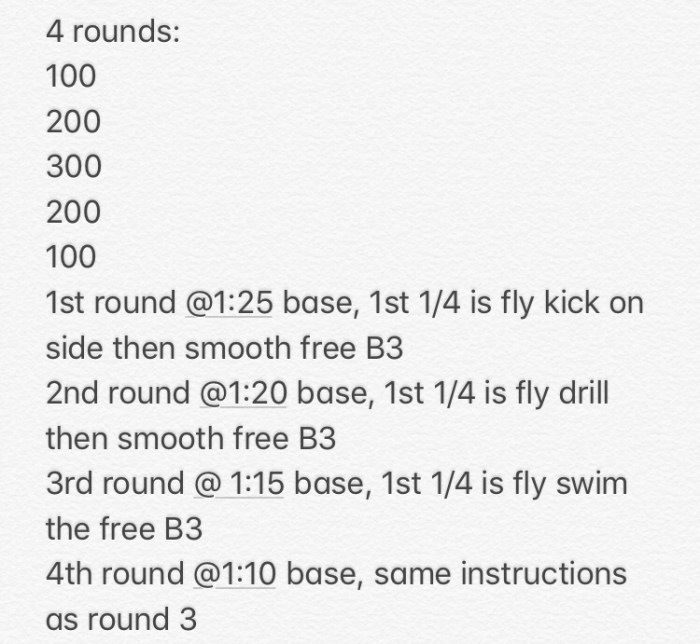
SCY This one is just a little fly mixed into some freestyle.
Free Swimming Workouts, Sets, Ideas, and Dryland Exercises from Professional Coaches Around the World
Ryan Woodruff, Lynchburg YMCA
SCY This one is just a little fly mixed into some freestyle.
Ryan Woodruff, Lynchburg YMCA
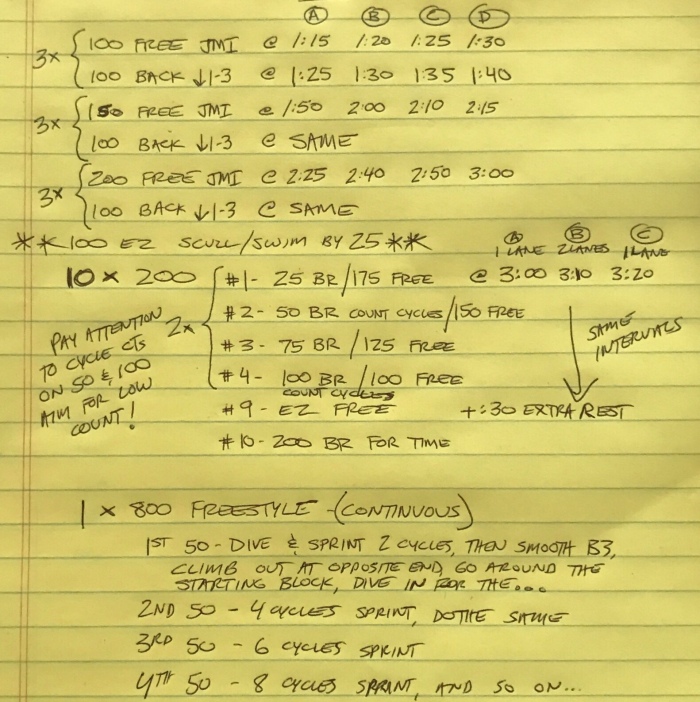
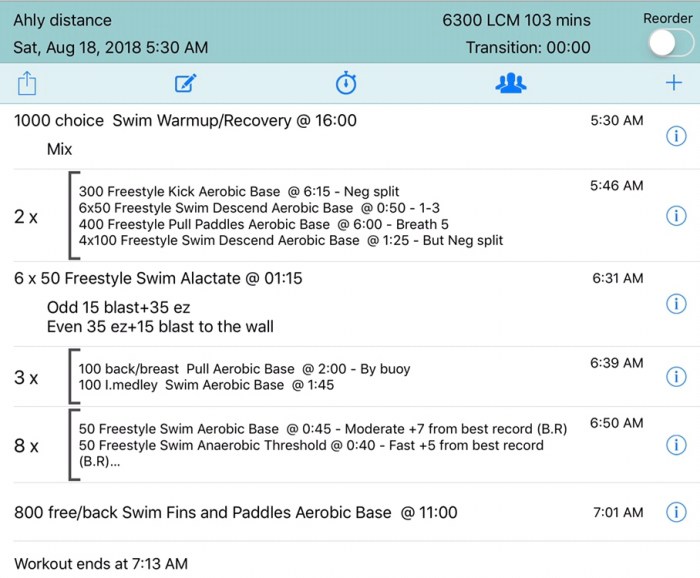
Ashraf Salah, AHLY
Ryan Woodruff, Lynchburg YMCA
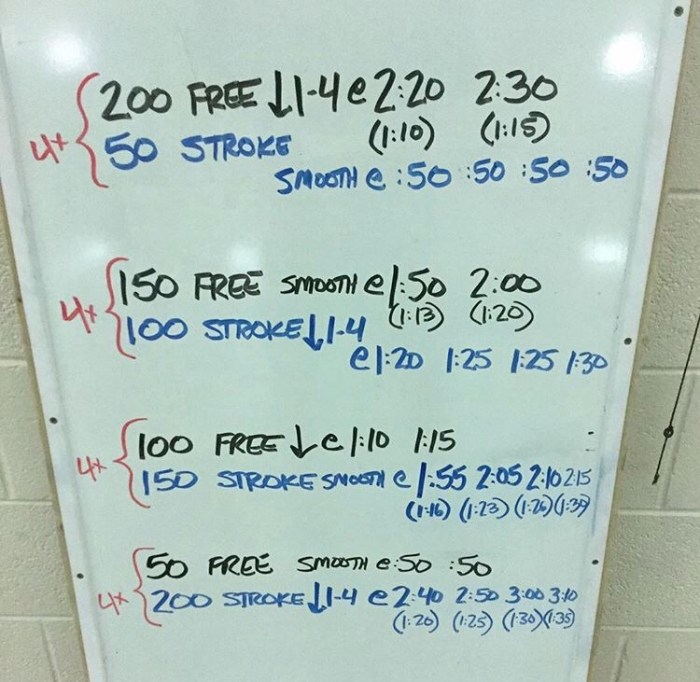
“Stroke” parts were backstroke or freestyle
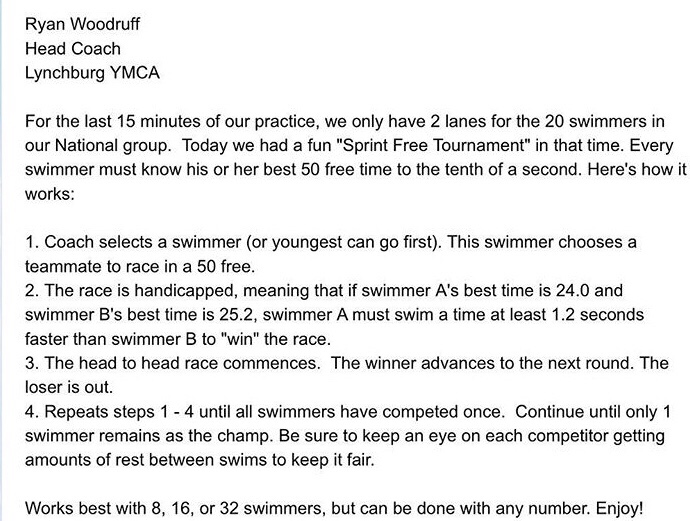
Ryan Woodruff, Lynchburg YMCA

Editor’s note: This set was originally published to this blog in July 2015.
Coach Lauren Harrington
Warmup
300 free
200 IM drill/swim
100 pull
12×25 12 1/2 yards fast, getting the heart rate up
4x50s from mid-pool (stroke)
4x50s from mid-pool (free)
Main Set – “The Dirty Thirty”
30x100s
The point of the set is to hold the same pace throughout…so you start out on 1:30/1:35 going as fast as you would to make a 1:10/1:15 pace. Obviously, you get a lot more rest at the beginning, but that’s the point. It’s a test of endurance, and it’s always fun to see where the swimmers are at the beginning of the season doing this set vs. the end of the season. It’s a good benchmark for where they’re at.
EASY 100 Stretch it out
6x100s 50 catch-up drill/50 swim freestyle to regain stroke and make sure swimmers are not just spinning their wheels after a set like that…@ 1:30
200 Warm Down
Editor’s Note: This set was originally published to this blog in 2010
Ryan Woodruff, Lynchburg YMCA
SCY. The purpose of this set was just to wake everyone up, get some good aerobic yardage in, and get the juices flowing for an aggressive end-of-practice kick set.
1000 free swim B3 @ 12:30 (1:15 base)
100 free pull B3 @ 1:15
800 free swim B3 @ 10:00
300 free pull B3-5-3 by 100 @ 3:45
600 free swim B3 @ 7:30
500 free pull B3-5-7-5-3 by 100 @ 6:15
400 free swim B3 @ 5:00
700 free pull B3-5-7-9-7-5-3 by 100 @ 8:45
200 free swim B3 @ 2:30
900 free pull B3-5-7-9-3-9-7-5-3 by 100 @ 11:15
5500 yards, 1 hour, 9 minutes
Editor’s Note: This set was originally published to this blog in 2010
Coach Erik Wiken

Swimmers are working on either their 200 or 1500 Freestyle events for this 25 minute Set. For 200s, they are doing 25 x 50. They start with one easy, then one build, then one at race pace. If they succeed at making that one, they do another one pace. If they succeed at that one, they do another one build and then one at pace. Any time they fail at making race pace, they cycle back to the top of the set.
For the milers, the set is 100s @:20 rest with a similar succeed/fail flow chart. You get the idea.
Editor’s note: We love how this encourages athletes to take ownership during the set and watch their own times. Coach Wiken says “I’m still monitoring, loosely, it’s more so to keep everyone moving the same direction.. they should know what they’re holding or should be holding at this point in our season. Kids who are on are having a lot of success in the set while others are given opportunities to be successful and continue to be a part of the set.”
Ryan Woodruff, Lynchburg YMCA
The set is pretty straightforward, unlike the title.
LCM. FPA = Fastest Possible Average

Ryan Woodruff, Lynchburg YMCA
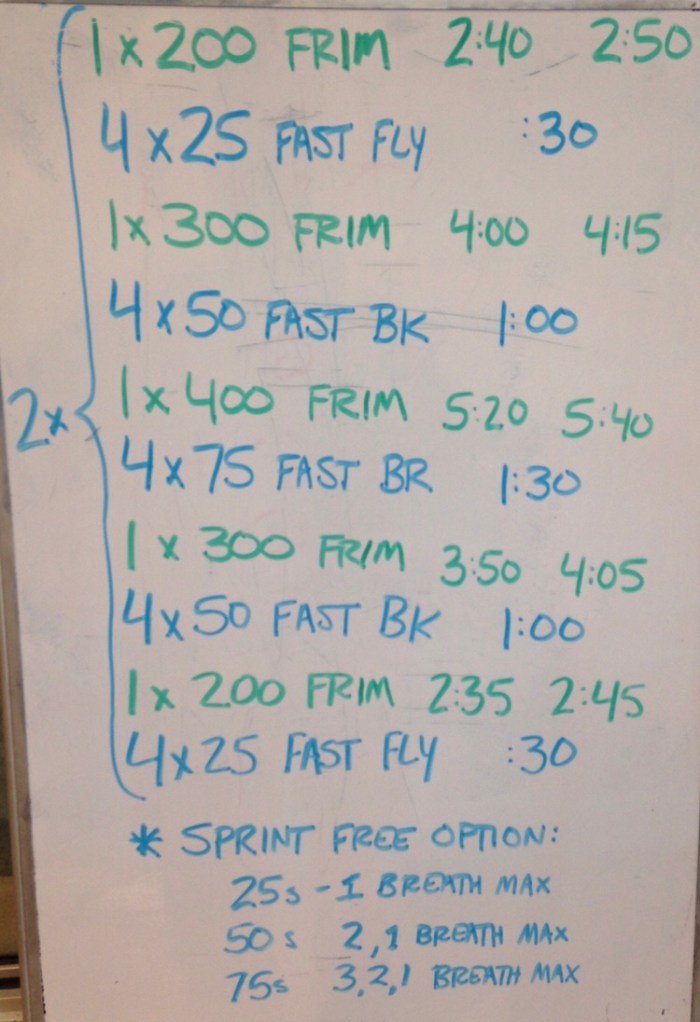
Ryan Woodruff, Lynchburg YMCA
Fat IM = add a 50 of a stroke
Skinny IM = one stroke is a 50 short of IM
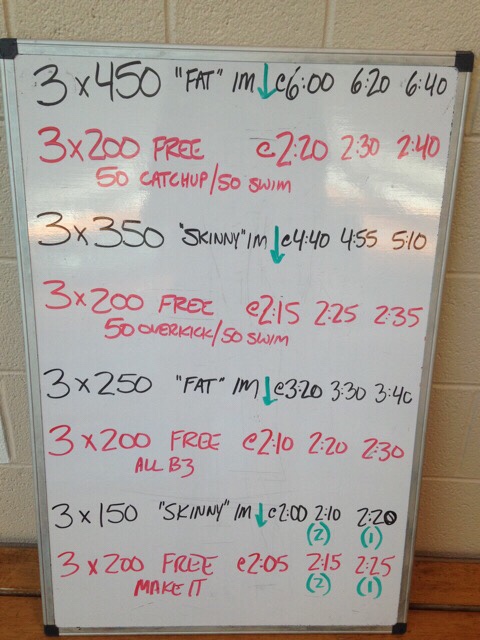
Ryan Woodruff, Lynchburg YMCA
I am an Open Water swimming enthusiast. It’s fun, interesting, and brings a different dimension to the sport. For swimmers new to Open Water, one of the biggest curveballs is “sighting,” which is lifting your head to peek forward over the water to get your bearings from landmarks or buoys. Efficient navigation is important to avoid swimming farther than necessary but most swimmers are very inefficient at sighting when starting out. The keys to doing well are:
Here is a set to test how well you are doing sighting:
9 x 200 free @:30 rest
#1 – no sighting – just swim at a moderately strong pace
#2 – sight once every 8 or 10 strokes. Try to keep your overall effort close to #1, and see how close your time is to #1.
#3 – sight once every 4 or 8 strokes, again at the same intensity. Check your time.
Repeat for #4-6 and #7-9.
The closer together your times, the better and more efficiently you are practicing your sighting.
Gwen Babcock, Dallastown Swim Club
I do a set called GI Joes. It’s like stations with dry land in between. Fun, quick yardage that is easy to get in, and it’s always changing so there is no reason to get bored. Warm up for that, could be 4×200 Swim/Drill or 3×300 Swim/drill/kick. You get the idea.
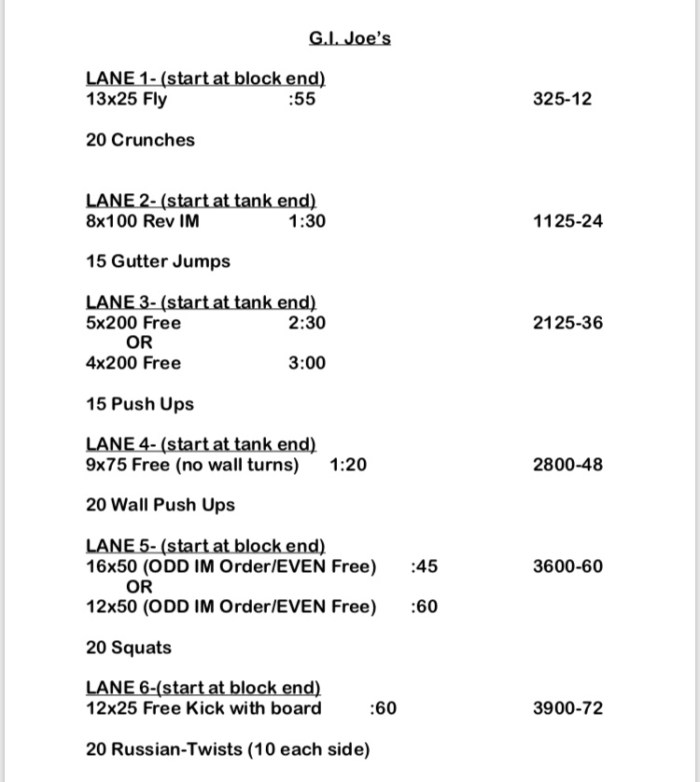
Gordy Westerberg, Clovis Swim Club
3 Rounds
50 chute for feel
50 from dive on :50
3×100 at 400 pace on interval ~25 seconds rest
50 push all out
E200
Goal of this set was to work on the middle 300 of a 400. I wanted them to go fast on the dive, not reckless, so they start the 3x100s with an elevated HR. Then apply pressure on all 3 100s. Once they are really tired, then sprint that last 50.
Results? They were way too conservative on round 1 in the dive and first 2 100s. Round 2 was better and then round 3 is where they should’ve been.
Ryan Woodruff, Lynchburg YMCA
3 rounds of:
Ryan Woodruff, Lynchburg YMCA
SCY
Ryan Woodruff, Lynchburg YMCA
LCM
Ryan Woodruff, Lynchburg YMCA
Ryan Woodruff, Lynchburg YMCA
SCM
IMO = IM order. 1st time is fly, 2nd time is Bk…etc.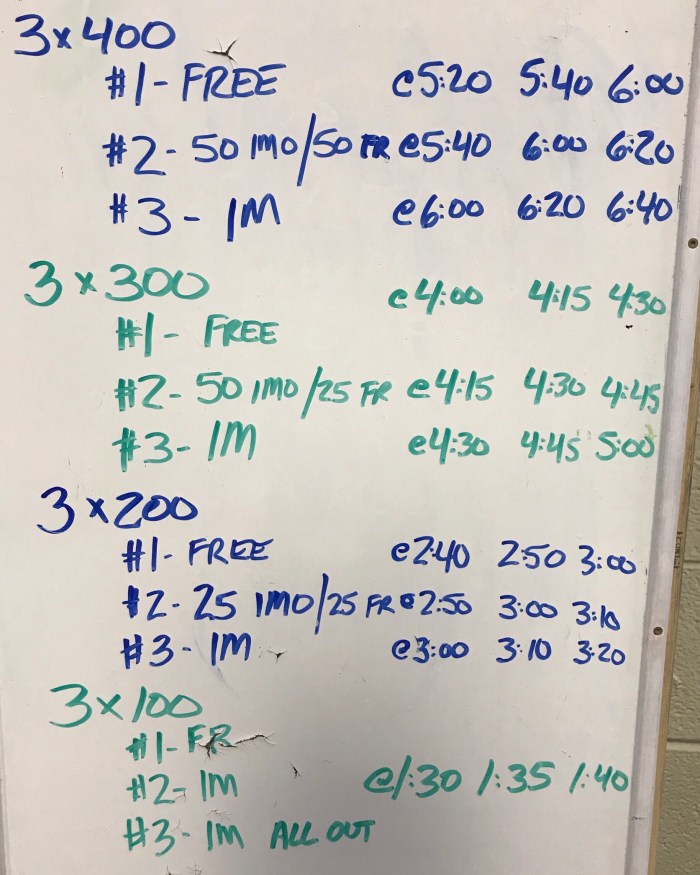
Ryan Woodruff, Lynchburg YMCA
I like incorporating dryland exercises I to practice occasionally, and deep water means it is an opportunity for one of my favorites — press-outs. A press out is essentially a vertical push-up at the side of the pool. The swimmer starts in the water with his belly close to the wall and hands in the gutter. Pressing down on the gutter, he raises himself up until his upper body is entirely out of the water and then drops back in. It is a great exercise for developing strength for all strokes. Here is one of my favorite sets to incorporate press-outs:
16 x 100 free LCM
#1 – with 4 press-outs at the 50 @1:30
#2 – with 3 press-outs at the 50 @1:25
#3 – with 2 press-outs at the 50 @1:20
#4 – FAST swim (no press-outs) @2:00
You can vary the number of press-outs and the interval to create many different interesting combinations of speed and reps. Make sure your swimmers’ shoulders are ready for the stress and don’t do too much too quickly.
Ryan Woodruff, Lynchburg YMCA
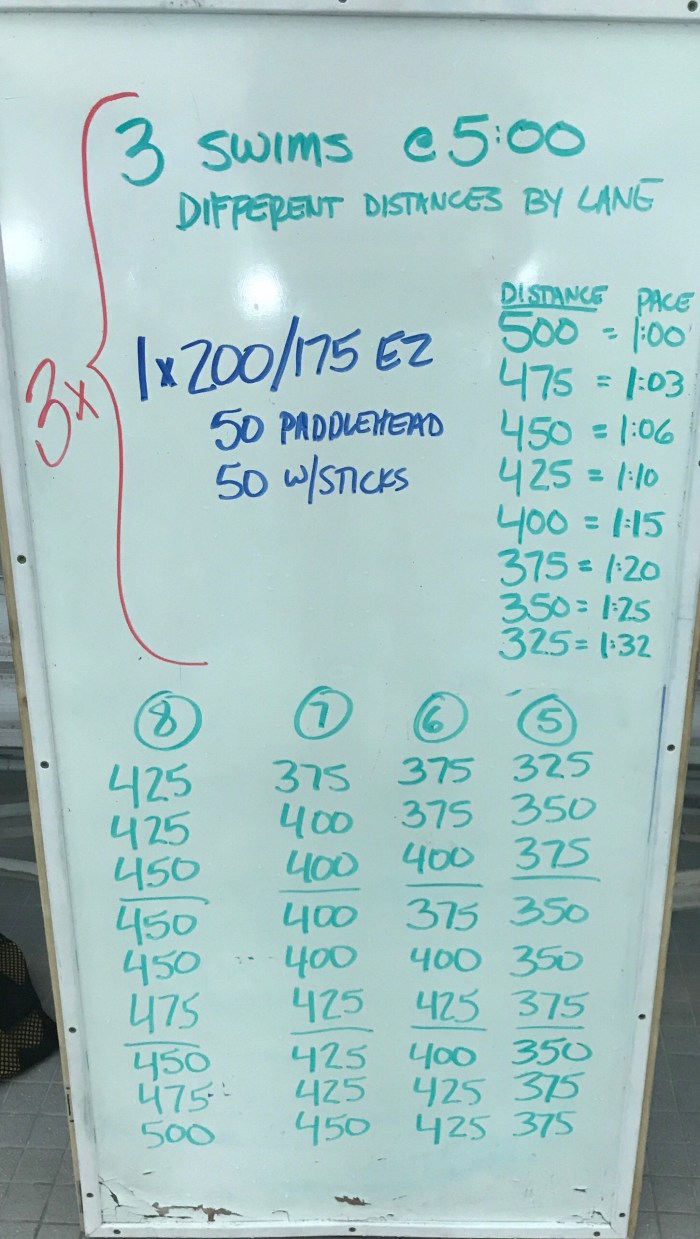
This SCY set allowed us to keep the group together on the same 5:00 interval. Each group/lane swam different distances (as indicated at the bottom of the dry-erase board) based on their ability.
We started each new round together. Swimmers were instructed to descend (swim faster) across the three swims even if/when the distance might stay the same.
Ryan Woodruff, Lynchburg YMCA
SCM

Ryan Woodruff, Lynchburg YMCA
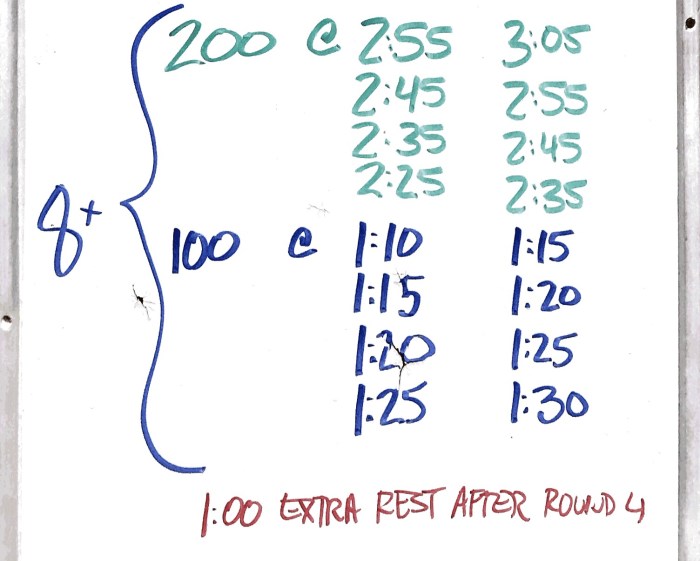
SCM intervals for our kids. Interval for the 200s decreases 1-4, and the interval for the 100s increases.
Ryan Woodruff, Lynchburg YMCA
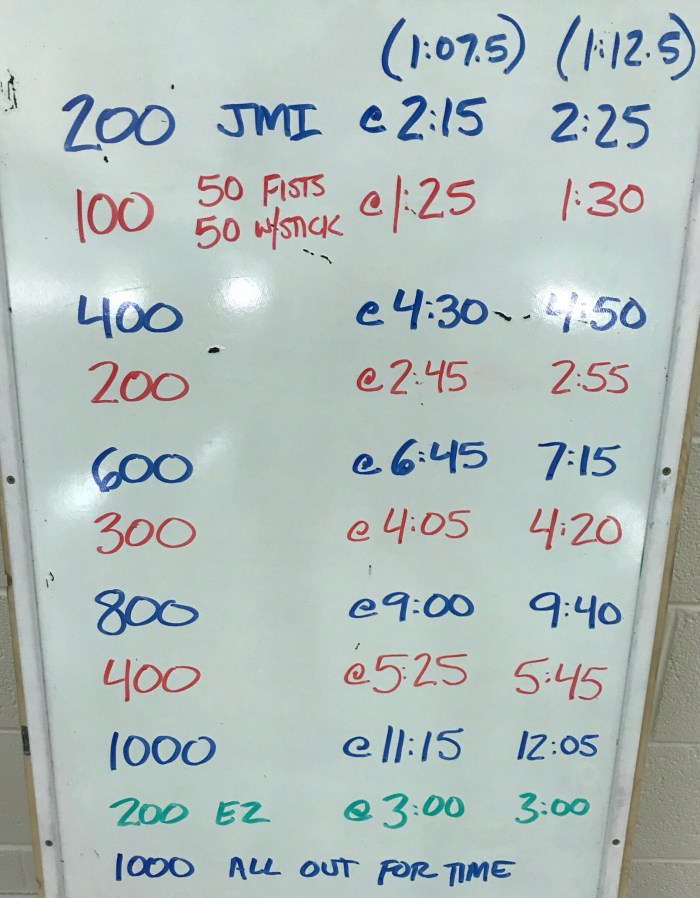
JMI = Just Make It
Red parts are smooth
SCY
Ryan Woodruff, Lynchburg YMCA
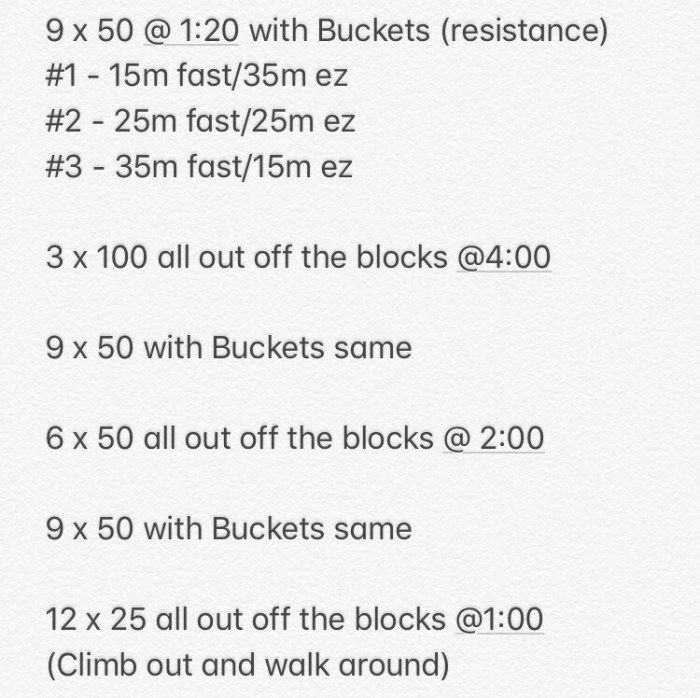
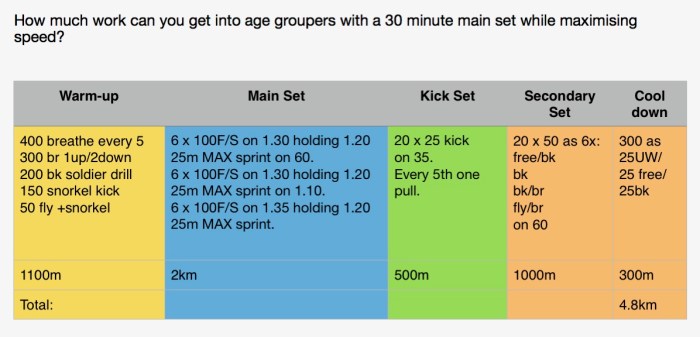
This was our speed set for the week. At over an hour in length, it was pretty intense. Our kids did well.
Ryan Woodruff, Lynchburg YMCA

Coach Mike Cook, Mason Makos

Ryan Woodruff, Lynchburg YMCA
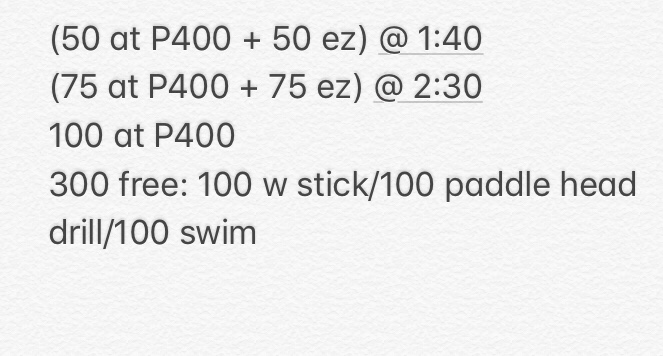
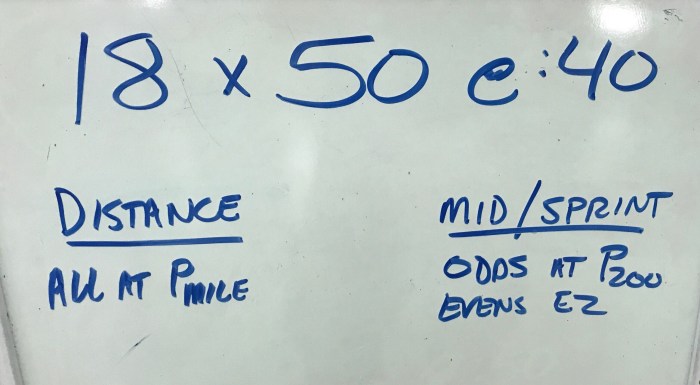
This a two part SCY workout. The first set was a freestyle and has two options — long swims for the distance group, 75s for the middle distance kids. We did a 200 ez before the second part, which proved to be quite a challenge.
Part 1

Part 2
 The Swimming Wizard