Ryan Woodruff, Lynchburg YMCA
SCY
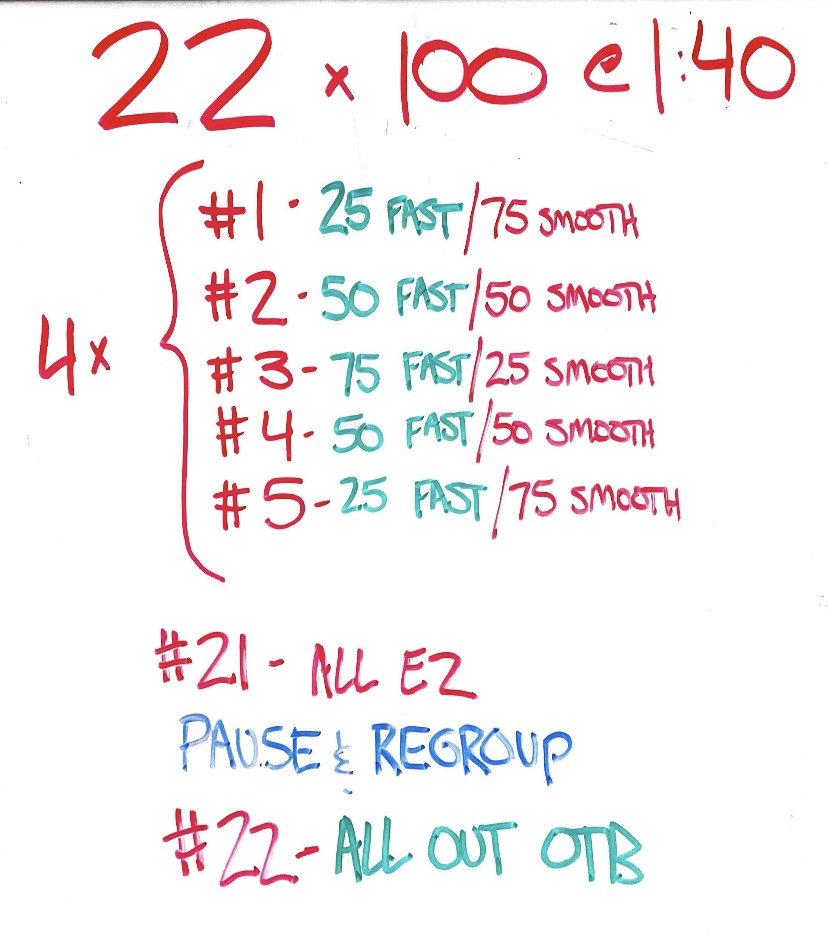
OTB = Off the blocks
Free Swimming Workouts, Sets, Ideas, and Dryland Exercises from Professional Coaches Around the World
Ryan Woodruff, Lynchburg YMCA
SCY
OTB = Off the blocks
Ryan Woodruff, Lynchburg YMCA
SCM
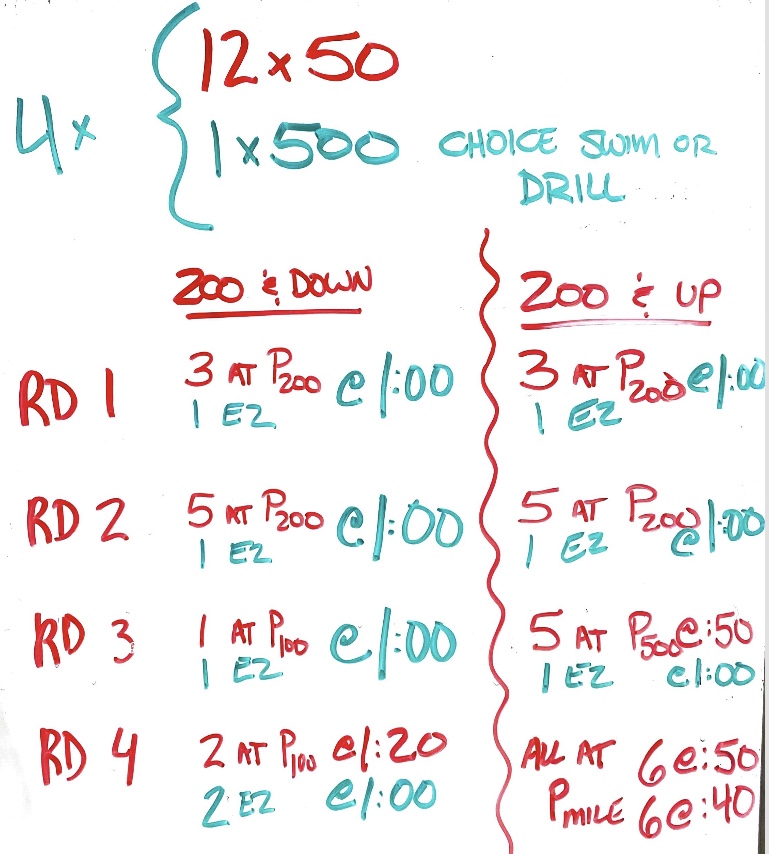
For this set, our training group was organized into swimmers who specialize in 200 & down (shorter) events and those who specialize in 200 & up (longer) events. For the first two rounds, the instructions were the same. For the last two rounds, we performed the 50s slightly differently.
P200 = Race pace for a 200 yard event
P100 = Race pace for a 100 yard event
P500 = Race pace for a 500 yard event
PMile= Race pace for the 1650
EZ = Easy
The 500 served as active recovery/technique work and preparation for the following set of 50s.
Ryan Woodruff, Lynchburg YMCA
SCM. Split the group. Everyone was one or the other.

Coach Blake Proffitt, SwimRVA
SCY
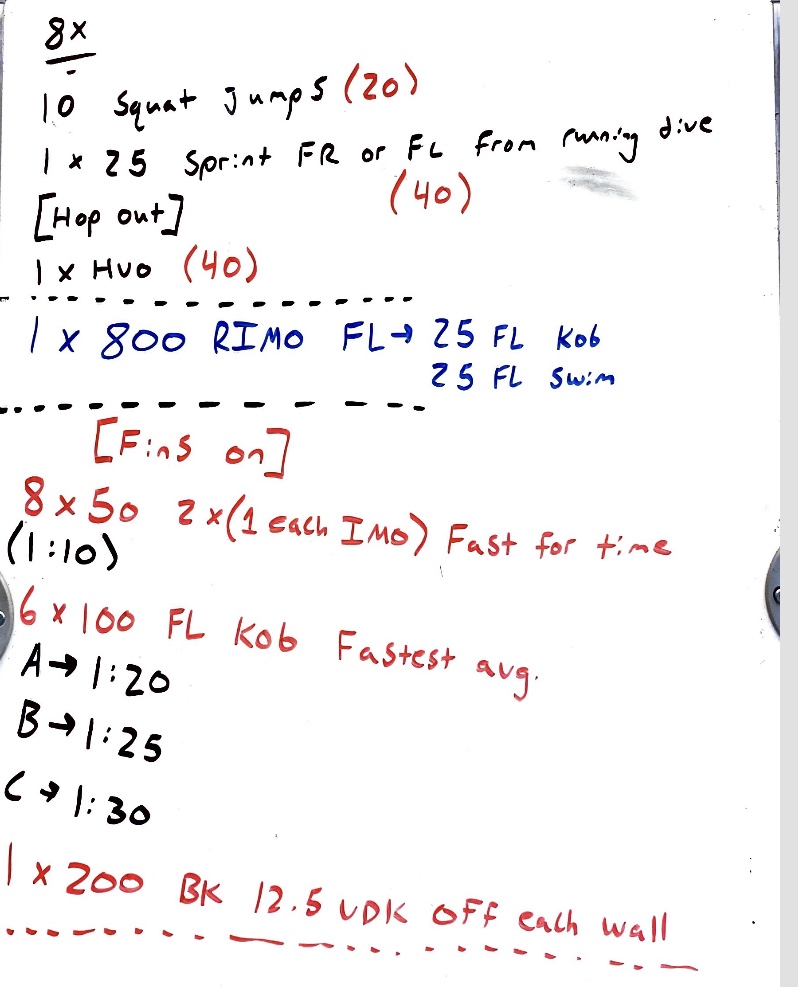
A few terms to define:
HVO = race pace (or faster) dive 25
RIMO = Reverse IM order (Fr-Br-Bk-Fly)
KOB = Kick on Back
UDK = Underwater dolphin kick
Ryan Woodruff, Lynchburg YMCA
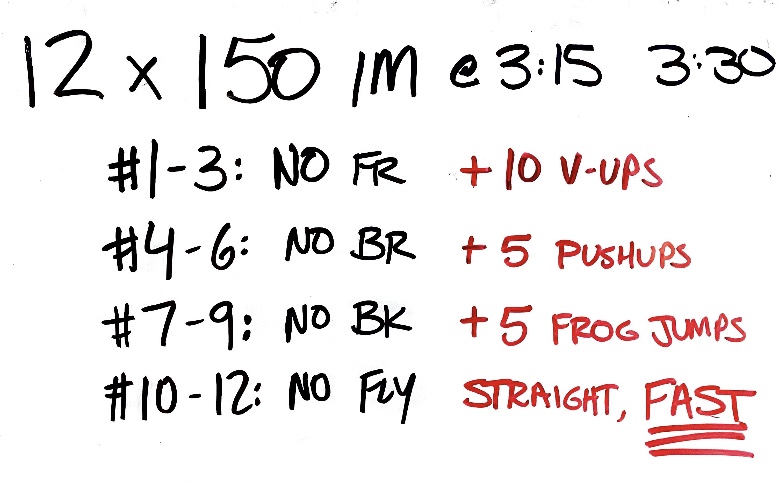
Sometimes inserting some dryland into a regular swim set can really spice up the challenge.
Ryan Woodruff, Lynchburg YMCA
SCM
Wanted to get our breaststrokers a decent volume set and included some drill. They did a nice job with this one.

Ryan Woodruff, Lynchburg YMCA
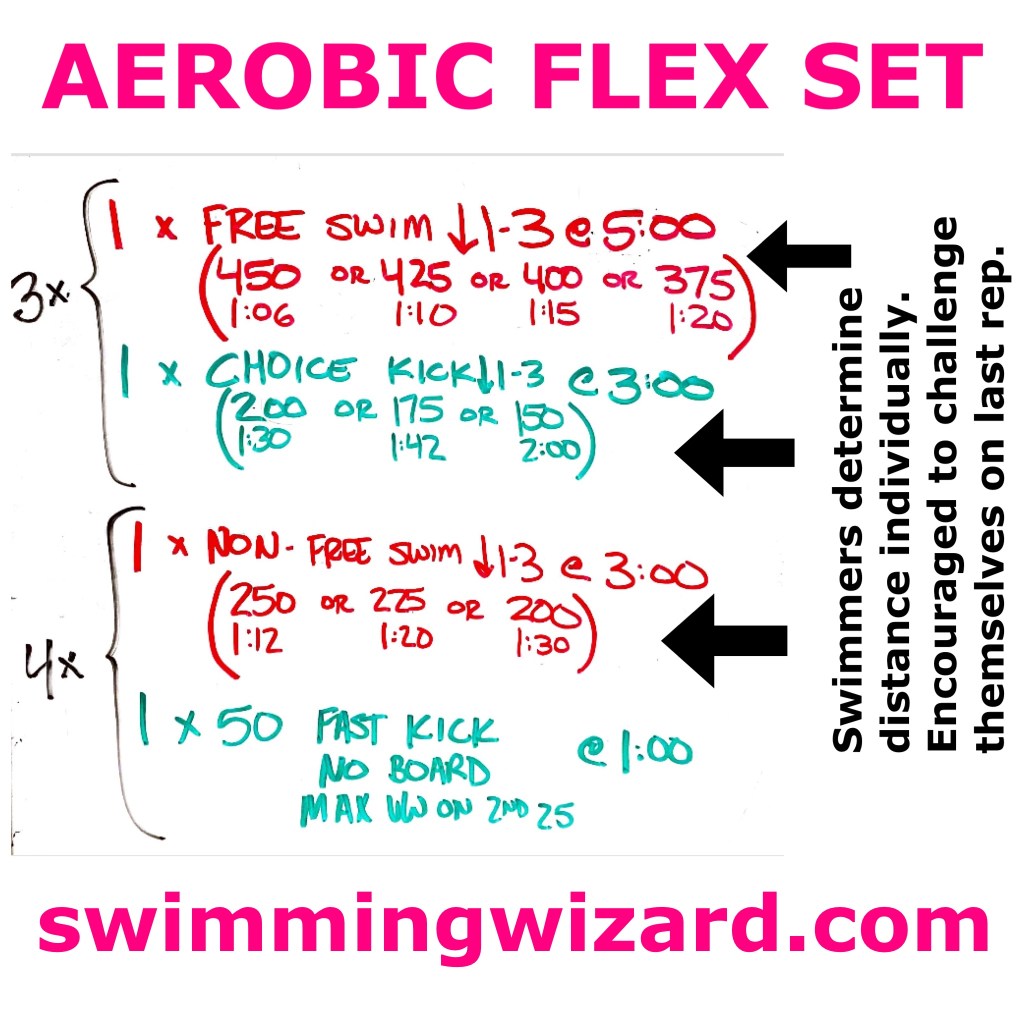
For this set, we had a diverse group of athlete abilities and speeds. This format allowed swimmers to choose their level of challenge.
The distances under each set represent the options, with the base pace written under each distance.
SCY
Ryan Woodruff, Lynchburg YMCA
SCY. Intervals remain the same all the way down the set. 50s are at about 200 pace +:03, 100s free need to make the interval by :05. This was a tough one.

Ryan Woodruff, Lynchburg YMCA
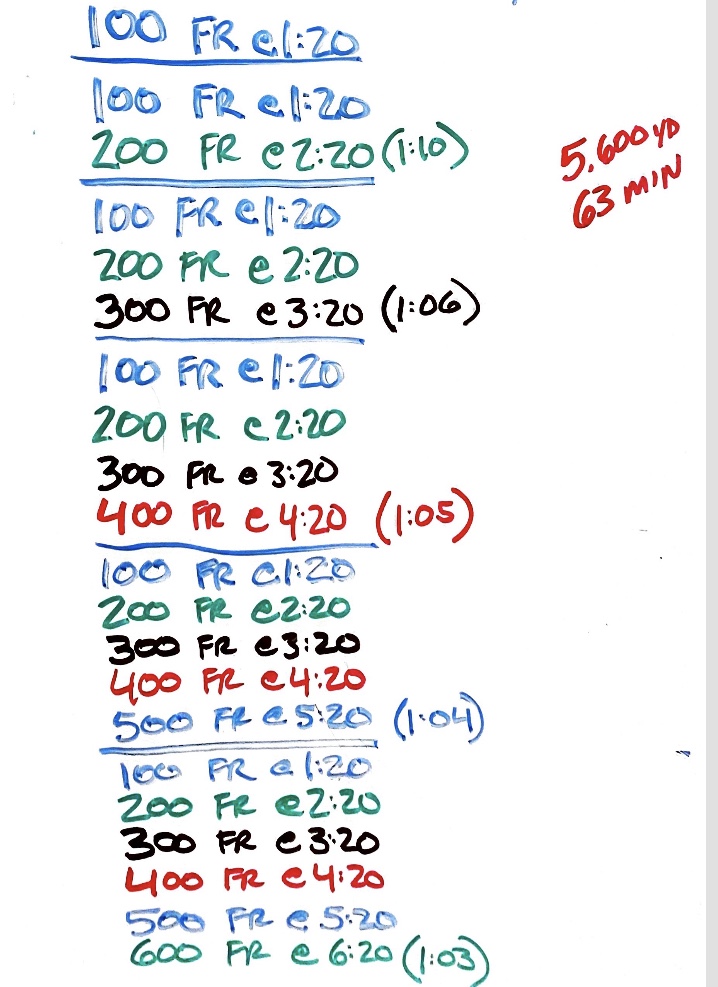
The basic concept here is to ramp up the challenge by adding a constant amount to the interval with each increasing 100 so that the average pace gets progressively harder. In this case, we added 1:00 each time so that all of the intervals ended in :20. Maybe for your swimmer the way to keep the set challenging but doable would be to add :55 or 1:05 or 1:15, but I like the symmetry of this set-up.
In this case, the lines are there to highlight the pattern. You could certainly insert brief breaks or recovery swims if needed.
The way the set is written, the swimmer does 5,600 yards in 63 minutes, an average of 1:07.5 for the interval.
SCY
Ryan Woodruff, Lynchburg YMCA

Ryan Woodruff, Lynchburg YMCA
In our pool, the black line is about 14m from one end and about 8m from the end we started this set from. SCY.

Ryan Woodruff, Lynchburg YMCA
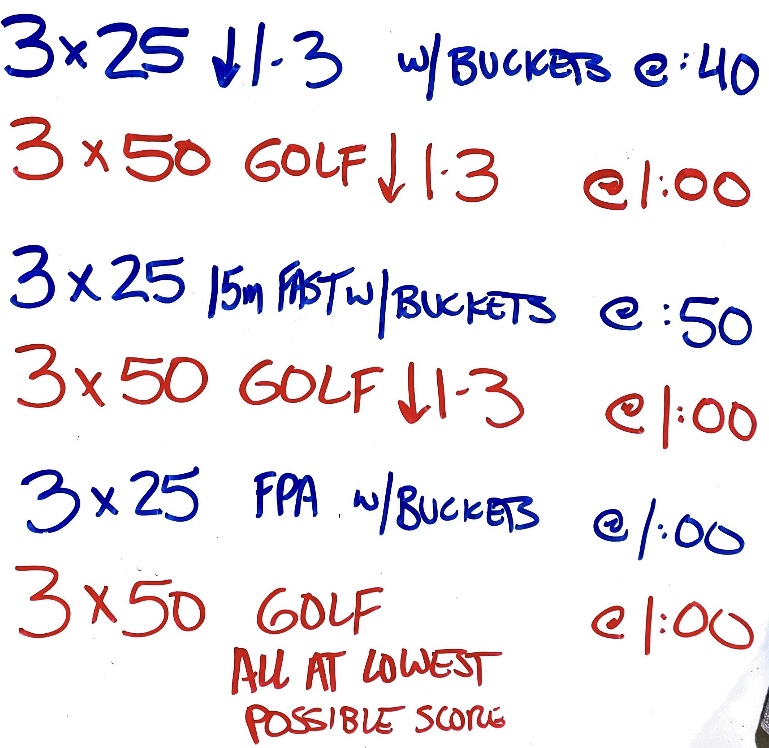
Golf = add your time plus your cycle count. This is your golf score. Try to lower the number. Buckets: We use 1-gallon plastic buckets attached to a waist belt to provide resistance. In this set we alternated between training for power and training for efficiency.
Ryan Woodruff, Lynchburg YMCA
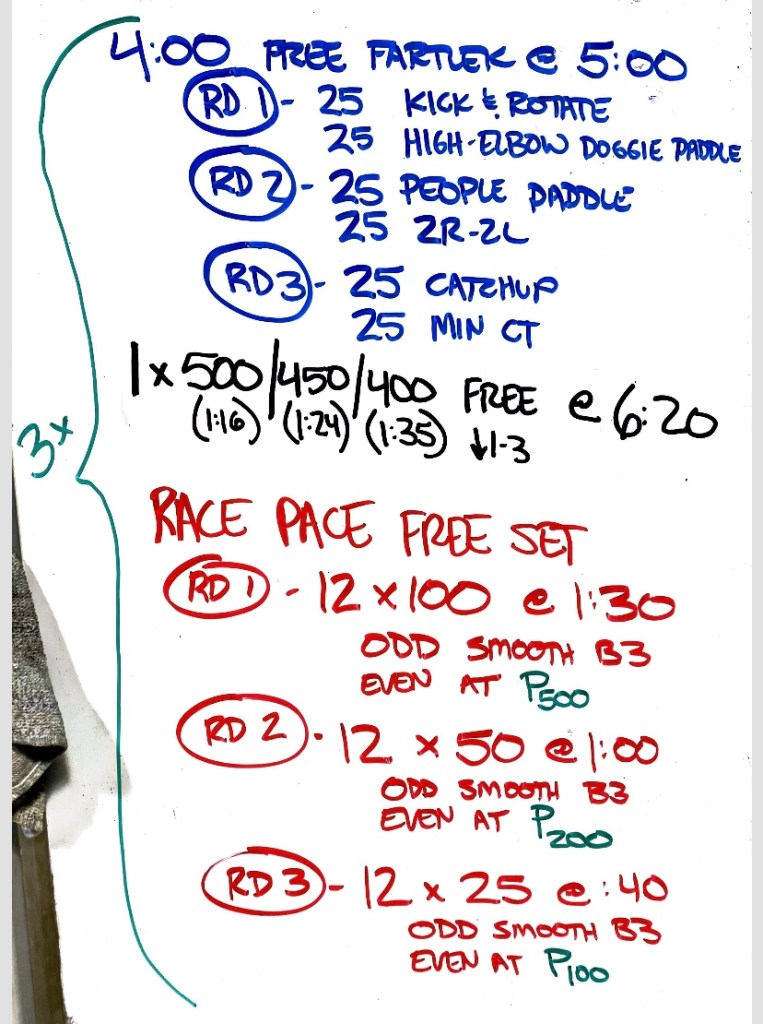
SCM
Ryan Sprang, Greater Philadelphia Aquatic Club
SCY
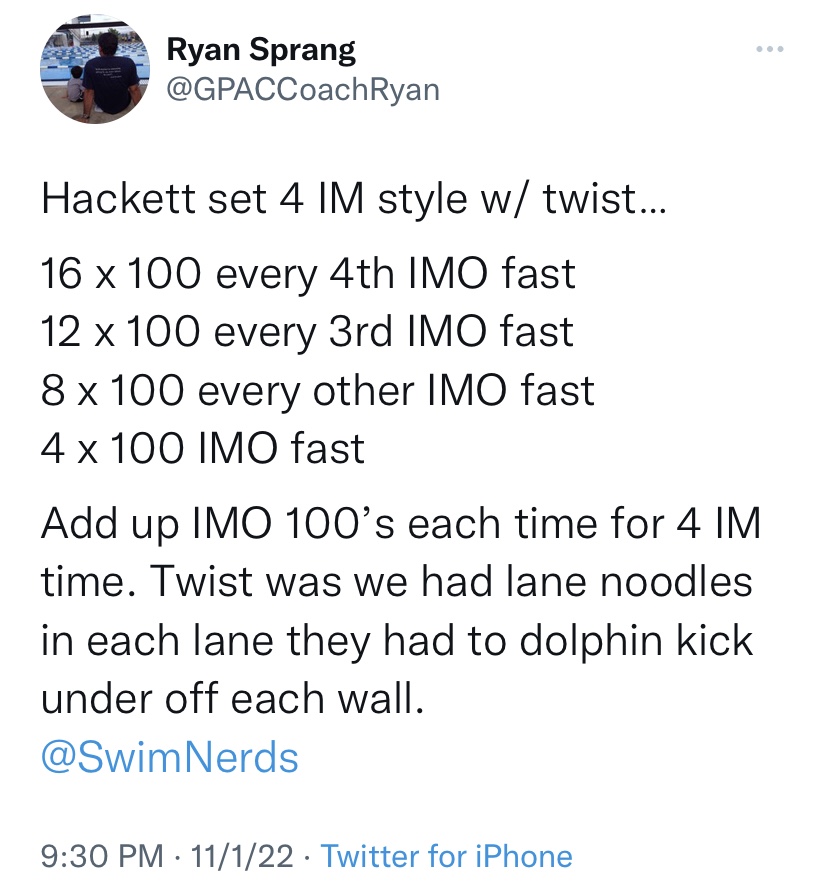
Intervals were 1:25/1:25/1:35/1:15 by stroke for IMO. Non-IMO were free on 1:20. They had to dolphin kick out about 10 yards off each wall to get under lane noodles. IMO = Individual Medley Order
Mathieu Leroy, Belford Natation
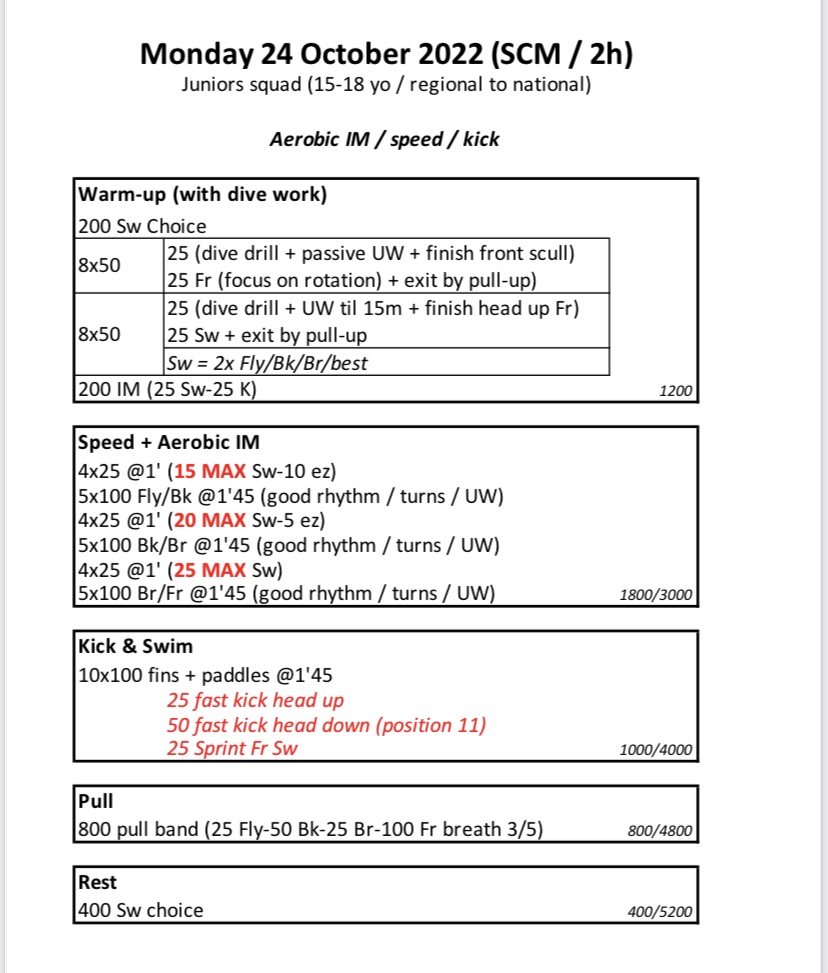
We started our season the last week of august but unfortunately for us, our main pool has been closed for 8 weeks for some major building maintenance. Because of this my squad can only swim 4 times weekly + 3x1h land training sessions during this period.
So when the half term holidays are coming, I took the decision to not ask my swimmers to swim twice daily as we usually do during half-term: that’s why there are “only” 8 sessions.


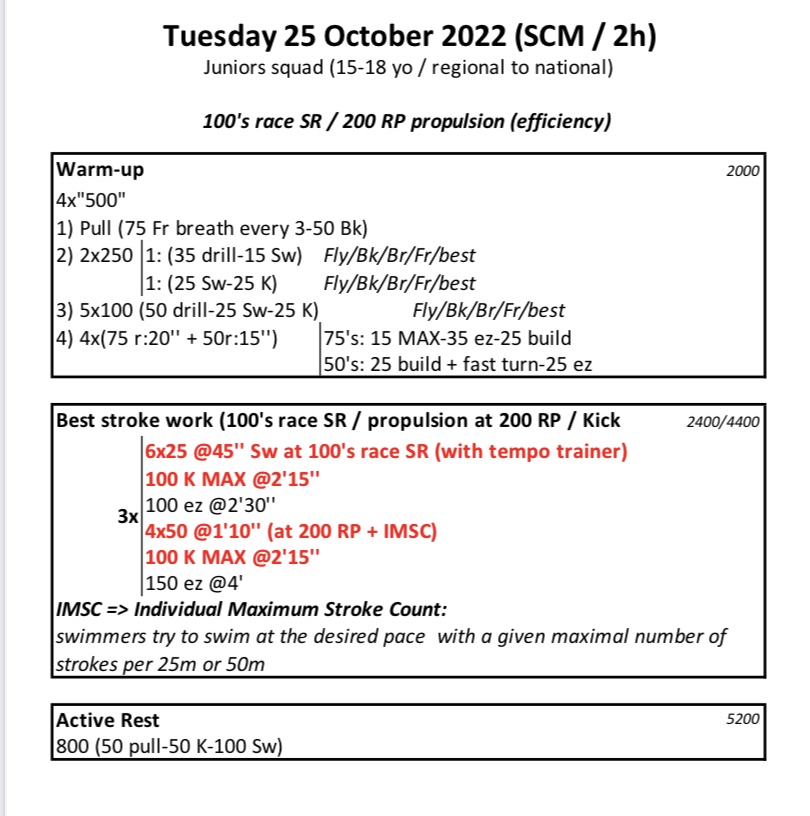

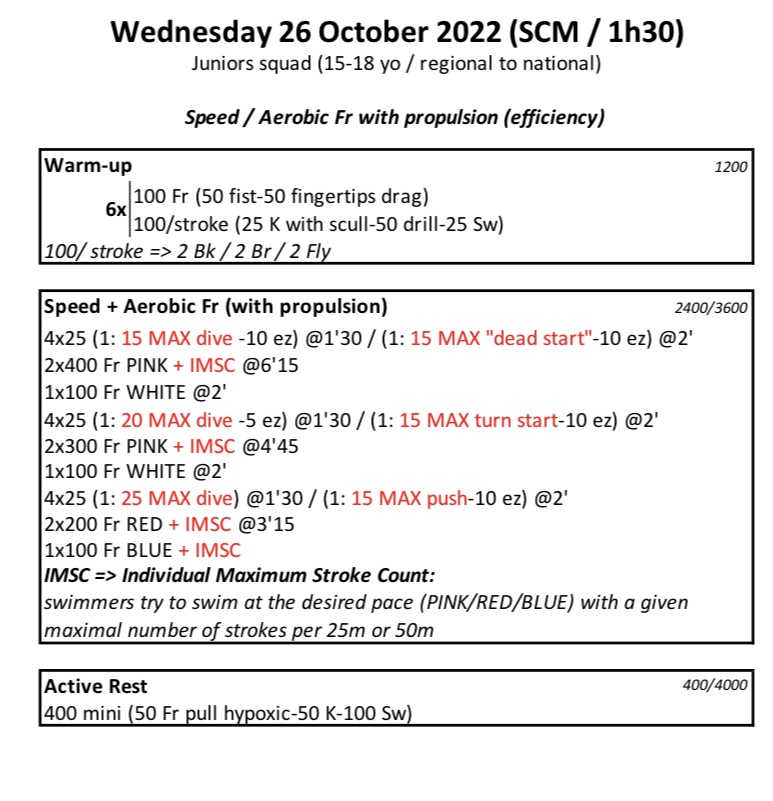
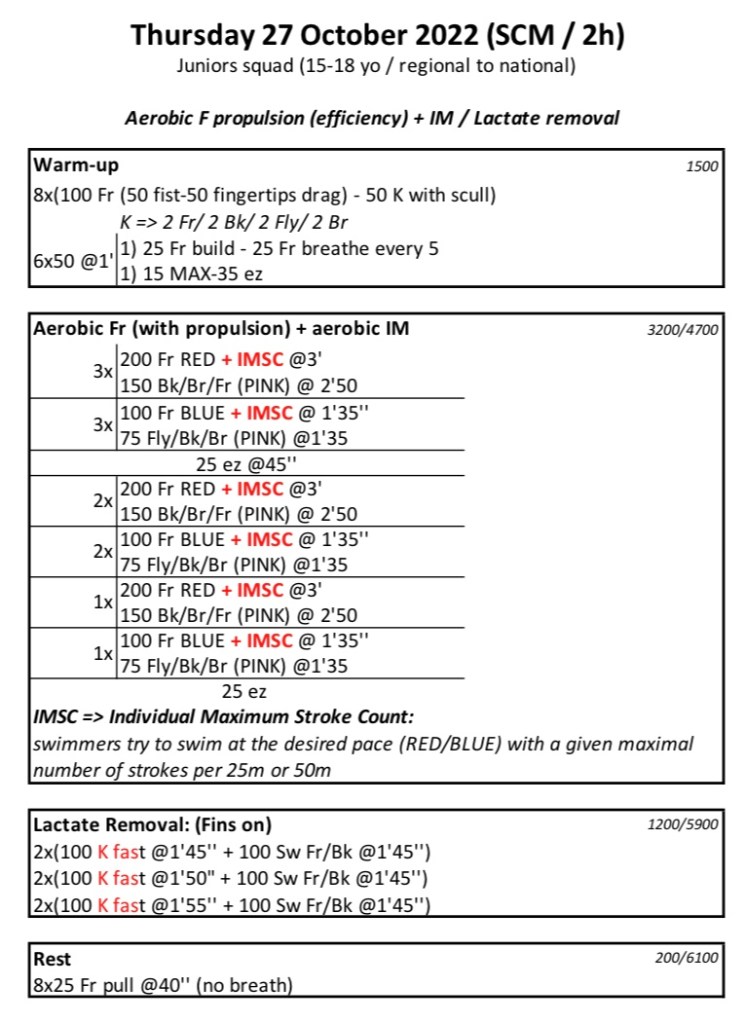


Ryan Woodruff, Lynchburg YMCA
SCY
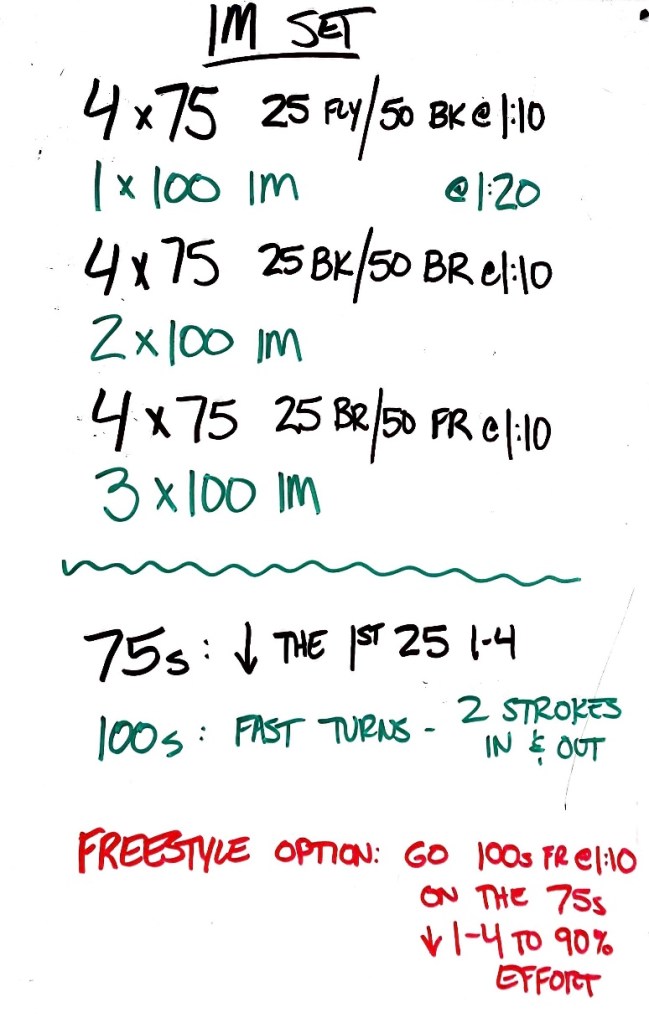
Ryan Woodruff, Lynchburg YMCA
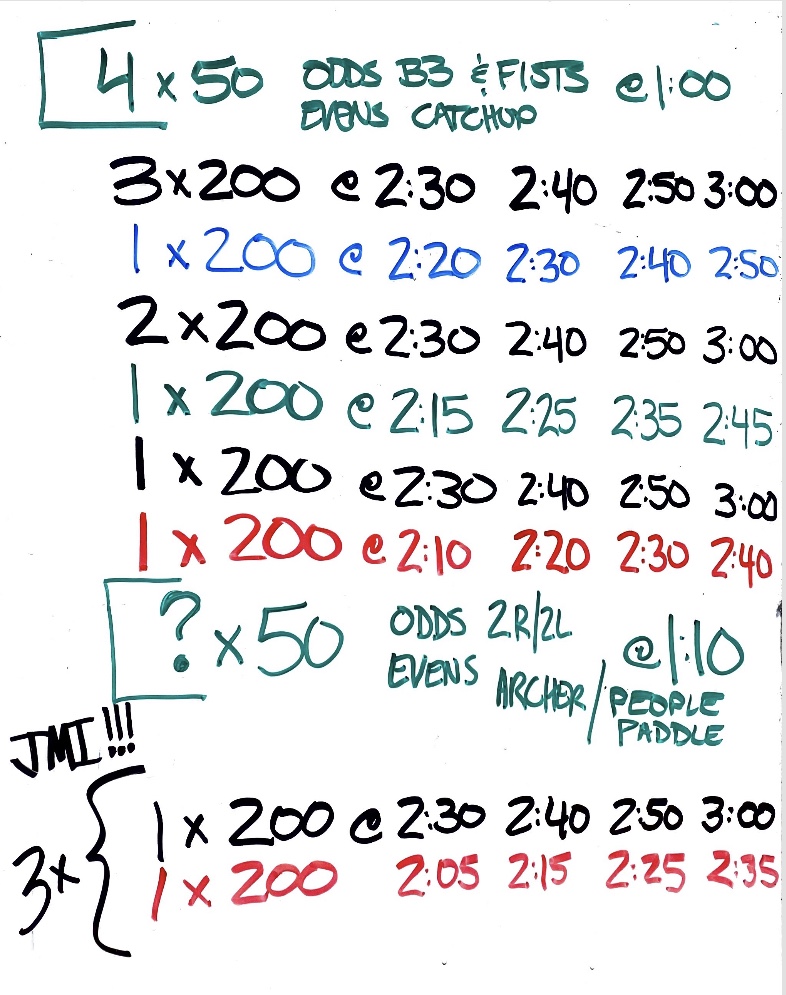
Ryan Woodruff, Lynchburg YMCA
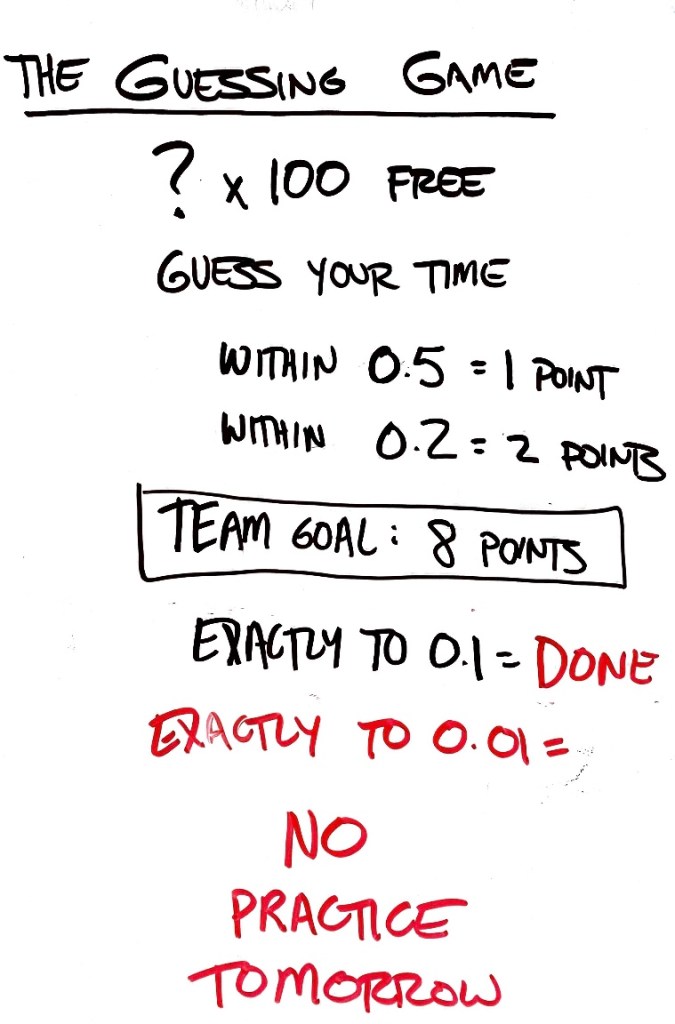
A favorite way to end practice: The Guessing Game. Turn off the pace clocks and swim 100s at any pace based on feel. The group is one team, with the goal to get out of practice as soon as possible with a few fun incentive possibilities. Yes, we still had practice the next day.
Ryan Woodruff, Lynchburg YMCA
We have done something very similar in the past. This was modified from other versions to include a certain number of kicks rather than a specific underwater distance. UWK = Underwater Kick. SCM.

Ryan Woodruff, Lynchburg YMCA
SCM
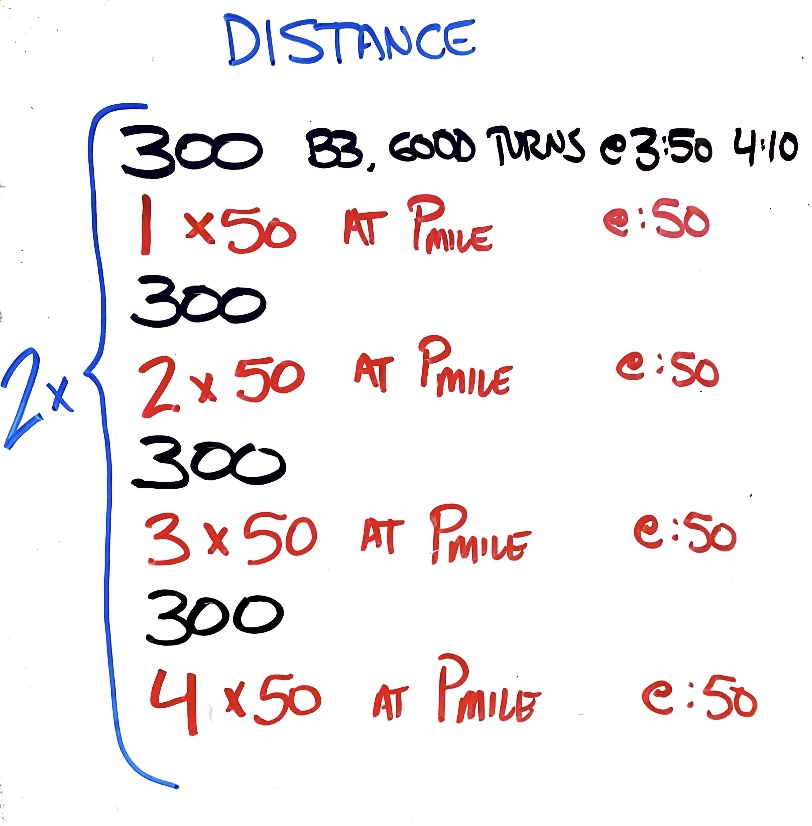
On the 300s, the focus was on breathing every 3 strokes and executing good turns. On the 50s, the goal was simply to be at 1650 free pace (PMile).
Ryan Woodruff, Lynchburg YMCA
SCM
We started off with a little swimming golf (add your time and cycles, bring the total lower) just to check in with efficiency before we really got going. Blue 50s at 200 race pace with fast 75s sandwiched in the middle. We got an excellent effort on the 75s kick, and that sometimes caused the 50s at pace to be a little off. After the 3rd sandwich, the 4 x 75s kick at the bottom were a surprise (they were not written on the set originally) and a challenge. Opening up the interval a bit and challenging them to rise to the occasion worked like magic.

Gwynn Harrison, Bridgewater College
SCM
6 x 25 w/ MONOFIN – odds kick, hands at side….evens swim for form on 30
3 x 100 Fly – 75 Build to RED, 25 Free DPS on 1:40
200 IM @ RED on 3:10
6 x 25 Back – Odds kick with hand crossed in front/ Evens Extended breakouts on :30
2 x 200 – 150 Build to BLUE / 50 Free DPS on 3:10
1 x 300 IM (75 each stroke – build to FAST exchanges) on 4:45
6 x 25 w/ MONOFIN – Swim Breaststroke on :30
1 x 400 IM FAST, TIMED
100 Easy – Regroup
8 x 25 on :25 Free – Build into fast flip
2 x 100 w/ FINS + Paddles FAST on 2:00
300 Recovery – 75 Back (25DAB)75 free
Ryan Woodruff, Lynchburg YMCA
SCY
A handful of our swimmers are preparing for an open water swim, so I included some “sighting” practice in the first part of this set. The race portion flowed well from that first part.

Ryan Woodruff, Lynchburg YMCA
Our two favorite inexpensive ways to train with resistance. We use 1-gallon buckets attached to a waist belt and @aquavolo ‘s Drag Sox.

Ryan Woodruff, Lynchburg YMCA
SCY
Golf= add time (in seconds) + cycles (per 50). Bring this score down.
OTB = off the blocks, fast.
All choice, but do the Golf and OTB the same stroke for each part.
Context: we are less than 48 hours after our first SCY meet of the season, where we swam a very full order of events in short sessions. We had a medium-difficulty practice yesterday. We were on fire with this today.

Ryan Woodruff, Lynchburg YMCA
SCM

Ryan Woodruff, Lynchburg YMCA
SCM

Ryan Woodruff, Lynchburg YMCA
SCM

Ryan Woodruff, Lynchburg YMCA
SCY
Ryan Woodruff, Lynchburg YMCA
SCM
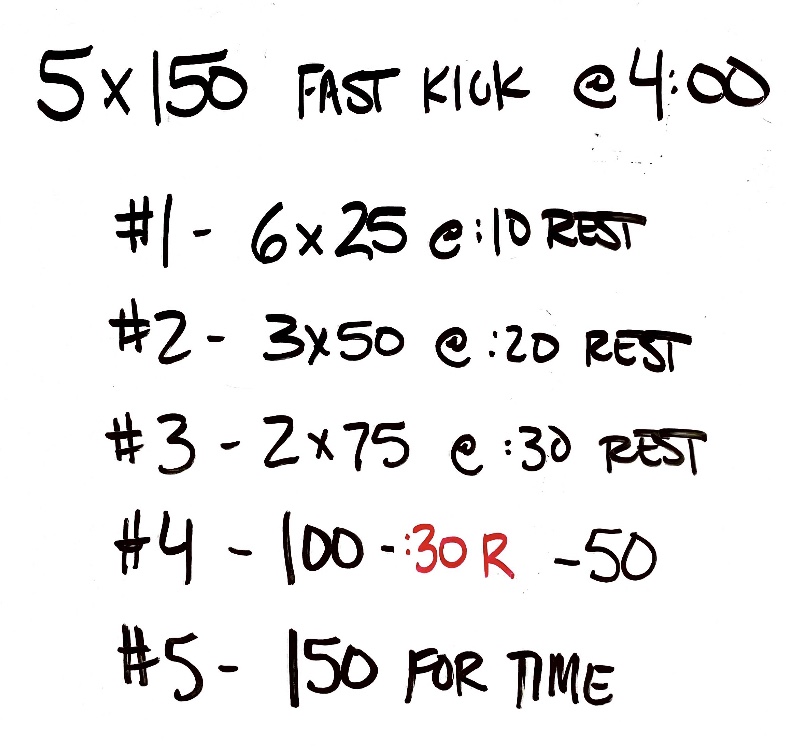
This set is a spin on a classic IM set. We build up from 50 to 150 like we are getting ready for a 200 IM. Instead of a 200, the IM swim in the middle of the set is a mystery distance ranging between 100 and 1000m, to be announced just before it is swum.
We did 3 rounds as shown. The mystery distance ms we did were 300, 400, and 100m. The 100 was done FAST for time.

 The Swimming Wizard