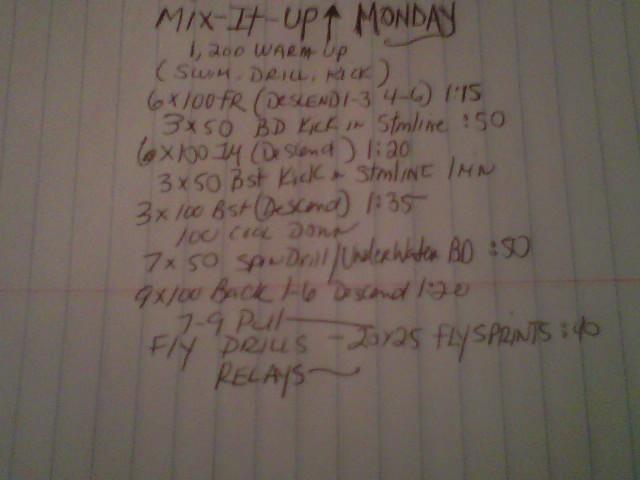
Mix-It-Up Monday with @ErinQuinn11

Erin Quinn
!function(d,s,id){var js,fjs=d.getElementsByTagName(s)[0];if(!d.getElementById(id)){js=d.createElement(s);js.id=id;js.src=”//platform.twitter.com/widgets.js”;fjs.parentNode.insertBefore(js,fjs);}}(document,”script”,”twitter-wjs”);

Mix-It-Up #Monday should have been titled #MoshPitMonday! Pool Jam-Packed with #Hawks Dreaming Big Working #Harder 🙂 

http://twitter.com/ErinQuinn11/status/273268027791929345

A Kick Set That Burns

Ryan Woodruff

I like having our athletes kick for maximum distance in a specified amount of time.  Like most teams, our range of kicking speeds is greater than our range of swimming speeds, so kicking for distance becomes an effective way to challenge each athlete when we don’t have the ability to go on 6 different intervals.  When we kick for distance, I like to put markers on the edge of the pool every 5 yards so that the athletes can determine their disance kicked to the nearest yard.

5 x 3:00 kick for distance @ 4:00 (descend 1-5)
100 easy swim @ 2:00
4 x 2:00 kick for distance @ 3:00 (descend 1-4)
100 easy swim @ 2:00
3 x 1:00 kick all out @ 2:00


The CrossSwim Set

Ryan Woodruff
ryan.d.woodruff@gmail.com

Inspired by CrossFit, we gave the following swim/dryland hybrid set a go tonight.  One time through the whole thing as fast as possible.  No rest. X = 1/2 of athlete’s pre-determined pullup max (minimum 3)

500 freestyle
X Pullups
30 squats (butt down to a bench)
400 freestyle
X Pullups
30 squats
300 freestyle
X Pullups
30 squats (butt down to a bench)
200 freestyle
X Pullups
30 squats
100 freestyle
X Pullups
30 squats
3 x 50 free fastest possible average @ 1:00 (begin on the first multiple of 5 or 10 after you finish the previous 30 squats)

Fastest time by anyone in our group: 21:55

Man-Ups!

Spencer George
Head Coach
Long Eaton Swimming Club

A set we like to use at Long Eaton Swimming Club, Derbyshire England is called “man ups”. Its a basic complex training set that hurts but is great fun.

Straight through the following:
10 Press ups
50m swim max effort
10 squats
50m swim max effort
10 Dips
50m swim max effort
10 Calf raises
50m swim max effort

Our top lane swimmer go around 2:10 200 free and their turnaround is 3:45 for 8 Man Ups. You can add Med Balls or weights to increase the intensity of some of the exercises if you want. Another variation is for IM, obviously the 50’s are IM order but the exercises change to hit the strokes as close as possible, so V sits before Fly, Dips before Back, Squats before Breast and press ups before Free. Have fun and “MAN UP”

Ryan Lochte’s "Brutal" IM Set


Pick Your Kick Distance

Ryan Woodruff

SCY
30 x (50 or 75 or 100 yards kick)
#1-10 @ 1:30
1:00 rest
#11-20 @1:20
1:00 rest
#21-30 @1:10
The goal of course is to cover the most distance possible. For added motivation, we split up into teams and devised a points system; team with the most total points wins.
Successfully complete 100 yards = +2 points
Successfully complete 75 yards = +1 point
Only completed 50 yards= -1 point

Endurance with Speed Set

Jack Roney

YOTA Swimming (Raleigh, NC)

A great set to work some aerobic endurance while keeping the R&S (Racing and Speed) a significant factor.

8×75 on :50 (Adjust Interval so that swimmer averages no more than :05 sec rest – “:00-:05 sec. rest”)

4×25 (1-Easy / 3-ALL OUT) on 1:00

6×150 on 1:40 (Adjusted Interval – :05-:10 sec. rest)

6×25 (2x — 1-Easy / 2-ALL OUT) on 1:00

4×300 on 3:20 (Adjusted Interval – :10-:15 sec. rest)

8×25 (4x — 1-Easy / 1-ALL OUT) on 1:00

The 75s/150s/300s are created to represent a group of swimmers training at a sustained 1:06 Base Interval. This 1:06 was projected to give the swimmers between :00 and :05 sec. rest on the 75s:05-:10 sec. rest on the 150s – and :10-:15 sec. rest on the 300s.

After the 75s / 150s / 300s the swimmers did an easy 25 on 1:00 – then went into 3 / 2 / or 1 FAST 25 depending on where in the set they were. As the set advanced on, the amount of FAST 25s decreases, to where they are alternating Easy/FAST for the last set of 25s on 1:00 (Essentially — 4×25 FAST on 2:00)

The swimmers did a decent warm-up and prep. set beforehand. My aim was to make sure they were not tired before the set, but also were not rested and full of energy before we began. This way they would demonstrate great technique/quality swimming while making sure their body is working hard!

Variety Kick Set

Ryan Woodruff
ryan.d.woodruff@gmail.com

The following kick set is good for overall lower body fitness while giving the athletes a specific goal to shoot for on the :50 kick for distance. Their individual goal distances were determined using the 15-minute kick test set.

SCY

200 kick @ 3:40

20 blastoffs @ :40

:50 kick for distance @1:30

200 kick @ 3:40
20 blastoffs @ :40

2 x :50 kick for distance @1:30

200 kick @ 3:40
20 blastoffs:40

3 x :50 kick for distance @1:30

200 kick @ 3:40
20 blastoffs:40

4 x :50 kick for distance @1:30

Exam Week at Carthage

Greg Earhart
Head Coach
Carthage College

Last week was finals week so we open up the pool and the guys train around their exam schedule.  I generally make the practices simpler (i.e. less thinking and stress) and give them a couple of options – more aerobic or challenging – depending on their own personal stress level.

I tried to inject a little fun into last week’s and I’ve attached what I came up with.

Two Grand Tempo

Brent Nichols
I wanted to share a workout using the Temp Trainer.  Following Coach Ryan Woodruff’s idea on how to determine “sweet spot”, http://swimmingwizard.blogspot.com/2010/05/find-your-sweet-spot.html, I came up with this set to help me work on speed without losing control.
300 Warm up consisting of:
25 Fist swim
25 open hand
25 1 finger
25 open hand
25 2 finger
25 open hand
25 3 finger
25 open hand
100 easy swim for stroke count
All three sets using TT at 1.05:
Set #1 400
4 x 25 + 3 x 50 + 2 x 75 + 1 x 100 1.05
20 second rests
Recovery swim
100
Set #2 400
4 x 25 + 3 x 50 + 2 x 75 + 1 x 100@1.05
15 second rests
Recovery swim
100
Set #3 400
4 x 25 + 3 x 50 + 2 x 75 + 1 x 100@1.05
10 second rests
Recovery swim
100
Warm down 300 yards easy swim
2100 total yards

Set #2 From Down Under

Clare Labowitch, Darwin Swimming Club
Northern Territory, Australia

We are in an endurance phase at the moment the what follows is the second of two Wednesday morning aerobic endurance sets which the swimmers handled particularly well.

Warm Up
4 x100 as 50 reverse IM order, 50 free on 1.35
4 250 as 200 free D1-4 to 85% + 50 form 20 sec RI
8 x 50 choice on 65 as 35 drill, 15 race finish
Kick Swim Drill
4 x 200 as 100 6 kick switch with one stroke to change + 100 slow arms fast kick on 3.20
Main – A1-A2
8 x 200 free as
 #1          200PB +35
#2-3       200PB +30
#4-5       200PB +25
#6-7       200PB +20
#8           take 2-3 secs off last swim
Fins
4 [ 4 x 50 as
Round 1- form on 50
Round 2- 25 form, 25 free on 45
Round 3- free on 40
Round 4 –choice on 35 – (one swimmer chose to do this round in fly)

200 easy backstroke and out

Miler 25s

Gary Galbreath, Dayton Raiders

Did this set early during taper for the Distance Group
Repeat Set 3 Times.  All 25s are to a hand touch.  Do Not Flip.
2 x 25 @ 25 Smooth
3 x 25 @ 20 Fast
2 x 25 @ 25 Smooth
3 x 25 @ 19 Fast
2 x 25 @ 25 Smooth
3 x 25 @ 18 Fast
2 x 25 @ 25 Smooth
3 x 25 @ 17 Fast
2 x 25 @ 25 Smooth
3 x 25 @ 16 Fast
2 x 25 @ 25 Smooth
3 x 25 @ 15 Fast


Race Pace Under Fatigue Part 2

Ryan Woodruff

A little while back, we posted Part 1, a similar set. This week’s set is another step forward (more fast swimming).

10x through:
Dryland exercise @ :30
1 x 50 at P200 @ :40
1 x 50 ez free @ :50
1 x 50 at P200 @ 1:00

Dryland exercises:
#1 – :20 prone hold in pushup position
#2 – 10 press-outs
#3 – :20 prone hold in pushup position with one leg off the ground
#4 – 12 press-outs
#5 – same as #3, other leg
#6 – 14 press-outs
#7 – :20 mountain climbers
#8 – 12 press-outs
#9 – :20 prone hold in 90-degree pushup position
#10 – 10 press-outs

Race Pace Under Fatigue

Ryan Woodruff

This set will help swimmers learn to swim at race pace under fatigue.
SCY
10x through:
Selected dryland exercise @:20
1 x 50 @ :40 beat P200 from a push
1 x 50 @ :40 smooth swim of the same stroke, hold great technique
1 x 50 @ 1:00 ez swim

Selected dryland exercises:
#1 – 10 pushups
#2 – 10 frog jumps
#3 – 12 pushups
#4 – 12 frog jumps
#5 – 14 pushups
#6 – 14 frog jumps
#7 – 12 pushups
#8 – 12 frog jumps
#9 – 10 pushups (hold your breath)
#10 – 10 frog jumps (hold your breath)

I.M. Transitions

Ryan Woodruff, North Carolina Aquatic Club
coachryan@ncacswim.org

SCY
The purpose of this set is to improve the swimmer’s ability to swim quality backstroke, breaststroke, and freestyle while dealing with the residual fatigue from butterfly, backstroke, and breaststroke, respectively. After each initial swim, the :05 rest allows the swimmer just enough time to catch a breath or two so as to allow for high-quality technique on the subsequent 100 yard swim. Descend the three 100s back (and breast, and free). Descend the three 200 IMs. Lay it all on the line for the broken 400 IM, being sure to swim each stroke completely (don’t glide into the end of each 100).

100 Fly (:05 rest) + 100 Back @ 2:40
150 Fly (:05 rest) + 100 Back @ 3:20
200 Fly (:05 rest) + 100 Back @ 4:00

200 IM @ 3:00

100 Back (:05 rest) + 100 Breast @ 2:50
150 Back (:05 rest) + 100 Breast @ 3:30
200 Back (:05 rest) + 100 Breast @ 4:10

200 IM @ 3:00

100 Breast (:05 rest) + 100 Free @ 2:40
150 Breast (:05 rest) + 100 Free @ 3:20
200 Breast (:05 rest) + 100 Free @ 4:00

200 IM @ 3:00

100 ez @ 2:00

Broken 400 IM (:10 rest every 100)
Long Course Speed Test

Ryan Woodruff

To test your speed for long course swimming, do some 35m sprints off the blocks regularly. Using the Goal Pace Spreadsheet for LCM, determine the swimmer’s race-pace time to 35m for the 100m distance of each stroke. The 35m mark should be easy to spot (same as the 15m mark from the turn end). Time to the swimmer’s head crossing the line. 35m is a manageable distance for most swimmers to hold their 100m race pace in training. Strive to swim at your race pace as often as possible, and check your speed regularly with these 35m sprints!

Are You Training Fast Enough?

Coach Ryan Woodruff

How fast are you planning to be this season? Are you swimming at race pace in practice? Check out our race pace cards that can be easily individualized to each swimmer.
Here are the instructions once you have the sheet open in Excel:
1. Type the swimmer’s name where it says ‘Name here.’
2. Enter a swimmer’s goal time in the C column. Do not use any punctuation. For instance, for a goal time of 24.99 in the 50 free, type 2499. For a 2:28.50 in the 200 breast, type 22850.
3. The sheet should automatically compute pace times for you. ‘Pace’ means the swim is from a push. ‘Start’ means the swimmers goes off the blocks (or from a start for backstroke). The sheet computes different pace values for different events based on what I deemed the most useful information. For instance, a 15m start time is of little consequence in the mile, but could come in handy in the 100 fly.
4. Print out the pace card and take it to practice!

A few other notes:

* The sheet is based on the assumption that a swimmer will swim an even pace for every length after the 1st 25 (50 for LCM). For freestyle, the difference between the 1st and 2nd 25 is 1.7. For fly, the difference is 2.0, for backstroke the difference is 1.0, and for breaststroke it is 2.5 seconds.
* The C column is cross-hatched and the goal time is in gray in order to keep the swimmer’s focus on the race pace rather than her goal time.

Enjoy – let me know how it goes!

Click here or on the top menu to go to our “Tools for Coaches” page to see other useful tools

The Chunker

Ryan Woodruff, North Carolina Aquatic Club
coachryan@ncacswim.org

LCM
18 x 15 meter sprint @ 2:00

#1 – from a start
#2 – 7.5m in and out of a turn
#3 – from mid-pool into a finish

All start and turn sprints are timed to the head crossing the line. Swim easy between the repeats. Use this chart to see how fast your 15m “chunks” need to be based on your best time.

9 Ways to Train I.M.

Ryan Woodruff

We all know that I.M. is a great way to put some variety into your training. Here are some ways to put a little variety into your variety.

#1 – Reverse I.M. A commonly used version, simply swim the strokes in reverse order.
#2 – Free I.M. Good for masters swimmers who are fly-reluctant or for any time that you want to get good back, breast, and free training without the butterfly. Simply substitute freestyle in for the butterfly portions of the I.M.
#3 – Inside-out I.M. Swim the strokes in the order Back-Fly-Free-Breast
#4 – Fat I.M. – Do these for lengths that are 25% longer than your standard I.M.-125s, 250s, 500s, etc. Double up on one of the strokes (this is the Fat stroke). A 250 Fat I.M. (Back) would thus be 50 Fly/100 back/50 breast/50 free.
#5 – Lemon I.M.
#6 – Emily I.M.- For swimmers with knee injuries/pain or whose breaststroke is not a focus of your efforts for improvement. Swim backstroke double the normal distance and leave out breaststroke altogether. Yes, this is named after a swimmer.
#7 – Baltimore I.M.s
#8 – Skinny I.M. This is the opposite of Fat I.M.s Swim distances like 175s, 350s, etc. Cut the distance of one stroke in half.
#9 – Gator I.M. Alternate stroke and free. A 300 Gator I.M. would be 50 fly/50 free/50 back/50 free/50 breast/50 free.

Do you have any other interesting or creative ways of training I.M.?

The Swimming Calculator

Coach Ryan Woodruff

Ever wonder how much faster your swimmer would be if he would just fix his turns? Curious about the combination of tempos and cycle counts that will lead to the fastest time for your swimmer?

This is the tool for you.

The Swimming Calculator (click to download the excel sheet)

Toy around with it a bit and let me know what you think. I am interested to hear any suggestions, and if anyone knows how to set this up in an html format, I would love to be able to put it on the web to eliminate the cumbersome excel download.

The Swimming Calculator can also henceforth be found in the Tools for Coaches section in the menu above.

30-60-90

Ryan Woodruff

Here is one of our favorite core exercises. We call it 30-60-90 for each of the body angles where we pause.

Have the swimmer be seated on a physio ball and have a teammate stand on his feet. The swimmer should then streamline and hold a straight line from wrists to shoulders to hips as he moves through the different angles. We like to go for 1:00 straight shifting positions about every 3 seconds and finishing with 10 seconds holding the 30 degree position.

Slot Water Polo

Ryan Woodruff
Slot Water Polo came about when I wanted a fun game for my swimmers to play that was safe, was easy to set up, didn’t have too many rules, and wouldn’t be overly physical while still demanding their effort. It is similar to traditional water polo in several ways — it has a ball, two teams going in opposite directions, an out-of-bounds area, etc. Here is what makes it different:

1. Play with a physio ball (swiss ball). This makes the game slower and less dangerous (it doesn’t hurt to get hit in the face).
2. Swimmers wear fins. Makes for a great lower body workout.
3. Swimmers must stay in their lanes (slots). At the beginning of the game, swimmers must choose their slot and remain in it until a goal is scored. A swimmer may reach outside of his lane, but his waist may not cross the lane line.
4. The goal is a traffic cone placed on each side of the pool. A goal is scored when a cone is knocked over.
5. If one team is camping out defensively, the coach may move the cone to another lane at any time during the game. This also adds an extra element of strategy to the game.
6. For a more interesting game, play with two or three physio balls at a time.