Ping Pong Butterfly

Ryan Woodruff, North Carolina Aquatic Club
coachryan@ncacswim.org

This butterfly mini-set will encourage them to swim with long strokes and work their underwater kick-outs. It is best done with one or two people in the lane.

LCM

Push off of the wall and perform 1 cycle fly. Open turn mid-pool, kick on back to the wall, then immediately push off and perform 2 cycles of fly. Keep repeating with 3 cycles, 4 cycles, 5 cycles, etc until they cover the entire 50. Upon completing the 50, rest :05 and then sprint a 50 fly for time. No underwater kicking beyond 15m allowed.

The swimmers will quickly figure out that when they get up to a number of cycles that they can make the 50m, they will perform their best dolphin kicks, and then hold long strokes for the entire 50, some even going 4+ fewer strokes than normal. Grabbing that short rest and then going the 50 sprint for time is a challenge, but they will usually step up and swim well.

Twenty Ways to Do 20 x 25 – #20

Ryan Woodruff, North Carolina Aquatic Club
coachryan@ncacswim.org

#20 – Climb-out kicks
SCY
All are @ :30
2x:
1 ez swim
1 fast kick
1 ez swim
2 fast kick
1 ez swim
3 fast kick

#19 and #20 – Fast streamline underwater kick

All 25s are from a dive. Swimmers must climb out and be prepared to dive within the interval. This is what truly makes the set challenging!

The Bear

Ryan Woodruff, North Carolina Aquatic Club
coachryan@ncacswim.org

LCM
1 x 800m Free @ 12:00
1 x 35m sprint choice @ 3:00
1 x 800m Free @ 12:00
2 x 35m sprint choice @ 3:00
1 x 800m Free @ 12:00
3 x 35m sprint choice @ 3:00
1 x 800m Free @ 12:00
4 x 35m sprint choice @ 3:00
1 x 800m Free @ 12:00
5 x 35m sprint choice @ 3:00

This set takes 1 hour and 45 minutes to complete. 800s are fastest possible average, and 35m sprints are all-out timed to the head crossing the line. Record all times.

Distance Free + Speed Fly

Ryan Woodruff, North Carolina Aquatic Club
coachryan@ncacswim.org

100 free catchup drill @ 1:20
200 strong free swim @ 2:20
2 x 25 Fly sprint, 1 breath max @ :40
100 free catchup drill @ 1:20
100 tennis ball drill @ 1:20
300 strong free swim @ 3:30
4 x 25 Fly sprint, 1 breath max @ :40
100 free catchup drill @ 1:20
100 tennis ball drill
100 6-3-6 drill
400 strong free swim @ 4:40
6 x 25 Fly sprint, 1 breath max @ :40

Long Course Speed Test

Ryan Woodruff

To test your speed for long course swimming, do some 35m sprints off the blocks regularly. Using the Goal Pace Spreadsheet for LCM, determine the swimmer’s race-pace time to 35m for the 100m distance of each stroke. The 35m mark should be easy to spot (same as the 15m mark from the turn end). Time to the swimmer’s head crossing the line. 35m is a manageable distance for most swimmers to hold their 100m race pace in training. Strive to swim at your race pace as often as possible, and check your speed regularly with these 35m sprints!

Are You Training Fast Enough?

Coach Ryan Woodruff

How fast are you planning to be this season? Are you swimming at race pace in practice? Check out our race pace cards that can be easily individualized to each swimmer.
Here are the instructions once you have the sheet open in Excel:
1. Type the swimmer’s name where it says ‘Name here.’
2. Enter a swimmer’s goal time in the C column. Do not use any punctuation. For instance, for a goal time of 24.99 in the 50 free, type 2499. For a 2:28.50 in the 200 breast, type 22850.
3. The sheet should automatically compute pace times for you. ‘Pace’ means the swim is from a push. ‘Start’ means the swimmers goes off the blocks (or from a start for backstroke). The sheet computes different pace values for different events based on what I deemed the most useful information. For instance, a 15m start time is of little consequence in the mile, but could come in handy in the 100 fly.
4. Print out the pace card and take it to practice!

A few other notes:

* The sheet is based on the assumption that a swimmer will swim an even pace for every length after the 1st 25 (50 for LCM). For freestyle, the difference between the 1st and 2nd 25 is 1.7. For fly, the difference is 2.0, for backstroke the difference is 1.0, and for breaststroke it is 2.5 seconds.
* The C column is cross-hatched and the goal time is in gray in order to keep the swimmer’s focus on the race pace rather than her goal time.

Enjoy – let me know how it goes!

Click here or on the top menu to go to our “Tools for Coaches” page to see other useful tools

The Tag Relay

Ryan Woodruff, North Carolina Aquatic Club
coachryan@ncacswim.org

The Tag Relay is a fun challenge for your team that can help develop teamwork and flat-out speed.

If you are in a SCY pool, space out 4 to 8 swimmers along the lane in a circle-swimming pattern. For LCM you will need a few more (maybe 12-18). The first person will dive in, sprint to tag swimmer #2, who sprints to tag swimmer #3, and so on. You can do this for any distance and any stroke. Try having them go in medley order for fun. You will be surprised at how fast they can go when they touch hand-to-foot and get to practice it a few times. Try to break the national age group, American, or World records.

The Chunker

Ryan Woodruff, North Carolina Aquatic Club
coachryan@ncacswim.org

LCM
18 x 15 meter sprint @ 2:00

#1 – from a start
#2 – 7.5m in and out of a turn
#3 – from mid-pool into a finish

All start and turn sprints are timed to the head crossing the line. Swim easy between the repeats. Use this chart to see how fast your 15m “chunks” need to be based on your best time.

Vertical Kick + Power Tower

Ryan Woodruff, North Carolina Aquatic Club
coachryan@ncacswim.org

Some vertical kicking and Power Tower work to get you going:

1:00 vertical kick arms across chest
100 drill @ 2:00
8 x 25 Power Tower odd sprint/even EZ @ :40
:40 vertical kick with weight belt in front of chest
100 drill @ 2:00
6 x 25 Power Tower same as above
:20 vertical kick with weight belt held overhead
100 drill @ 2:00
4 x 25 Power Tower same as above

Late-Season Quality Set

Ryan Woodruff, North Carolina Aquatic Club
coachryan@ncacswim.org

Testing our ability to hold race pace:

4 x 200 75@P200 + 50 ez + 75@P200 @ 4:00
8 x 100 Descend 1-4 and 5-8 to P500 or P400IM or P200+5 @ 1:30
12 x 50 odd ez even @P200 @ 1:00
16 x 25 odd ez even @ P100 to a foot touch

Teammate Slingshots

Ryan Woodruff

This exercise builds off of the Teammate Drag. It is best done for a 25 at a time. Here is how it works. Swimmers are partnered, with one swimmer pulling (sprinting) and the other being pulled. Somewhere between the 15m marks, the trailing partner pulls the leading partner’s leg, attempting to slingshot to the lead. They then sprint to the wall. The kids love this exercise, and it really got them going pretty fast.

Here’s a video example:

Power Hour at SwimMAC Carolina

Chris Webb, SwimMAC Carolina

Goal of set is promote sprint power/endurance and to bring it all together with measurable data at the end of the set for 100 speed. Using real stroke #'s and kick counts from meets are encouraged. Training at race #'s and speeds can really help athletes take ownership.  Using this set and variations ( or different equipment) during heavy volume periods can prevent losing touch with relevant speed and measure fatigue.  

60×25 on 1:00 fr/bk/or fly as follows:
 
4×25's  build to overspeed!
4×25's w/T-shirt MAX sprint
4×25's w/T-shirt & paddles MAX sprint
8×25's  running dive MAX sprint no equipment focus on carrying speed to surface and  your length of stroke

12×25 underwater Body dolphin (dolphin kick) w/fins  MAX sprint
8×25 running dive 12.5 – 15m underwater BD then swim MAX sprint

20×25 ideal BD off each wall with a stroke count and time  CPT (concentration, precision, and Technique) (you must know your kick and stroke #'s)

The Near-Race-Pace Set

Ryan Woodruff, North Carolina Aquatic Club
coachryan@ncacswim.org

This set is designed for the swimmers to achieve near-race-pace speeds and progress in intensity through the set.

4 x 175 @ 3:30 Beat your best 200 time
400 ez swim
6 x 90 (float the last 10)@ 3:00 Beat your best 100 time
400 ez swim
8 x 50 @ 2:30 Be within 2.0 sec of your best 50 free time or within 1.0 of your dive P100 time (see the Race Pace Calculator to determine this time).

Done correctly, the athlete will be swimming at 88% of 200 race pace on the 175s, at 90% of 100 race pace on the 90s, and at least 90% OF 100 race pace on the 50s.

The Rocket Tower

Ryan Woodruff, North Carolina Aquatic Club
coachryan@ncacswim.org

Check out the Rocket Tower:

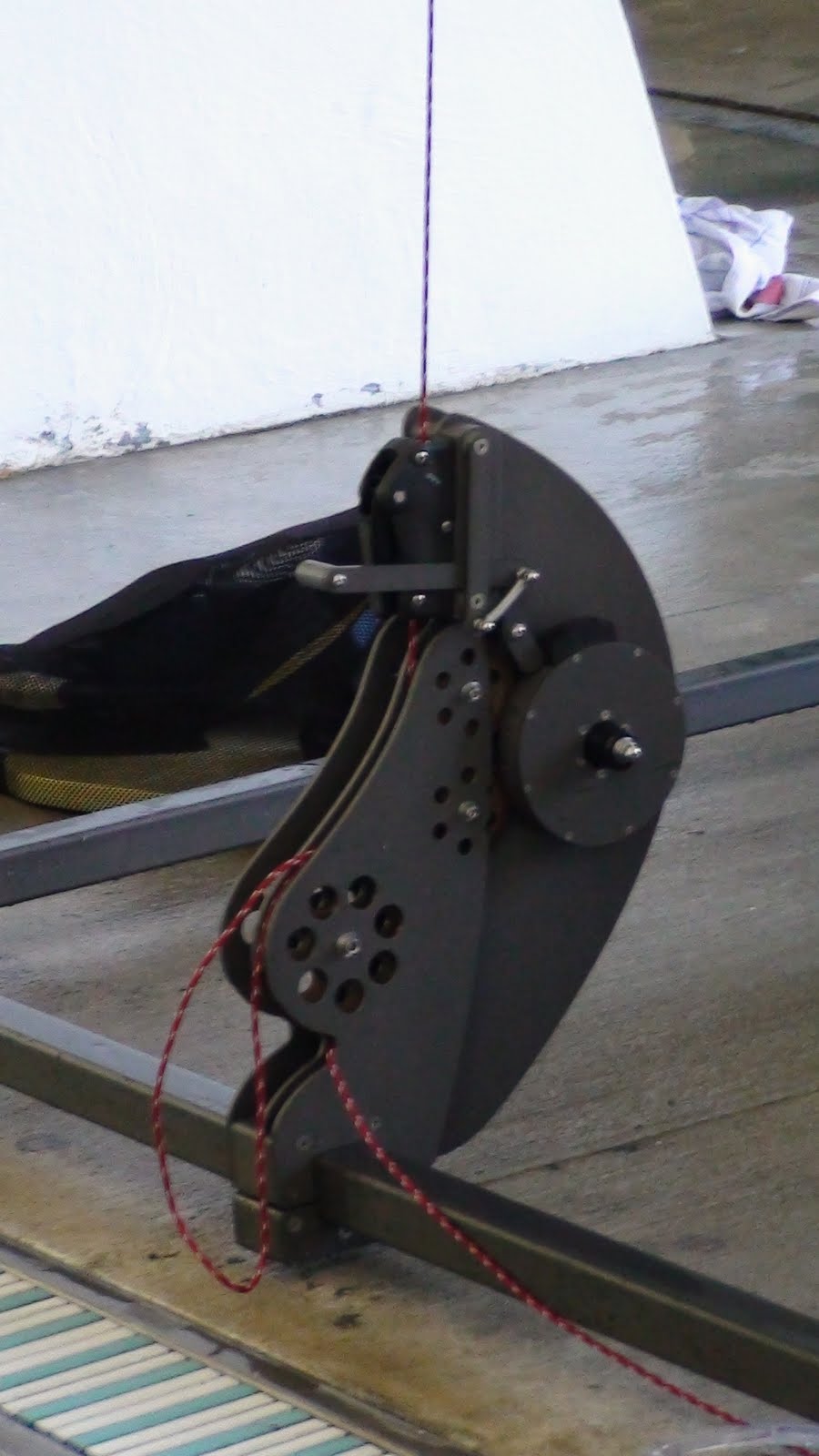
Sunday I was at the pool in Huntersville, NC for our Senior Champs and watched Nick Brunelli training on this beast. I had been looking at it sitting in the corner all weekend, wondering if it really was what it seemed. It’s a Power Tower on steroids, with the capability of providing assistance or resistance over 50 meters. Brunelli was eager to tell me about it when I asked. Apparently there are only 3 in existence right now–this one, one in Fullerton, CA with Sean Hutchison’s Center of Excellence group, and one at Arizona State (Brunelli’s alma mater and the home of the inventor). Brunelli said that it is vastly improved over the Power Rack, Power Reel, and Power Tower for a few reasons:

1) You can use it over 50 meters. Brunelli said it can pull him to a 21-second LCM 50 free.
2) It is made of military spec hard-anodized aluminum and FAA-Approved pulleys. The inventor is a metal fabricator in Tempe. Believe the hype when it comes to quality. The cable glides so smooth and with so little apparent friction, it makes the Power Tower look like someone’s 5th grade science project.
3) Very constant resistance and assistance. Unlike previous power training equipment, Brunelli said he feels very little “bounce” in between strokes. The forces are very smooth and steady. I am guessing this is due to the quality construction and the number of pulleys involved (I counted 15).

A few other observations:
1) The rocket on top is just for show. It houses the top pulleys, but those fins are merely for coolness.
2) The blue tube you see is the draining hose. The bucket is 60 gallons (HUGE!) yet drains easily through this and a secondary smaller tube.
3) There is an Inertia Safety Clutch built into the lower pulley system. This comes in handy if the belt happens to come off, and it can also be manually locked if you are 50m away and simply want to rest without clinging to the wall.

So I was impressed initially with the Rocket Tower. It is still in its infancy, but you can check out their website.

Back and Free Sprint Set

Ryan Woodruff, North Carolina Aquatic Club
coachryan@ncacswim.org

WARMUP W/ SNORKEL – FREESTYLE

30 X 100 @ :10 REST

                #1 – 50 STREAMLINE FACE DOWN KICK/50 FISTS DRILL

                #2 – 50 KICK ON SIDE/ 50 CATCHUP

                #3 – OVERKICK AND CATCHUP


BACKSTROKE

50 – 3 SCULLS/3 STROKES DRILL @ :10 REST

3 X          200 SWIM RACE PATTERN (FOCUS ON UNDERWATERS AND TURNS) @ :20 REST

                4 X 25 @ :30   12.5 YDS SPIN DRILL/ 12.5 YDS EZ SWIM


POWER TOWER SET –


6 X 75 BACKSTROKE  @ 1:45  FAST GOING OUT, EZ COMING BACK IN

200 EZ FREESTYLE B3– NO BELT

6 X 50 BACKSTROKE @ 1:15  5+ YARDS KICK, 20 YARDS BUILD/25 EZ BACKSTROKE

200 EZ FREESTYLE B3 – NO BELT

6 X 25 ALL OUT SPRINT BACKSTROKE @ :40

200 EZ FREESTYLE B3 – NO BELT

Fly On the Wall

Ryan Woodruff, North Carolina Aquatic Club
coachryan@ncacswim.org

SCY Here’s a fantastic fly set that will get the swimmers going fast while preserving technique and motivation for the end. They will spend some time on the wall, however.
Use the Goal Pace Spreadsheet to determine P100 (100 race pace)times.

100 x 25 @ :30
For the first 96, do the following 8x:
#1-5 drill (#1 – 3R-3L-3cycles, #2 – w/br kick, #3 – w/flutter kick, #4 – clap drill, #5- triple kick drill)
#6 – Swim at P100
#7-9 Swim smooth at race cycle count
#10 – Fast swim at P100
#11 – easy kick on back
#12 – Fast swim at P100

#97 – 100 are all fast swim at P100

Configuring the 25s as I have listed above will allow the coach to stay at one end of the pool and time every race-pace 25.

Gettin’ Goin’ with Rowan

Matt Hall, Rowan Aquatic Club

This is the main set only – takes about 90 minutes.  First time through is freestyle, rounds 2 & 3 are choice stroke.


3 X (10 x 100 SPRINT off of the blocks)

what to do

within best time

interval

2x kick

20 seconds

2:30

2x 75 kick/25 sprint

16 seconds

2:40

2x 50 kick/50 sprint

12 seconds

2:50

2x 25 kick/75 sprint

8 seconds

3:00

2x sprint

4 seconds

3:10

200 EZ on 4:40


The Finisher

Ryan Woodruff, North Carolina Aquatic Club

This set makes a good practice finisher. After a long hard set, it gets them going fast, swimming hypoxically, and working together to build some team unity.

Divide the swimmers into groups, ideally a number that can all swim side-by-side for a 25. All swimmers will swim a no-breath 25 freestyle, and one swimmer will be chosen by the coach to swim FAST no breath and given a time to beat. If that swimmer achieves the time AND all other swimmers in that group make the 25 without breathing (time doesn’t matter), the group earns a point. Repeat the exercise with each group until they earn 5 points (or any number you set). When a group gets their 5 points, they are free to go. The 25s can be done from a push or off the blocks.

The 12 Sets of Christmas

Ryan Woodruff, North Carolina Aquatic Club
coachryan@ncacswim.org

“At Christmas, train hard with vigor and cheer, for Christmas comes but once a year.”
– Anonymous swim coach

This workout takes approximately 2 hours and 45 minutes

1 X 900 WARMUP CHOICE – OPEN TURNS, 4+ D-KICKS EVERY WALL @ 13:00

2 X 25 @ :50 at P100

3 X 700 FREE PULL-300 B3/100 B7/300 B3 @ 8:10 8:30 8:50
(PADDLES, BUOY)

4 x 25 @ :50 at P100

5 x 500 IM @ 6:40 7:00 7:20
(#1- 200 FLY, #2-200 BACK, #3-200 BREAST, #4 – 200 FREE, #5 – STRAIGHT IM)
6 x 25 @ :50 at P100

7 x 300 FREE ODD — 100 6-3-6/100 CATCHUP/100 OVERKICK @ 3:50 4:05 4:20
EVEN — DESCEND @ 3:30 3:40 3:50

8 x 25 @ :50 at P100

9 x 100 @ PRIME 1-3 BY 5+ SECONDS FLY & BK @ 1:25, BREAST @ 1:30

10 X 25 @ :50 at P100

11 x 50 @ 1:00 CHOICE – FAST TURNS & PERFECT FINISHES

12 X 25 @ :50 at P100

10,050y

Hypoxic from Utah

Dani Caldwell
St. George, Utah

 
Here is one of our favorite hypoxic workouts — it’s not much yardage, but it does the job and the kids like it.
 

4 x 25 FR @:45 – NO BREATHERS

4 x 75 FR @2:15, taking two breaths per length, at same locations each 25 (helps if you do kick counts and SL!)

4 x 25 CH @:45 – NO BREATHERS (No Backstroke, for obvious reasons)

4 x 75 CH @2:15, taking two breaths per length (3 for BR), at same locations

4 x 25 FR @:30 – NO BREATHERS


Twenty Ways to Do 20 x 25 – #14

Ryan Woodruff, North Carolina Aquatic Club
coachryan@ncacswim.org

#14 – Fun with Streamline Sticks

You’ll need four lanes to do this. Position one set of Streamline Sticks in each lane in such a way that the swimmers swim a “snake” pattern – down the pool in lane 1, back in lane 2, down in lane 3, back in lane 4.

Lane 1 – Streamline Sticks at 5 yds
Lane 2 – Streamline Sticks at near 15 m mark (about 7.5 yards from the wall)
Lane 3 – Streamline Sticks at 12.5 yards
Lane 4 – Streamline Sticks at 15 m

20 x 25 @ :30
Do freestyle, backstroke, or freestyle in groups of 4 x 25 at a time. Descend 1-4.
#1 – in lane 1
#2 – in lane 2
#3 – in lane 3
#4 – all out fast in lane 4

After #4, take an additional 30 seconds rest to migrate back to Lane 1.

Sprint 25s with Curl-Burke

Ryan Woodruff, North Carolina Aquatic Club
coachryan@ncacswim.org

Lately, I have enjoyed reading “Reach for the Wall,” Washington Post writer Paul Tenorio’s blog about training with the Curl-Burke Swim Club and Coach Jeff King. As a coach, it is interesting to hear what the workout feels like from his perspective. Thursday he wrote about one of Coach King’s sets which I have written below:

Warmup 700 (100 IM order)

200 swim
200 kick
2 x 25 sprint swim
175 swim
175 kick
3 x 25 sprint swim
150 swim
150 kick
4 x 25 sprint swim
125 swim
125 kick
5 x 25 sprint swim
100 swim
100 kick
6 x 25 sprint swim
75 swim
75 kick
7 x 25 sprint swim
50 swim
50 kick
8 x 25 sprint swim
25 swim
25 kick
9 x 25 sprint swim

Thanks for sharing, Paul!

The Guessing Game (For Sprinters)

Ryan Woodruff, Lynchburg YMCA

The concept here is similar to yesterday’s post – The Guessing Game. For a sprint or non-freestyle version of the Guessing Game, I like to do 50s, and have the swimmers guess within a 0.2-second range. They also have to be within a certain range (like 4 seconds) from P200. I use the same points system as in the regular Guessing Game.

I actually had a swimmer recently who guessed his 50 time to the one-hundredth of a second exactly on his first one. He was thus done with practice and the rest of his teammates seethed.

Give it a try and let me know how it goes!