Ryan Woodruff, Lynchburg YMCA

Free Swimming Workouts, Sets, Ideas, and Dryland Exercises from Professional Coaches Around the World
Ryan Woodruff, Lynchburg YMCA
Ryan Woodruff, Lynchburg YMCA
Ryan Woodruff, Lynchburg YMCA
SCY
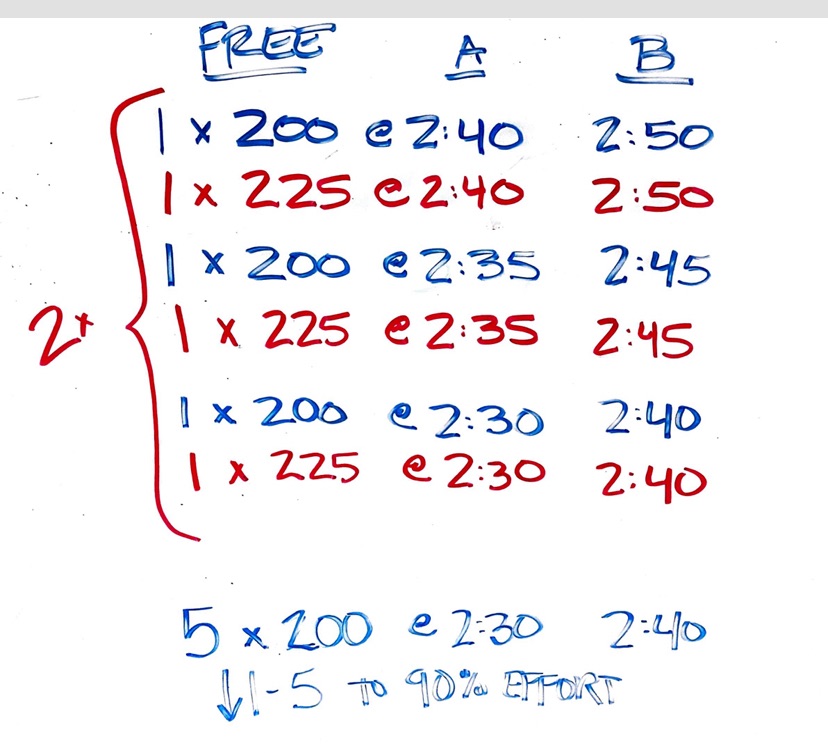
This was our biggest set on a recent Saturday morning. The instructions were the same for the 50s all the way down through the set. The A-B-C intervals represent different lanes/levels of swimmers in our practice. “MIN CT” = minimum cycle count.
Ryan Woodruff, Lynchburg YMCA
SCY.
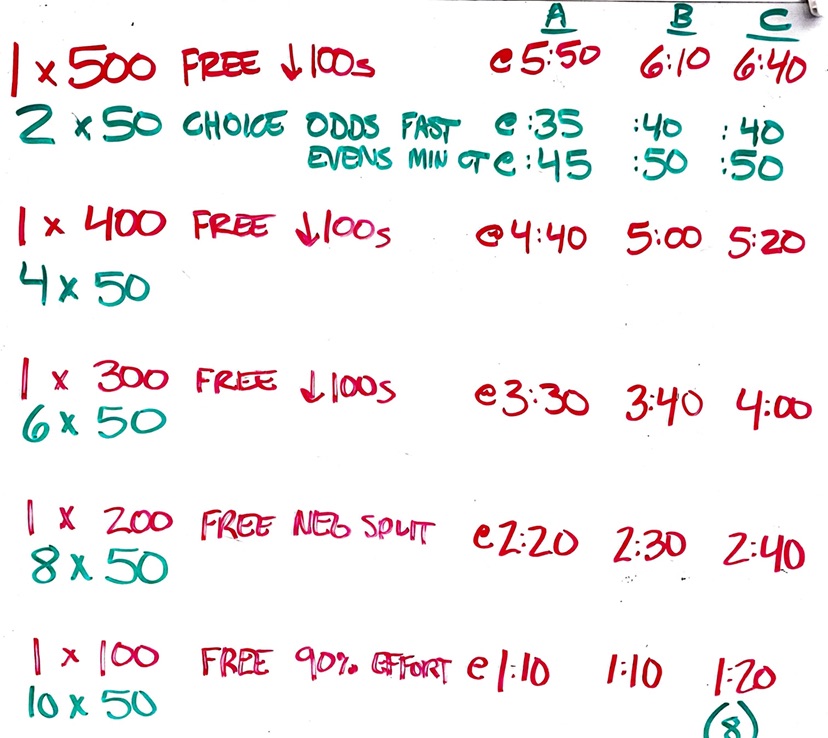
On the 200s, steady medium effort with focus on underwater kicks. On the red descend parts, stick with a stroke for 3 swims in a row.

Ryan Woodruff, Lynchburg YMCA
SCM
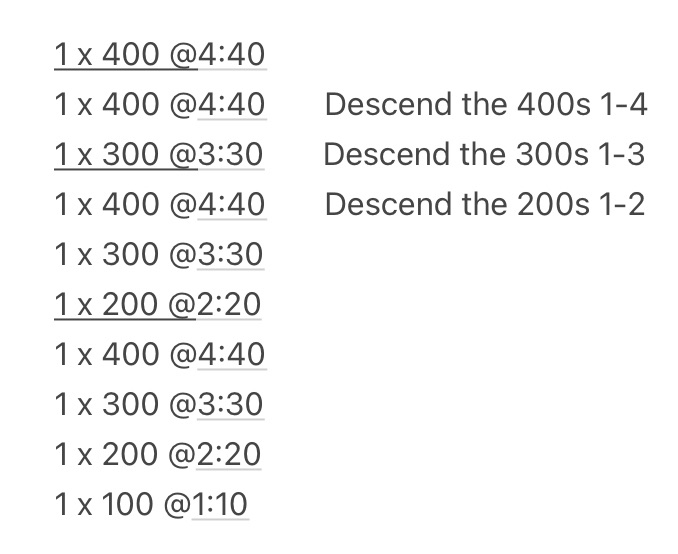
Within each descend set, we aimed to descend to a slightly faster time each time.

Ryan Woodruff, Lynchburg YMCA
The broad aim of this set was to give our group (that has a wide range of speeds for middle-distance swims) a challenge to push themselves on the 400 while still getting some recovery/drill/technique work in. We timed the 400s and then swimmers would start right into the fartlek (continuous swimming). After 5-7 minutes of the fartlek, I would verbally stop the group and we would rest a minute before starting the next 400. FPA = fastest possible average. K.O.S. = Kick on Side

Ryan Woodruff, Lynchburg YMCA
SCM
The 400s here got down to a challenging interval by the last one. The sets of 4 x 100s in between were on moderate interval. Just getting good work in. The two columns represent an A and B interval within our group.

Ryan Woodruff, Lynchburg YMCA
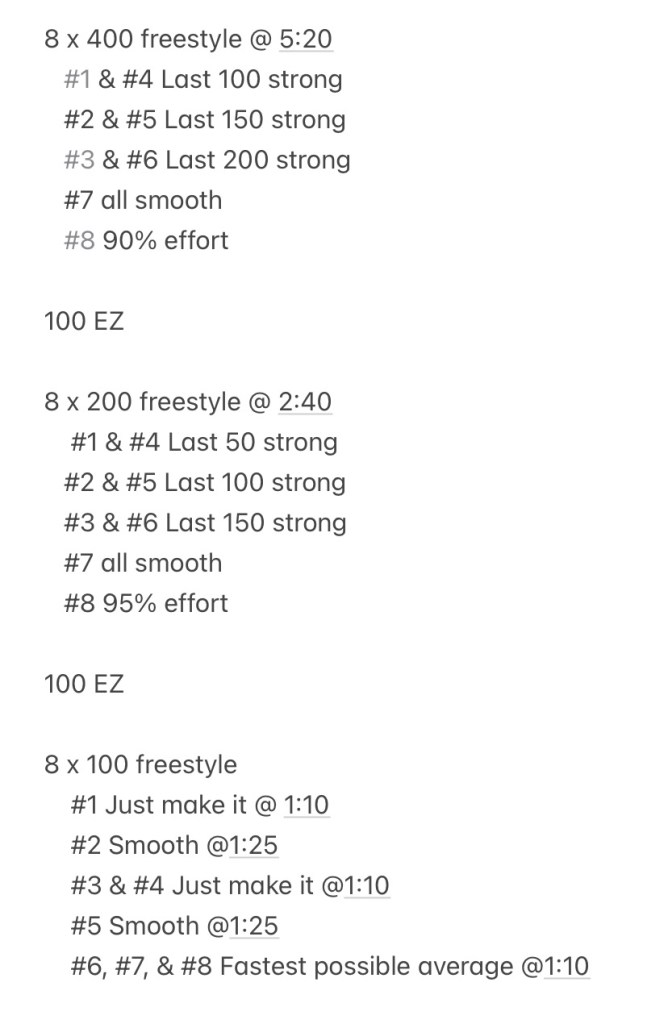
SCM. For the 400s and 200s, swimmers were instructed to do an open turn before the “strong” part to check the clock and get their split. The emphasis is always on being fast at the end of each repeat and the end of the set.
Ryan Woodruff, Lynchburg YMCA
SCY
Ryan Woodruff, Lynchburg YMCA.
We did this set on a day where we had less pool space than ideal and needed to get a good solid set for the various different specialties in our group.
This set was in a 25m pool. Intervals were the same for everyone.

Ryan Woodruff, Lynchburg YMCA

How a coach presents a set can have large implications in how it lands for the swimmer. In this particular case, the way the set is revealed is key. This set was given to the team in parts. At first, I told them just about the 10×100 and 1 x 150. Then, after we calculate their paces, I gave them the second part and challenge them to go faster. We did the second part, then we calculated their paces and revealed the 3rd part and challenged them AGAIN to go even faster. We could keep going, but the slow reveal effect starts to go away after the 3rd part. In total, this was an excellent set for our crew in terms of pushing themselves to go faster than they thought they could.
Ryan Woodruff, Lynchburg YMCA
We have had many posts on this blog using the “Golf” concept (adding seconds swum and cycles taken over a distance and aiming for a lower score). Here is a twist to that concept focusing on underwater dolphin kicking
6x (1x 100 back, fly, or free + 1 x 50 EZ) @ 3:00
On the 100s, get your time and then SUBTRACT the total number of dolphin kicks that you took in the 100. Calculate your score during the EZ 50. Give a high level of effort on the 100 and aim for a lower score each time.
Example:
Swimmer goes 1:08 in the 100 back and took 7 dolphin kicks off each wall (28 total), the golf score would be 40.
68 seconds – 28 dolphin kicks = 40
Ryan Woodruff, Lynchburg YMCA
Some old-fashioned distance work today. This was for two of our distance swimmers who are about 30 seconds apart in their best times. One went 500s and the other went 450s. Worked out pretty well for both on this set. Base paces for each distance are in parentheses.

Ryan Woodruff, Lynchburg YMCA
SCM. We aimed to hit a range of speeds and improve our self-awareness of our pacing.

Ryan Woodruff, Lynchburg YMCA
SCY
Progress through the sets 1 through 6 in order with the extra :30 rest after each set. The interval pattern in this set is suitable for an athlete with a threshold pace around 1:00.

Ryan Woodruff, Lynchburg YMCA
We did this set in a 25m pool with an eye toward our 200 free best times in SCY.

The goal on all the 150s (in meters!) is to be faster than our best SCY 200 free times. That was not a major challenge on the 1 x 150 and 2 x 150, but it becomes a significant challenge by the time you get to 4 x 150 and 5 x 150.
We did three different intervals, with swimmers’ best time indicated at the top. Swimmers with best times under 1:45 went on 2:00. Swimmers with best times between 1:45 and 2:00 went on 2:10, and swimmers with bests slower than 2:00 went on 2:20.
In between, we did 3 x 100 the same way each time – #1 holding a tennis ball in each hand, #2 doing “Paddlehead” drill, and #3 using paddles, holding them against our forearms.
At the end of the set, we did an easy 100 and finished with a SURPRISE challenge – a fast 175m freestyle swim with fins and paddles with a goal of beating our best 200 yard times.
Overall, the set was highly successful. Most of our swimmers were making the 150s under their best, and a handful made the 175 goal. High levels of effort were pretty common across the group.
Ryan Woodruff, Lynchburg YMCA
SCY
Did this one for a set that allowed swimmers of varying abilities flexibility to choose their level of difficulty. Kept everyone on the same interval. This works best with three or fewer swimmers in a lane.

Ryan Woodruff, Lynchburg YMCA
SCY
For this set, we divided the group into swimmers with more of a distance focus and other who are more sprint/stroke-focused. The set provided a good challenge and kept things simple with a consistent interval.

Coach Ila Nathanson, Arlington Muskies Swim Team, Arlington Heights, IL
Coach Gwynn Harrison, Bridgewater College
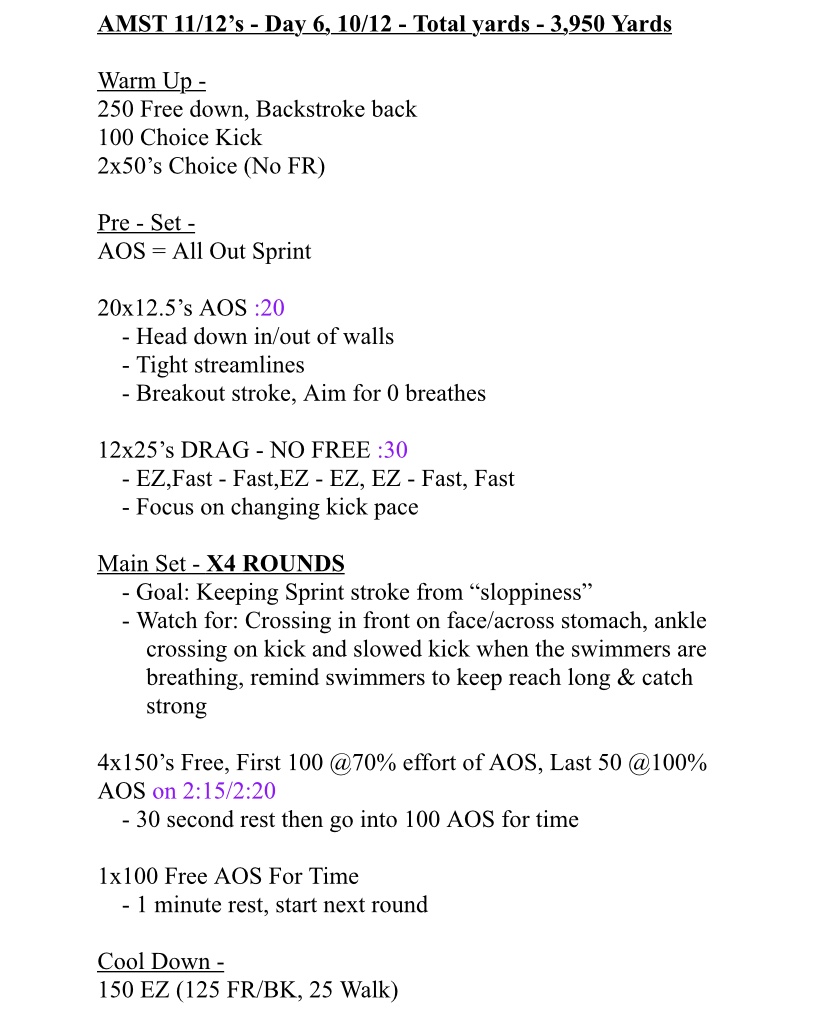
We did this set in a 25m pool, so note send-offs and goals.
5 x 500 (broken into):
175 – within 10 seconds of goal 200 time in yards…
25 Easy
75 – 3+ seconds under goal 100 time in yards…
25 Easy
Dive 100 – Goal: take out of your 500 free…
50 Easy REGROUP – about 1:00 between sets
Be sure to check out Coach Harrison’s Short But High Intensity Free Set that we posted yesterday.
Coach Gwynn Harrison, Bridgewater College
We did this set in a 25m pool, so note send offs and goals.
6 x 250 (broken into):
75 – on 1:15 4 dolphin kicks off first wall, 6 on 2nd, 8 on 3rd
75 on :55 – Make the Interval
75 – Push (male goal under 45 – most went 46-48) (female goal – under 52, most went 54-55)
25 – Easy, REGROUP, about :45 between sets
*this was coach send to restart, they got about :45 rest in between rounds.
Brayden Rigby, Cache Valley Marlins (Utah)
I thought I’d share my favorite freestyle sprint set. We usually do the 200’s in groups to allow swimmers a bit more rest. Short course yards, 1800 yards total.

Ryan Woodruff, Lynchburg YMCA
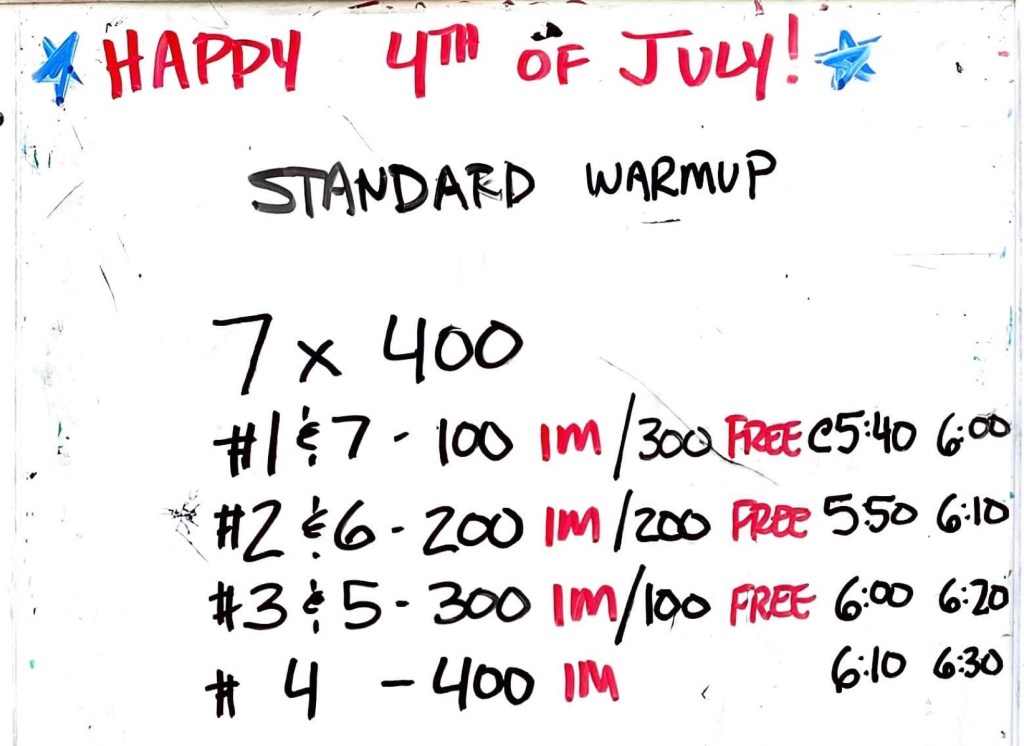
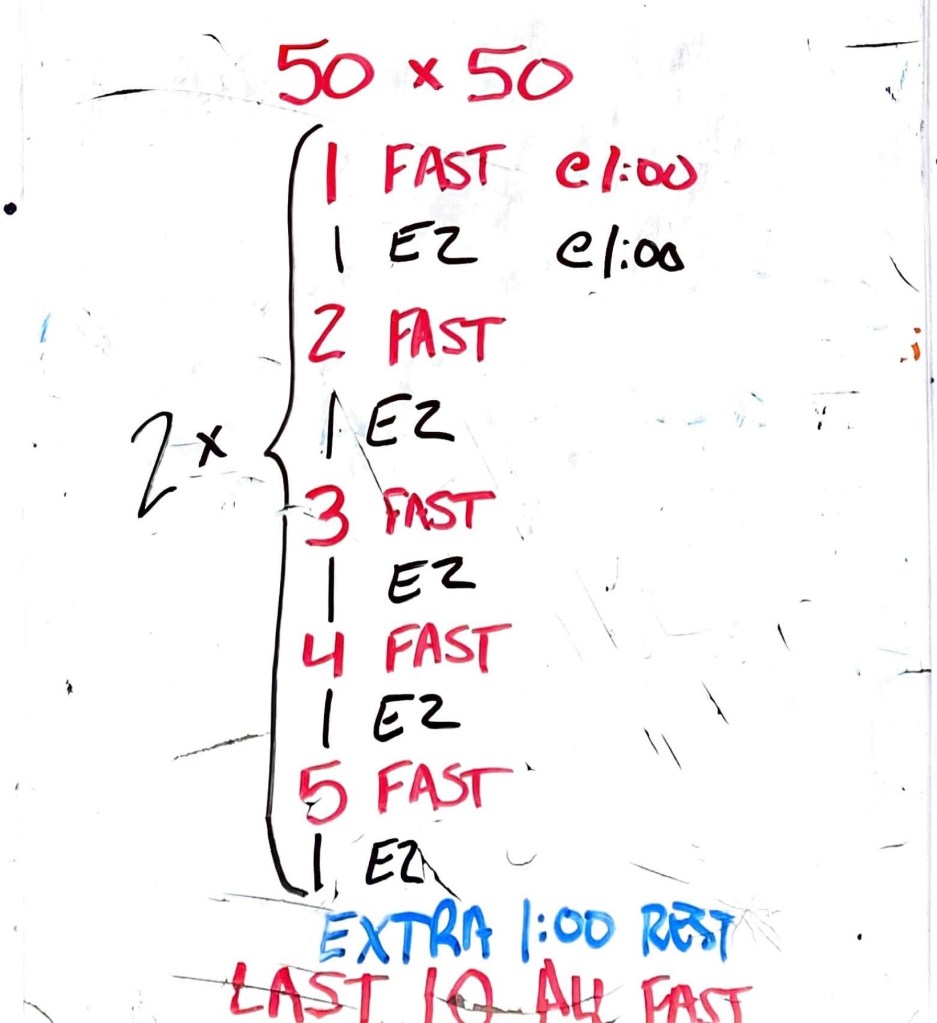
LCM. Here is the practice that we did last year on the 4th. 7 x 400 (for 7/4) and 50 x 50 to celebrate the 50 states. The last ten 50s are all fast.
Ryan Woodruff, Lynchburg YMCA
SCY
Instructions on the 400s were to keep it steady and make the interval by :10+. Intervals for 200s are a bit faster with instructions to push the pace. 25s are to maintain an underwater focus under fatigue. A,B,C intervals for 400s and 200s. For the 25s, A group does 8, B group does 6, C group does 4, allowing us to stay pretty close together on the set.

Ryan Woodruff, Lynchburg YMCA
SCY

Ryan Woodruff, Lynchburg YMCA

Ryan Woodruff, Lynchburg YMCA
SCM
At the beginning of my career (20+ years ago), I would have my team do a T-30 test multiple times per season. Since that time, I have gradually moved away from long steady paced swims such as that. The set below is the kind of thing I am more likely to do now. Each of the timed sets is “As Many Rounds As Possible” (AMRAP) with a set distance and rest to repeat. The amount of rest scales down with the distances, which allows for a pretty direct comparison of pace as the times decrease. We recorded each swimmer’s distances (to the nearest meter) on a dry erase board for all to see. As the time was cut in half, swimmers were urged to exceed 1/2 of their previous distance on the next swim. The 5:00 swims in between allowed for recovery and emphasis on technical reminders. Overall, it was a successful set with high levels of effort and engagement!

Ryan Woodruff, Lynchburg YMCA
SCY

Ryan Woodruff, Lynchburg YMCA
I’ve posted before about The Guessing Game and The Guessing Game for Sprinters.
Tonight we tried the guessing game with a new twist: Elimination.
We had 12 swimmers in the pool near the end of practice. Everyone swam a 100 free (any speed) and immediately had to guess their times. Top 3 swimmers who guessed closest to their actual time got to climb out and go home. Everyone else swam again and repeated the process. Incredibly, in order to be in the top 3 in the first round, a swimmer had to guess within 0.8 seconds. Similar results happened in subsequent rounds as the group sharpened their skills. One swimmer managed to finish 4th in both the first and second rounds.
The final three swimmers had the task of cleaning up the deck (equipment, etc.) before leaving.
Overall, it was a fun (and agonizing for some) way to finish practice.
Ryan Woodruff, Lynchburg YMCA
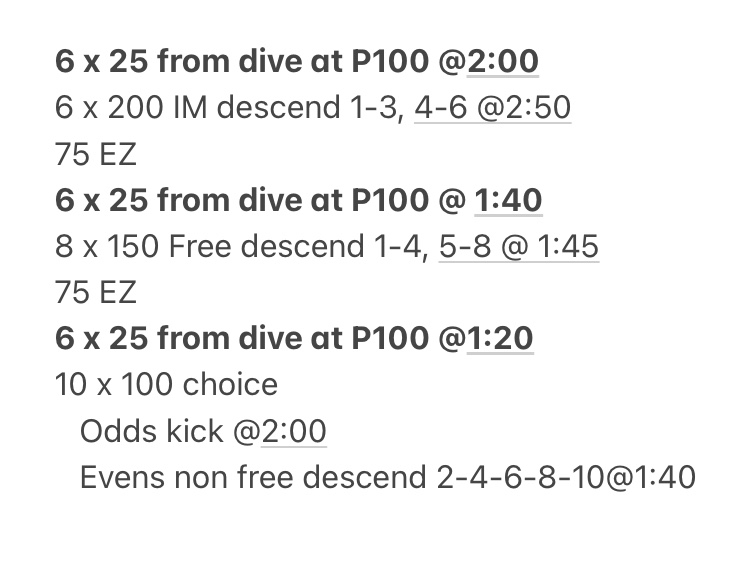
This one has a little bit of everything.
 The Swimming Wizard