
I.M. Warmup
Free Swimming Workouts, Sets, Ideas, and Dryland Exercises from Professional Coaches Around the World
Coach Ryan Woodruff, Lynchburg YMCA
SCY
This set was seeking a very specific pattern of pacing on each 600, as indicated by the line graph for each one. Failure to split it correctly meant repeating that 600. To interpret…
1 – 300 at a consistent pace, 300 at a faster pace, also consistent
2 – 3 x 200 descend, each one at a consistent pace
3 – 2 sets of 3 x 100 descending
4 – 4 x 100 descend + 200 fast and consistent
5 – 3 x 100 descend + 300 fast and consistent
6 – 2 x 100 descend + 400 fast and consistent
The second picture shows how it turned out for our swimmer, with splits written next to each graph. We had to do the first 600 twice due to some early set rusty-ness. Splits for the first of those two are not included.


Ryan Woodruff, Lynchburg YMCA. Simple competition. Print out best time splits ahead of time and start racing.
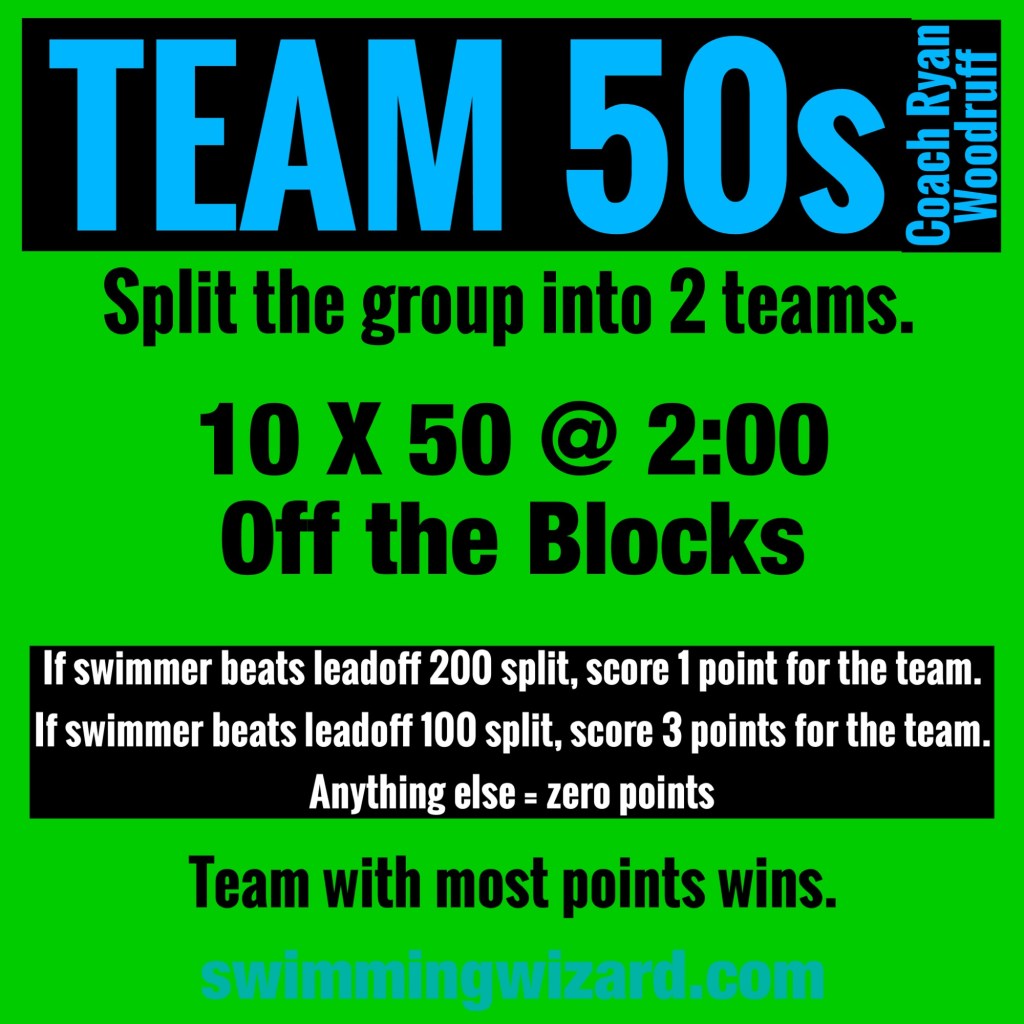
Ryan Woodruff, Lynchburg YMCA.
SCY.
Lock in excellence through repetition at decreasing amounts of rest.

Ryan Woodruff, Lynchburg YMCA
SCY
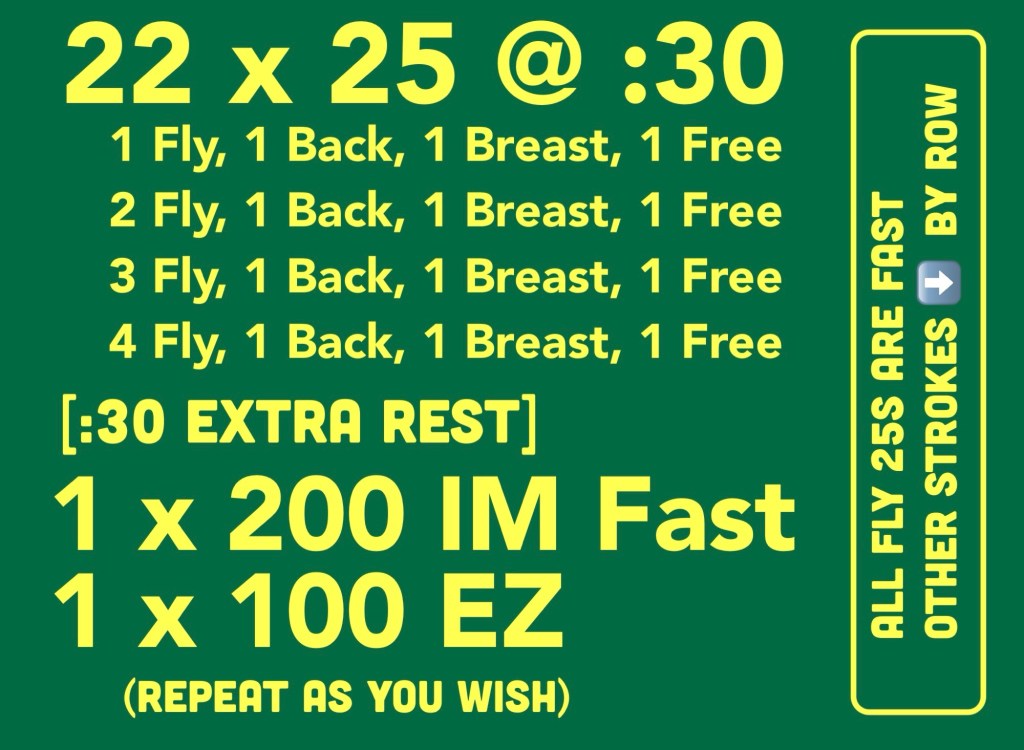
Ryan Woodruff, Lynchburg YMCA
SCY

Ryan Woodruff, Lynchburg YMCA
SCY
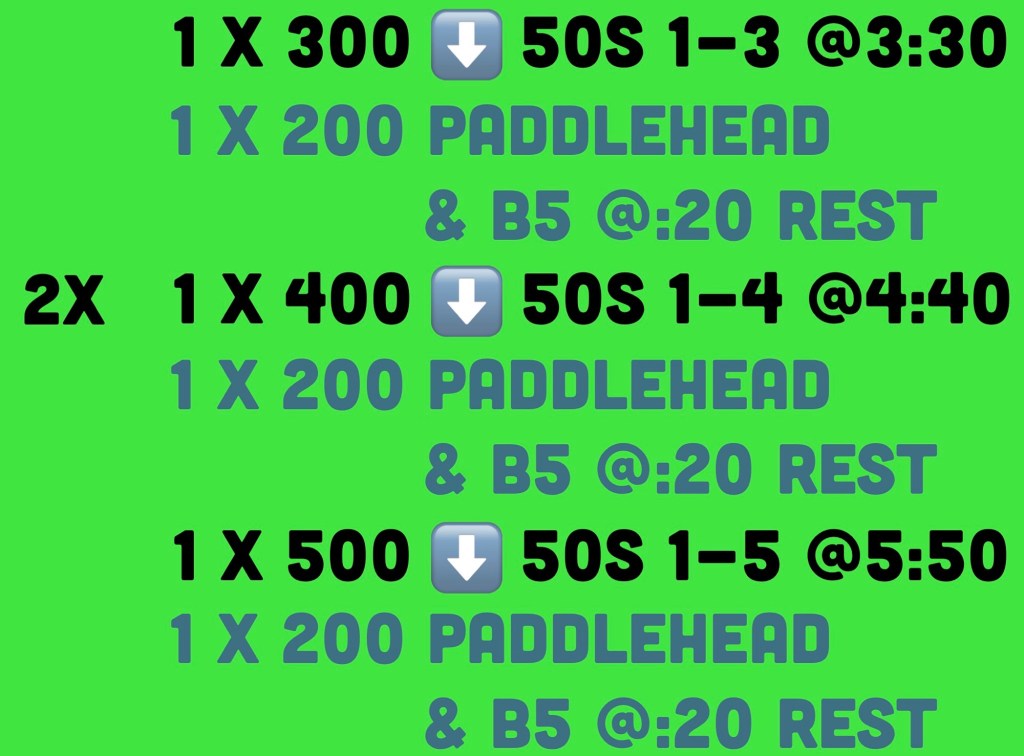
Ryan Woodruff, Lynchburg YMCA
SCY. This set really brought on the burn. FPA = Fastest Possible Average. JMI = Just make it. Initially, the 7 x 50 were not written on the board and then were added during the 2nd 200 scull/swim by 25. This added a surprise challenge that they excelled at.

Ryan Woodruff, Lynchburg YMCA
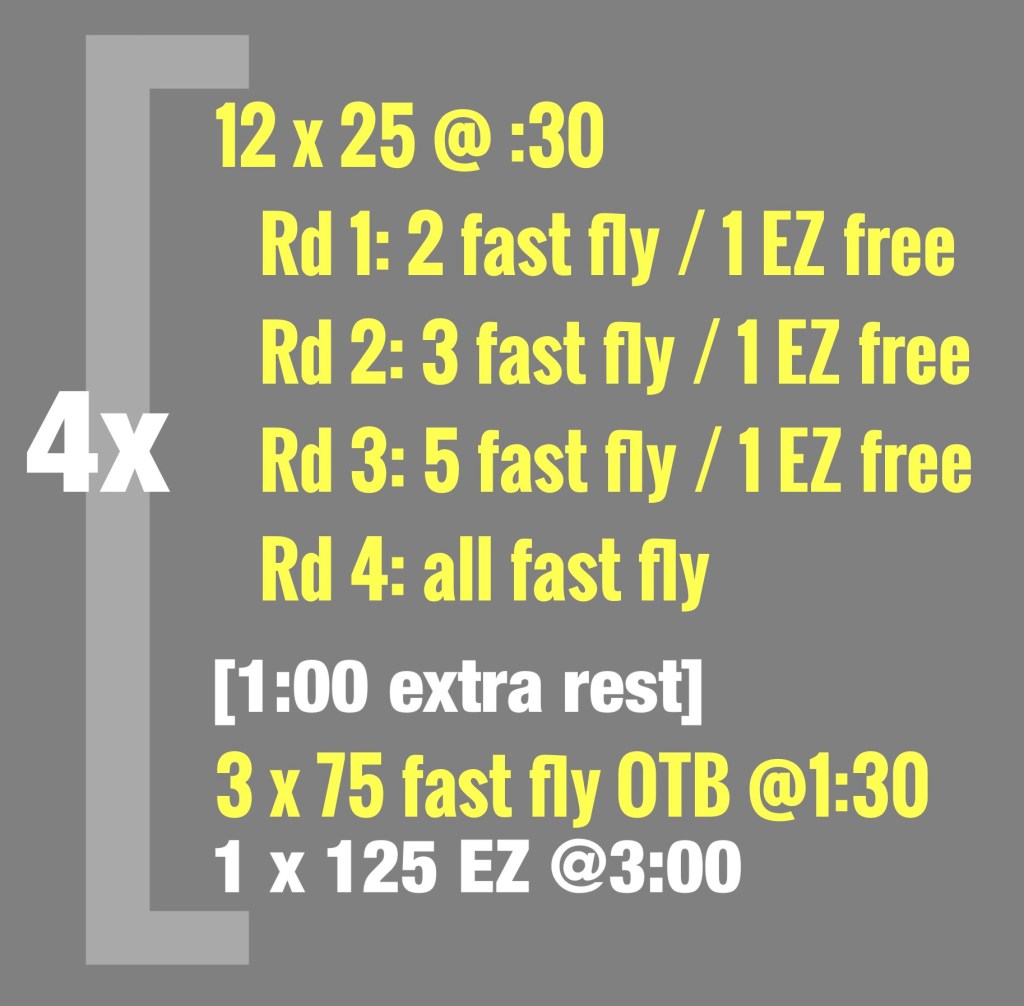
Ryan Woodruff, Lynchburg YMCA
SCY

Ryan Woodruff, Lynchburg YMCA
SCY
We use 1-gallon painter’s buckets attached to a waist belt via 4 feet of rope. Resistance training on a small budget.

Ryan Woodruff
Several years ago, I was coaching between 12 and 20 swimmers at practice by myself, and I was looking for a way to time a series of 25s off the blocks. I wanted a system that could provide an audible “take your marks” command followed by a starting beep and repeat exactly 10.00 seconds apart. This would allow me to stand at the opposite end of the pool and accurately time the swimmers coming to the wall without having to verbally start each successive group. Below are the instructions for you to replicate the system I created.
I used a free iPhone app, a Bluetooth speaker, and my iPhone to create a system to make me a more efficient and accurate coach when we do quality sets.
First — the app. It is called IntervalTimer and is available for free in the iPhone App Store. I don’t know if it also exists for Android.
Next, I got a Bluetooth Speaker. There a lot of options available. I used the Ion Pathfinder Rugged Bluetooth Portable Speaker and set it where it won’t get wet. If you get a waterproof one, it works to set it between the starting blocks. My speaker was able to connect to my phone from over 50m away, which was helpful for long course season.

In the app, I created a timer using the HIIT template. I created 2 intervals – one called “Go” and one called “Take Your Mark.” I also chose to do 3 sets (you can choose whatever number you like), toggled “Repeat” to ON, and set it for “x100”. This creates a loop that would do starts for 50 minutes non-stop, more than long enough for most of our quality sets. Make sure you have all the settings as I have it pictured.

When setting up “Go”, and “Take Your Mark,” I set the sound settings as pictured below.
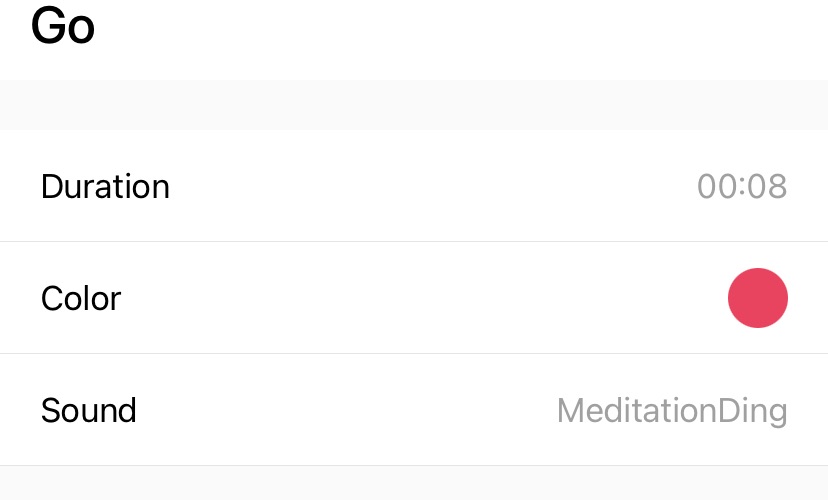

These settings show a countdown from :08 to :00, at which time the app says “Take your marks” and two seconds later sounds a loud “ding” sound.

A few final tips for usage:
If you use this system and have any questions or feedback, please let me know at swimmingwizard@gmail.com.
Ryan Woodruff, Lynchburg YMCA
SCY

Ryan Woodruff, Lynchburg YMCA
SCY
This one is a twist on yesterday’s post. The challenge hits a little faster in this one.

Ryan Woodruff, Lynchburg YMCA
SCY
Swimmers can choose their stroke on the 175s, but kept it the same for 3 x 175s in a row. The goal on each 175 is to beat your best 200 time. This isn’t a huge goal for 1, but as fatigue starts to accumulate, this set becomes more difficult.

Ryan Woodruff, Lynchburg YMCA
SCY
We used stretch cords for this one. The 4-cycle sprints were done with the belt attached to a cord with a teammate holding the cord for resistance. They would quickly move to the outside lane for an assisted 25 with teammates pulling each other on the cord. As soon as possible after the assisted 25, we started the 75 off the block (OTB). We got some excellent performances on the 75s.

Ryan Woodruff, Lynchburg YMCA
SCY

Ryan Woodruff, Lynchburg YMCA
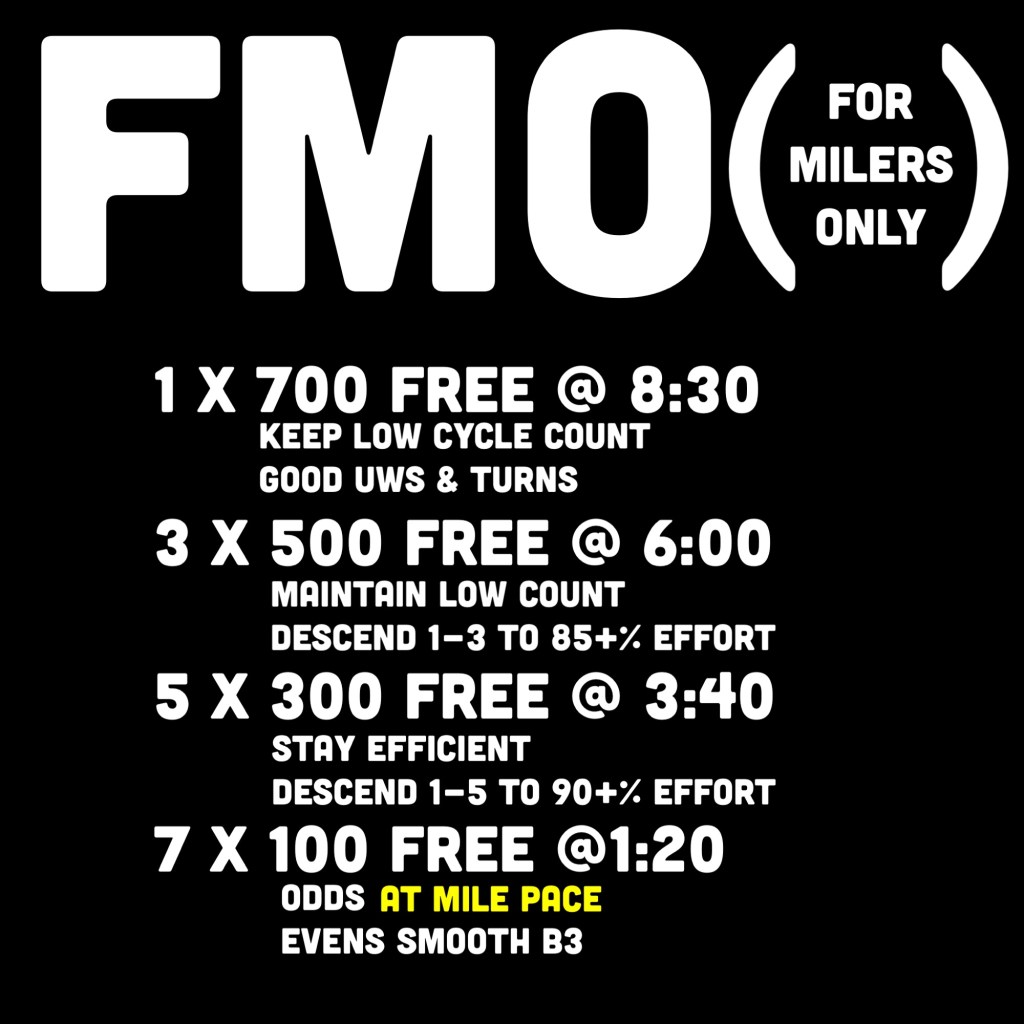
Set for just the distance squad. SCY. Intervals are for a group that is sub-17:00 for the 1650.
Ryan Woodruff, Lynchburg YMCA
3K1P = Breaststroke drill where swimmer does 3 kicks for every 1 pull. 2 x pullouts = do 2 pullouts off every wall.

Ryan Woodruff, Lynchburg YMCA
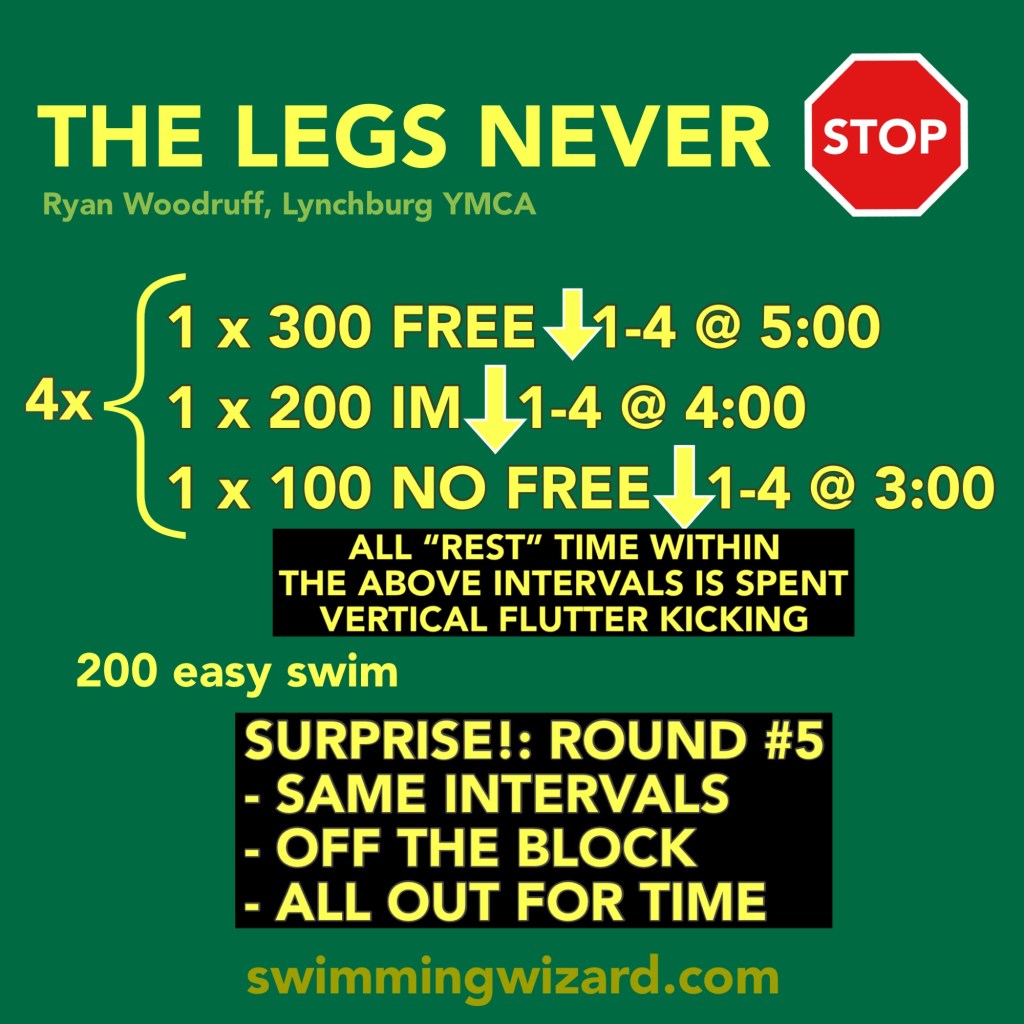
No real rest through this whole set…as soon as swimmers come to wall, they vertical flutter kick until the interval comes up. SCY.
Ryan Woodruff, Lynchburg YMCA
SCY
Ryan Woodruff, Lynchburg YMCA
This set gave us some work on the front half of the IM, specifically descending the backstroke coming off the fly. The next time we do something like this, I will probably add a bit more fly. The last part of the set served as a little speed work before a quality set to finish practice.

Ryan Woodruff, Lynchburg YMCA
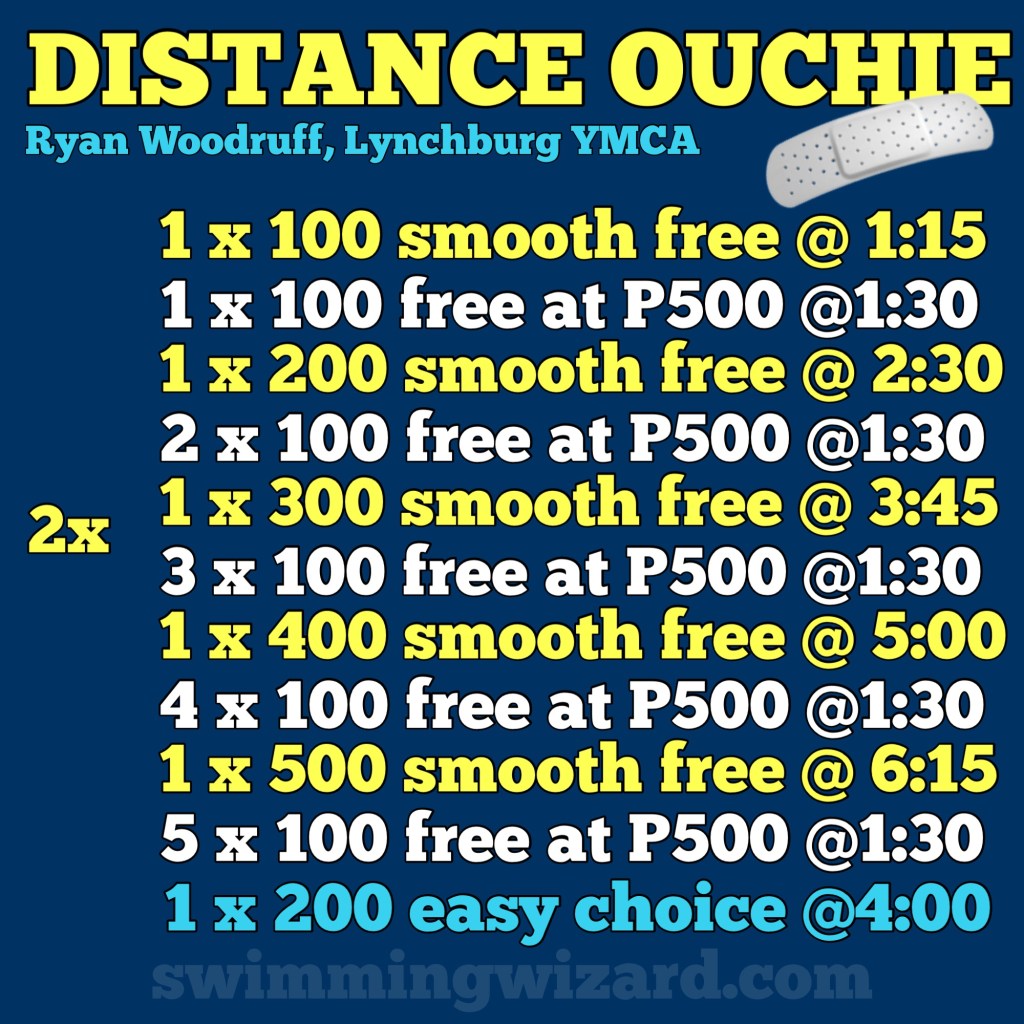
This one hurts. A meat-and-potatoes kind of distance set. SCY.
P500 = 500 pace
Our crew that went on this interval has best 500 times ranging from ~4:40 to ~5:00. We didn’t make P500 the whole way, but several came close.
Ryan Woodruff, Lynchburg YMCA
Our breaststroke group had a solid day with this one.

Ryan Woodruff, Lynchburg YMCA
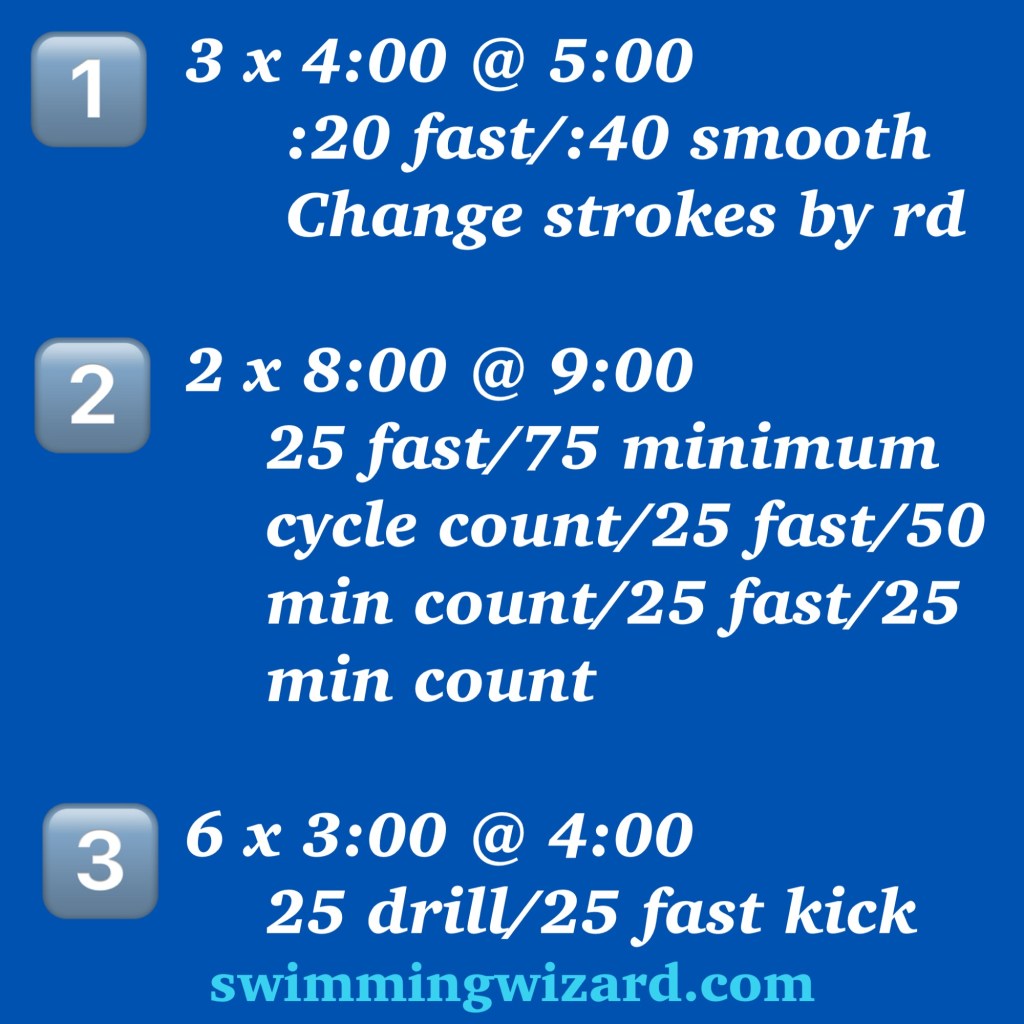
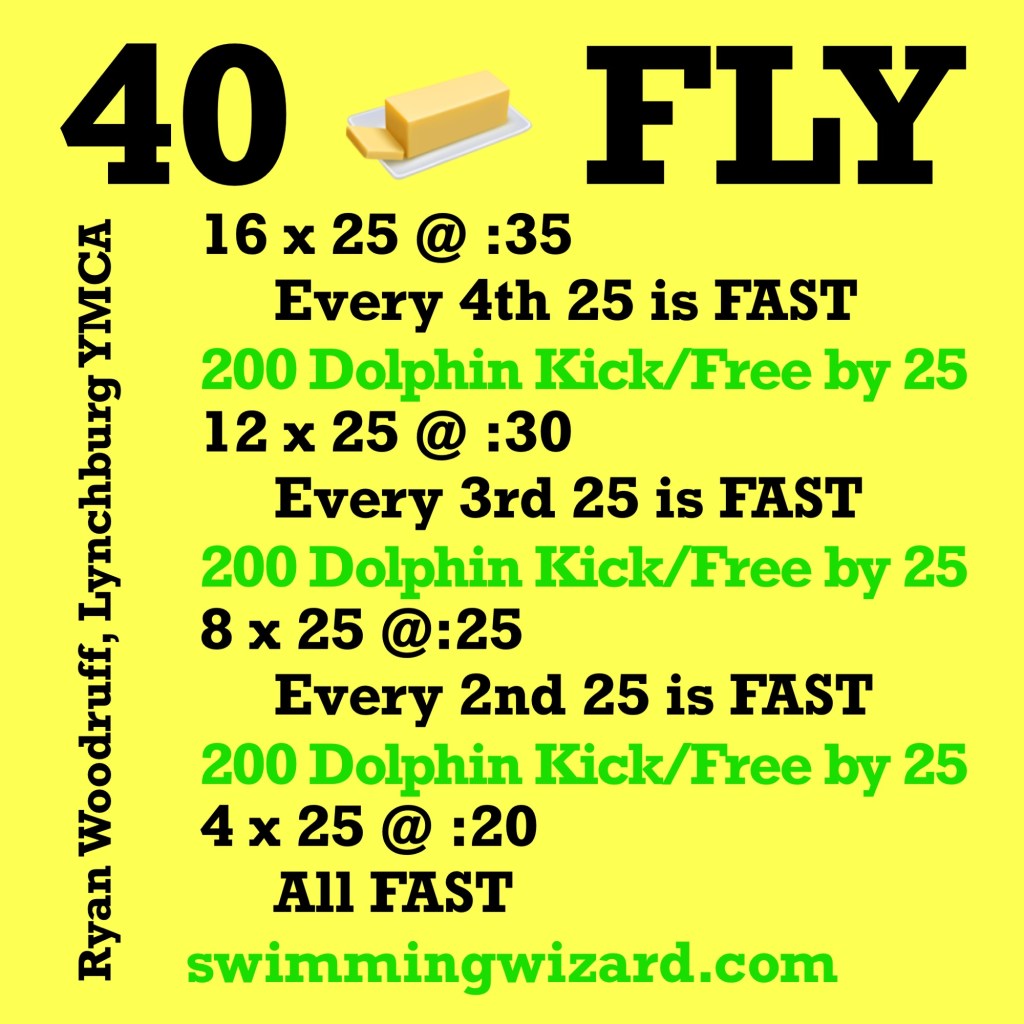
Have you tried FARTLEKS with your squad? It’s a good way to mix up your training a bit, plus it is fun to say!


Ryan Woodruff, Lynchburg YMCA
SCY

Ryan Woodruff, Lynchburg YMCA
Of course they’re not really infinite, but they might feel that way!
This one’s a mindbender. Start by doing 50s off the blocks. When coach is satisfied that the desired level of work has been achieved, the round may end and the 200 smooth commences. An even better way to end the round is to throw out a goal time for a particular swimmer to end the round for the group. Start with an outlandish number. If failure occurs, the group does another 50 and then a second swimmer gets a goal time, a bit more reasonable. Repeat until success. Carefully monitor how the team responds. Do they rally together or get negative and resentful? Use it as a team-building exercise. Coach determines how many rounds.

Ryan Woodruff, Lynchburg YMCA
SCY
Each part of the set is 1,650 yards

Ryan Woodruff, Lynchburg YMCA

 The Swimming Wizard