Fun Relay Speed Work

Ryan Woodruff, Lynchburg YMCA

Recently at practice about half of our group was missing for a high school meet. We had a block of about 45 minutes that I wanted to get in some good speed work. How to get them excited for it and get some good results? Wacky relays.

We had 12 swimmers split into 4 teams of 3, which allowed us to swim at a roughly 1:2 work-rest ratio. We did 5 relays followed by some active recovery swimming.

Relay 1: 450m each person swims 6×25 free (keeping it simple to get us started)

Relay 2: 450m, each swims 6 x 25 no free

Relay 3: 450m, each swims 25 no free, 75 free, 25 no free, and 75 free

Relay 4: 450m, each swims 25 free, 75 no free, 25 free, 75 no free

By this time, each relay team had won a single race thanks to my expert dividing of teams. The final race would decide who had to do the longest warm down:

Relay 5: 300m each person swims 2 x 50m free dragging a partner holding on to their ankle.

Result: all teams disqualified for various forms of cheating.

The 4-way tie mandated an immediate 50 fly swim-off by a single swimmer from each team.

I got way more energy and effort out of them with this strategy than I would have with a traditional set!

———-

Do you coach swimming and love good quotes? Then you need this: https://swimmingwizard.com/e-books/

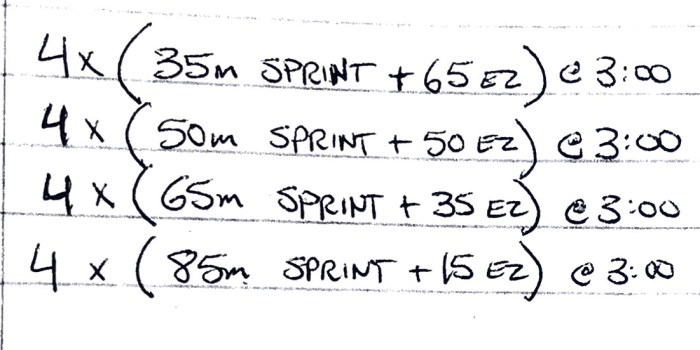
Build-up 100s

Ryan Woodruff, Lynchburg YMCA

LCM

We did this quality set interspersed with some stretch cord work today.

The goal on the 35 and 65 was to get a total time faster than your best 100.

Goal on the 85 was to beat best 100 time by 4 seconds.

Goal on the 100 was simply AS FAST AS POSSIBLE.

I really liked how it demanded flat-out speed early on and then encouraged them to hold it for longer.

Breaststroke in a Short Pool

Ryan Woodruff, Lynchburg YMCA

We have been making good use of our 10m diving well lately. I am enjoying getting creative with it. Here’s a set for breaststrokers:

4 rounds:

6 x 10m one pullout only @:20

:30 vertical eggbeater in streamline position

:10 rest

1 x 40 breast FAST @ 1:00 (add 1 x 40 each successive round so that round 4 = 4 x 40 FAST @1:00)

Sprint Set for Meters

Ryan Woodruff, Lynchburg YMCA

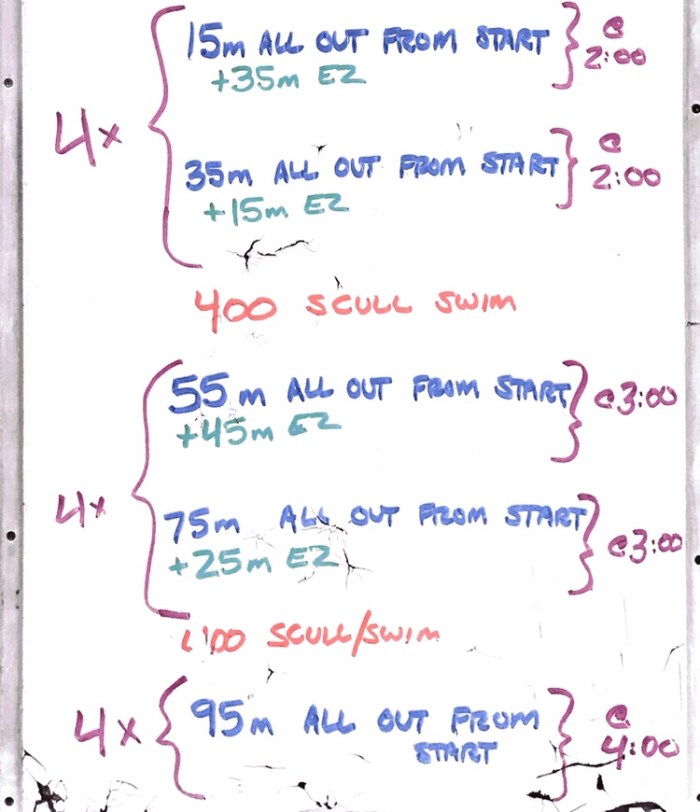
This set can be done in a SCM or LCM pool. All 35, 65, and 95s are done from a start and times to the head crossing the line.

Athletes are instructed to go all out on the 35. The goal for the 65 equals 2 x 35m time. The goal for the 95 equals the 35m time + the 65m time.

4x

35m sprint, 100 ez @4:00

65m sprint, 100 ez @4:00

95m sprint, 100 ez @5:00

We did the set 4x through to allow our IMers to go 1x each stroke.

Extend the Sprint!

Ryan Woodruff, Lynchburg YMCA

The idea behind this SCM set was to challenge our swimmers to maintain “top” speed over progressively longer distances. It turned out to be a very difficult set, but one that went well.

We used our pace cards to set objectives for the 15m sprints, and then the instructions from there were to go “all out” on the 35s.

From there, we set goals for the 55s and so on.

For example:

15m time = 6.6

35m time = 18.2 (difference = 11.6)

55m goal = 18.2 + 11.6 = 29.8

75m goal = 29.8 + 11.6 = 40.4

95m goal = 40.4 + 11.6 = 52.0

This gets difficult quickly! As an alternative to the math above, you can re-calculate the goal after the 55s and the 75s.

One thing I would change would be to give a little more active recovery between swims. We just didn’t have the lane space/time to make this happen.

The Tennis Ball Technique Challenge Set

Ryan Woodruff
Head Coach
Lynchburg YMCA

The purpose of this set was to challenge our athletes from a technical standpoint in all strokes.  For the first 75, they swam with a tennis ball in each hand.  As we have posted in the past, this essentially removes the hand as a propulsive surface, encouraging use of the forearms, the kick, and the core for propulsion.   Setting the tennis balls down, we sprinted the first 25 (on a tight interval), paying attention to our cycle count and enjoying the sensation of having use of the hands again.  We followed that up very quickly with a 25 of the same stroke, demanding excellent efficiency and stroke length by asking for the 25 to be performed with 2 fewer cycles than the previous 25.