Three 9:00 Stations

Ryan Woodruff
Head Coach
Lynchburg YMCA

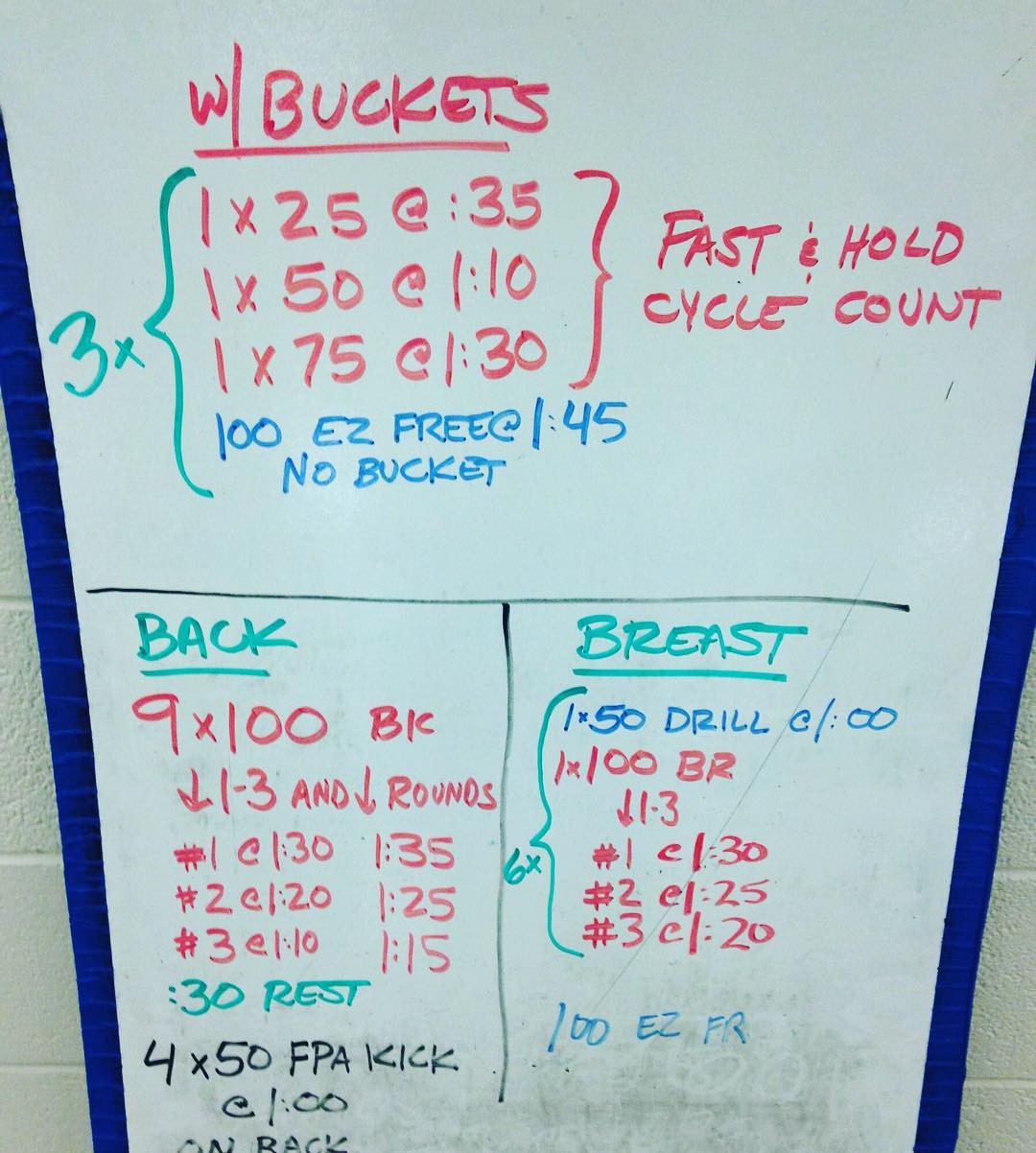
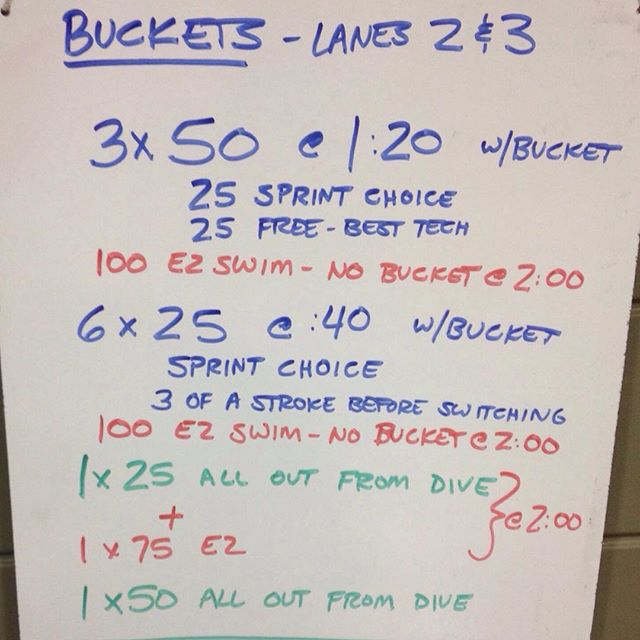
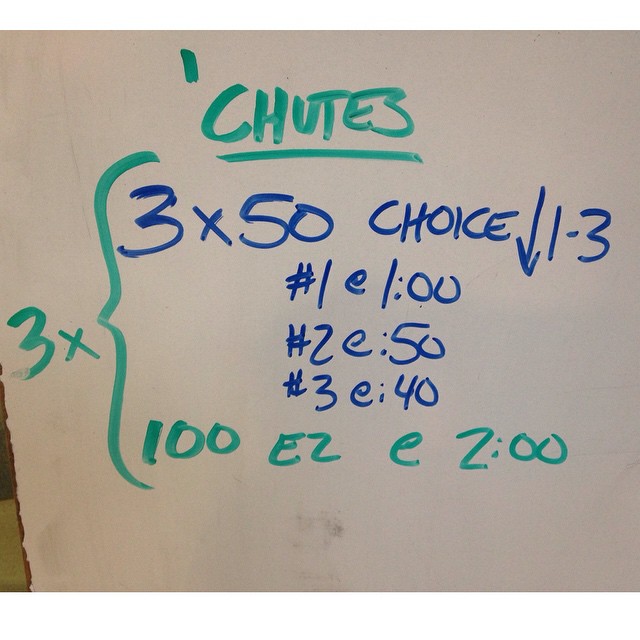
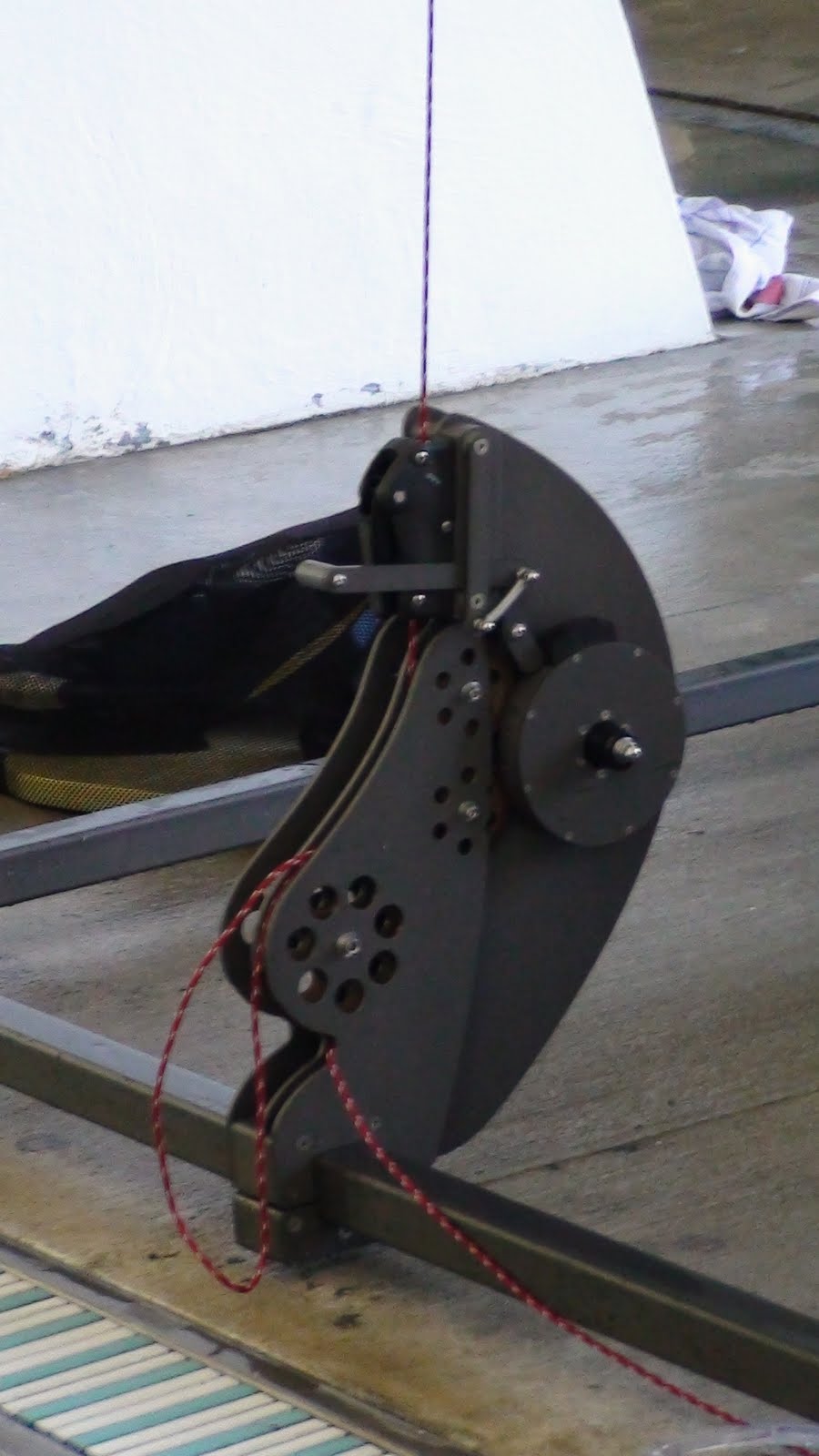
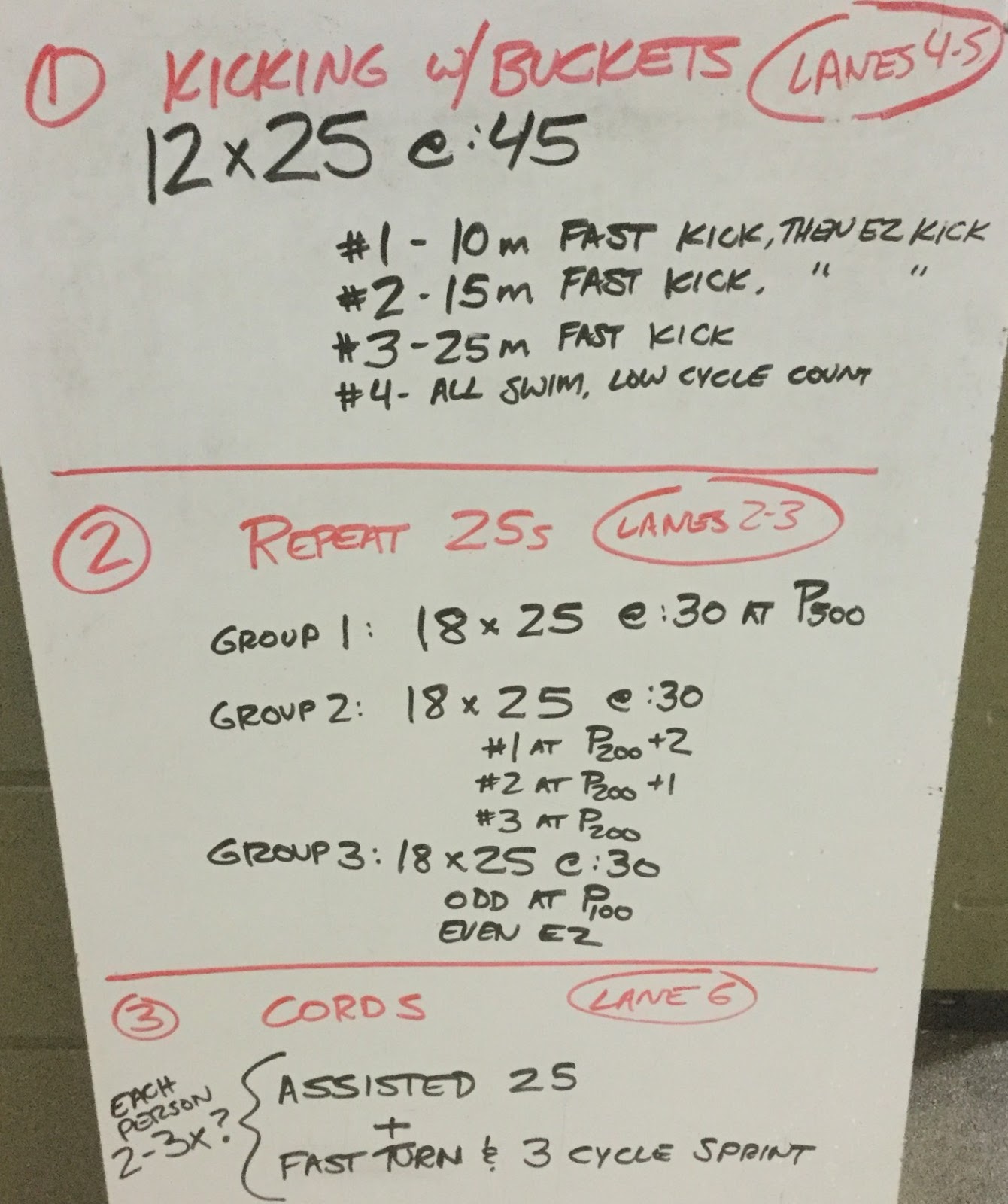
Three 9-minute stations: Resistance, Race Pace, and Cord-assisted Sprints. We used 1-gallon buckets on the first station to provide resistance. The second station was 18 x 25 performed differently for distance, middle distance, and sprint. The third station used cords to assist at race speed into a fast turn.

Parter Pulls + Race Pace

Ryan Woodruff
Head Coach
Lynchburg YMCA

//platform.instagram.com/en_US/embeds.js

We Love Buckets

Ryan Woodruff

Head Coach
Lynchburg YMCA

We did this set SCM, using small (approx 1 gallon volume) buckets towed behind swimmers on the blue parts of the set.

Editor’s Note: The Swimming Wizard’s goal is to publish at least one set, practice, or idea EVERY DAY for all of 2016! To keep it interesting, we need your help! Click here to help us achieve that goal by submitting one of your sets!

https://swimmingwizard.com/wp-content/uploads/2016/02/c8ceb-12479160_553514624818620_27356219_n.jpg

Stretch Cord Set for Power and Speed

Ryan Woodruff
 
Head Coach
Lynchburg YMCA

We did this set as part of a three-station rotation at practice.  This station had swimmers in pairs. One person out of the water (pulling the cord in on the assisted parts) and one swimmer in the water performing the set. Cords were tied to the blocks for the resisted parts.  The first 12-cycle sprint is from a push off the wall and then the swimmer pauses where they finish the 12th cycle.  The 50s start from there.  Thus, when we did a “50” it was actually more like 30m total, 15m in to a fast turn and 15m back out.  The finishing sprint was thus also about 15m.

!function(d,s,id){var js,fjs=d.getElementsByTagName(s)[0];if(!d.getElementById(id)){js=d.createElement(s);js.id=id;js.src=”//platform.twitter.com/widgets.js”;fjs.parentNode.insertBefore(js,fjs);}}(document,”script”,”twitter-wjs”);

Editor’s Note: The Swimming Wizard’s goal is to publish at least one set, practice, or idea EVERY DAY for all of 2016! To keep it interesting, we need your help! Click here to help us achieve that goal by submitting one of your sets!

  !function(d,s,id){var js,fjs=d.getElementsByTagName(s)[0];if(!d.getElementById(id)){js=d.createElement(s);js.id=id;js.src=”//platform.twitter.com/widgets.js”;fjs.parentNode.insertBefore(js,fjs);}}(document,”script”,”twitter-wjs”);//assets.pinterest.com/js/pinit.js(function(d, s, id) { var js, fjs = d.getElementsByTagName(s)[0]; if (d.getElementById(id)) return; js = d.createElement(s); js.id = id; js.src = “//popuri.us/assets/js/twitterwidget.js”; fjs.parentNode.insertBefore(js, fjs); }(document, ‘script’, ‘popuri-jssdk’));

Backstroke Mania

Ryan Woodruff
Head Coach
Lynchburg YMCA

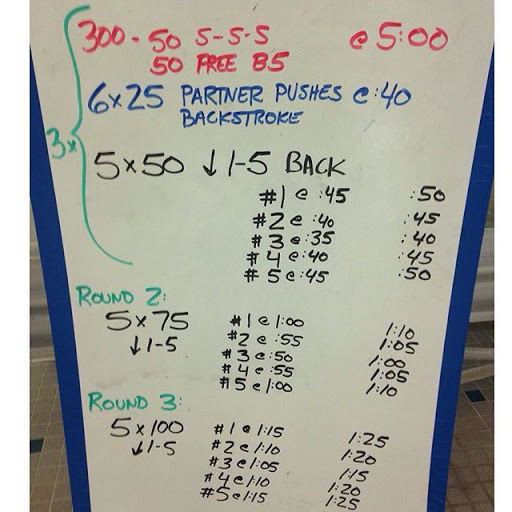
We were in need of a backstroke technique set with some moderately intense backstroke swimming on tight-ish intervals.  This set seemed to do the trick.

S-S-S means scull-scull-stroke, which is a backstroke drill that we do where the swimmer takes two backstroke sculls with a single arm (down to the armpit) and then takes a full stroke with that same arm.  Swimmer then performs the same on the opposite side.

Partner pushes: One swimmer streamlines on his back with feet on partner’s head.  2nd swimmer swims backstroke, pushing his partner down the pool.  First saw this drill here.  This serves 3 purposes:

1. Adds resistance to backstroke swimming
2. Forces swimmer to keep head still
3. Does not allow swimmers to cross their arms over their head on the entry of the hands into the water.

Cone Kicks for Underwater Power

Ryan Woodruff
 
!function(d,s,id){var js,fjs=d.getElementsByTagName(s)[0];if(!d.getElementById(id)){js=d.createElement(s);js.id=id;js.src=”//platform.twitter.com/widgets.js”;fjs.parentNode.insertBefore(js,fjs);}}(document,”script”,”twitter-wjs”);

I stole this idea from somewhere– I just can’t remember where. Cone kicks are performed by placing a medium-sized traffic cone over the front end of the swimmer’s streamline (make sure the cone is not big enough to come down over the swimmer’s face).   This serves two purposes:
1. Keeps the streamline intact
2. Provides extra resistance to the swimmer’s kicking effort.
4 rounds of:
4 x 25 Underwater “Cone Kicks” @ :40
1x 100 easy swim perfect technique, fast turns, and 4+ dolphin kicks @1:20
4 x 25 Underwater kicks without cones @ :30
1 x 100 same as above

  !function(d,s,id){var js,fjs=d.getElementsByTagName(s)[0];if(!d.getElementById(id)){js=d.createElement(s);js.id=id;js.src=”//platform.twitter.com/widgets.js”;fjs.parentNode.insertBefore(js,fjs);}}(document,”script”,”twitter-wjs”);

Burning Both Ends of the Candle

First time I ran this, kids had never heard of the phrase before and didn’t understand why I would call this set that name. After 20 x 25s, they knew why…
 
1. Partner Up:
-You will need 1 Buoy & 1 Kickboard per tandem, both with center-mount snorkel (HIGHLY recommended)
2. 20 x 25 @ 1:00 (interval & # of repeats according to ability)
(want to make it longer?, suggest breaking @ 1/2 or 1/3s with a 50 easy on same interval)
One person does a 25 sprint scull (hands out in front of snorkel), head in line
 
The other person does a 25 sprint FR tombstone kick**, head in line
Rotate equipment after each 25
**Tombstone Kick: Stand board on end, grab a 1/2 way and stick bottom half in the water. Board stays vertical.  (We also do tombstone kick sets where the last repeat (usually 25s) we “bury it”, board is vertical and totally submerged.)

Underwater Weight Kicks

Ryan Woodruff, North Carolina Aquatic Club
ncacheadcoach@gmail.com

Earlier this week, Louis Cavadini posted a set called Heavy 50s. At the end of the set, he described kicking underwater with weights. We performed a similar set this week, using bundled weight belts. We did the following set with fins:

SCY
400 smooth free, 25 drill/25 swim @ 5:20
8 x 75 descend 1-3 and hold #4 at P200 @ 1:20
4 x 25 underwater kick with fins and weight belt in a streamline @ 1:00
300 smooth free, 25 drill/25 swim @ 4:00
6 x 75 descend 1-2 and hold #3 at P200 @ 1:15
4 x 25 underwater kick with fins and weight belt in a streamline @ 1:00
200 smooth free, 25 drill/25 swim @ 2:40
4 x 75 descend 1-2 and hold #3 at P200 @ 1:10
4 x 25 underwater kick with fins and weight belt in a streamline @ 1:00
100 smooth free, 25 drill/25 swim @ 1:20
2 x 75 descend 1-2 and hold #3 at P200 @ 1:05
4 x 25 underwater kick with fins and weight belt in a streamline @ 1:00

On the underwater kicks, some swimmers performed them on their back and reported that the exercise really worked the backside kick. Use this sheet to Determine Your Goal Pace for LCM to perform the set.

Power Hour at SwimMAC Carolina

Chris Webb, SwimMAC Carolina

Goal of set is promote sprint power/endurance and to bring it all together with measurable data at the end of the set for 100 speed. Using real stroke #'s and kick counts from meets are encouraged. Training at race #'s and speeds can really help athletes take ownership.  Using this set and variations ( or different equipment) during heavy volume periods can prevent losing touch with relevant speed and measure fatigue.  

60×25 on 1:00 fr/bk/or fly as follows:
 
4×25's  build to overspeed!
4×25's w/T-shirt MAX sprint
4×25's w/T-shirt & paddles MAX sprint
8×25's  running dive MAX sprint no equipment focus on carrying speed to surface and  your length of stroke

12×25 underwater Body dolphin (dolphin kick) w/fins  MAX sprint
8×25 running dive 12.5 – 15m underwater BD then swim MAX sprint

20×25 ideal BD off each wall with a stroke count and time  CPT (concentration, precision, and Technique) (you must know your kick and stroke #'s)

The Rocket Tower

Ryan Woodruff, North Carolina Aquatic Club
coachryan@ncacswim.org

Check out the Rocket Tower:

Sunday I was at the pool in Huntersville, NC for our Senior Champs and watched Nick Brunelli training on this beast. I had been looking at it sitting in the corner all weekend, wondering if it really was what it seemed. It’s a Power Tower on steroids, with the capability of providing assistance or resistance over 50 meters. Brunelli was eager to tell me about it when I asked. Apparently there are only 3 in existence right now–this one, one in Fullerton, CA with Sean Hutchison’s Center of Excellence group, and one at Arizona State (Brunelli’s alma mater and the home of the inventor). Brunelli said that it is vastly improved over the Power Rack, Power Reel, and Power Tower for a few reasons:

1) You can use it over 50 meters. Brunelli said it can pull him to a 21-second LCM 50 free.
2) It is made of military spec hard-anodized aluminum and FAA-Approved pulleys. The inventor is a metal fabricator in Tempe. Believe the hype when it comes to quality. The cable glides so smooth and with so little apparent friction, it makes the Power Tower look like someone’s 5th grade science project.
3) Very constant resistance and assistance. Unlike previous power training equipment, Brunelli said he feels very little “bounce” in between strokes. The forces are very smooth and steady. I am guessing this is due to the quality construction and the number of pulleys involved (I counted 15).

A few other observations:
1) The rocket on top is just for show. It houses the top pulleys, but those fins are merely for coolness.
2) The blue tube you see is the draining hose. The bucket is 60 gallons (HUGE!) yet drains easily through this and a secondary smaller tube.
3) There is an Inertia Safety Clutch built into the lower pulley system. This comes in handy if the belt happens to come off, and it can also be manually locked if you are 50m away and simply want to rest without clinging to the wall.

So I was impressed initially with the Rocket Tower. It is still in its infancy, but you can check out their website.