The Blind Goal Workout

Ryan Woodruff
Head Coach
Lynchburg YMCA

Do you want to get a group of kids motivated and swimming fast 100s at practice? Try this workout for a psychological test.

? x 3 x 100 for time

Before practice, the coach writes down a goal time for each swimmer for 100y of one of their prime strokes. The goal time should be extremely challenging (i.e. their lifetime best practice time or maybe even a true lifetime best in some cases). The coach does not reveal the goal times but instead folds it up and pins it to the bulletin board. The group performs fast 100s in groups of three on 4-5 minutes of rest, with ez 200y swims between rounds. For each goal time met, the group receives a point, and the set continues until a group point goal is met. Coach reads the swimmers’ times after each 100 and states whether or not they have reached the goal time, but does not reveal the goal.
You will find out how psychologically strong your team is if you set the goals high enough. If they experience some early success scoring points, they will be more motivated. Should they hit a drought, some group members may give less than their best and no longer strive to swim really fast. If this happens, you may reveal the goal times and then give the group a final opportunity to achieve them. Seeing the goal times will help some athletes and others may be discouraged.

Regardless of how it shakes out, you are bound to get some fast swimming and some great fodder for discussion about goals (and how hard it is to not have them), expectations, and motivation.

If you give the Blind Goal Workout a try, please let me know how it goes.

Age Group Kick Set from Results H20 and Coach Josh Sinclair, Queensland, Australia

Josh Sinclair
Head Coach
Results H2O Swimming
Queensland, Australia

This is a kick set that we did on Saturday… It is a 2km kick set that works on hypoxic, balance and body position and quality.   When doing kick sets I like to always ensure it is challenging and engaging to the individual, so rather then just kick to a cycle or for distance I get them to hold under their pace 200, the “I don’t like kick” kids held pace 200 +5 or +10 and the “I hate kick” kids wore short Finz.

The 10 Best Things I Read, Watched, and Listened to This Year

Ryan Woodruff
Head Coach
Lynchburg YMCA

As a coach who is interested in personal improvement and being the best coach that I can be for my athletes, I am constantly on the lookout for ideas, motivation, and knowledge that can help me.  Here are a few of the best things I came across this year.

You are missing out if you aren’t part of the (1) Swim Coaches Idea Exchange on Facebook. With nearly 5,000 members, there is nearly always a pithy discussion of technique and tons of fresh ideas.  Be sure to check out posts from Jonty Skinner to be the at the tip of the spear when it comes to freestyle technique especially.

On my drive to and from practice, I love to listen to podcasts on a variety of subjects.  By far the best podcast I listened to this year was (2) Michael Gervais’ interview with former swim coach Sean Hutchison. Interesting, inspiring, and thought-provoking.

I got my start coaching with Gregg Troy at Florida, and reading (3) SwimmingScience.net’s Notes on his talk “Garbage Yards and Other Things that Work” was a reminder of the power of commitment that he always emphasized to the Gator teams that I was around.

If you have been paying attention on the club scene, then you know about the recent success of the York YMCA and Coach Michael Brooks’ swimmers.  I found this (4) great summary of his philosophy from his time at Brophy Prep.  He took many somewhat-formed thoughts right out of my head and put them down on paper in a clear, succinct, and firm way.

Here is my (5) favorite new drill of the year from Eagle Swim Team’s Scott Ward.  Swimmers love it, and it helps them with a critical skill in freestyle.

I have no idea if (6) this is a superior way to break out, but I love it as an example of outside-the-box thinking by the coaches at Tennessee.

My favorite passage I came across in my reading this year is from “The Olympian” by Brian Glanville written in 1969 (7):

I always enjoy reading Paul Yetter’s thoughts on his Create Performance blog.  This post was particularly insightful: (8) The Road to Greatness has Dips and Turns.

It has been interesting following along with Glenn Mills and Rachel Stratton-Mills as they have been on their Quest.  This article really hit home with me – (9) “Unreal Expectations.”

Jake Shellenberger wrote (10) “My 5 Top Drills for Sprint Freestyle,” a very helpful and informative post with more detail than your typical “listicle.”

What great resources did I miss?

Here is my list from 2013 and my list from 2012


Swim-Dryland Hybrid Set

Ryan Woodruff

Head Coach
Lynchburg YMCA

This set combines elements of dryland with a normal swimming set.  I like this as a change-of-pace and a way to challenge our athletes that they don’t see every day. The dryland exercise comes mid-swim and throws in a bit of fatigue.  We timed the 100 all out and really got some excellent efforts.

“In & Outs” – athlete must climb completely out of the pool (both feet onto the gutter) and then climb back in.
“Press-outs”- athlete lifts himself vertically up and down parallel to the wall.  At highest point, waist is at water level.  At lowest point, water level is at mid-chest.


Stopwatch Roulette

Ryan Woodruff, Lynchburg YMCA

This is a fun idea to try at practice someday just for variety. Write a set that can be done in any quantities like the one below.  Start a stopwatch and hand it to a swimmer.  The swimmer stops the watch randomly and whatever digit is in the hundredths place is the quantity for the first part.  Repeat for as many times as you need.


Age Group IM Set from Australia

Josh Sinclair
Head Coach
Results H2O
Queensland, Australia

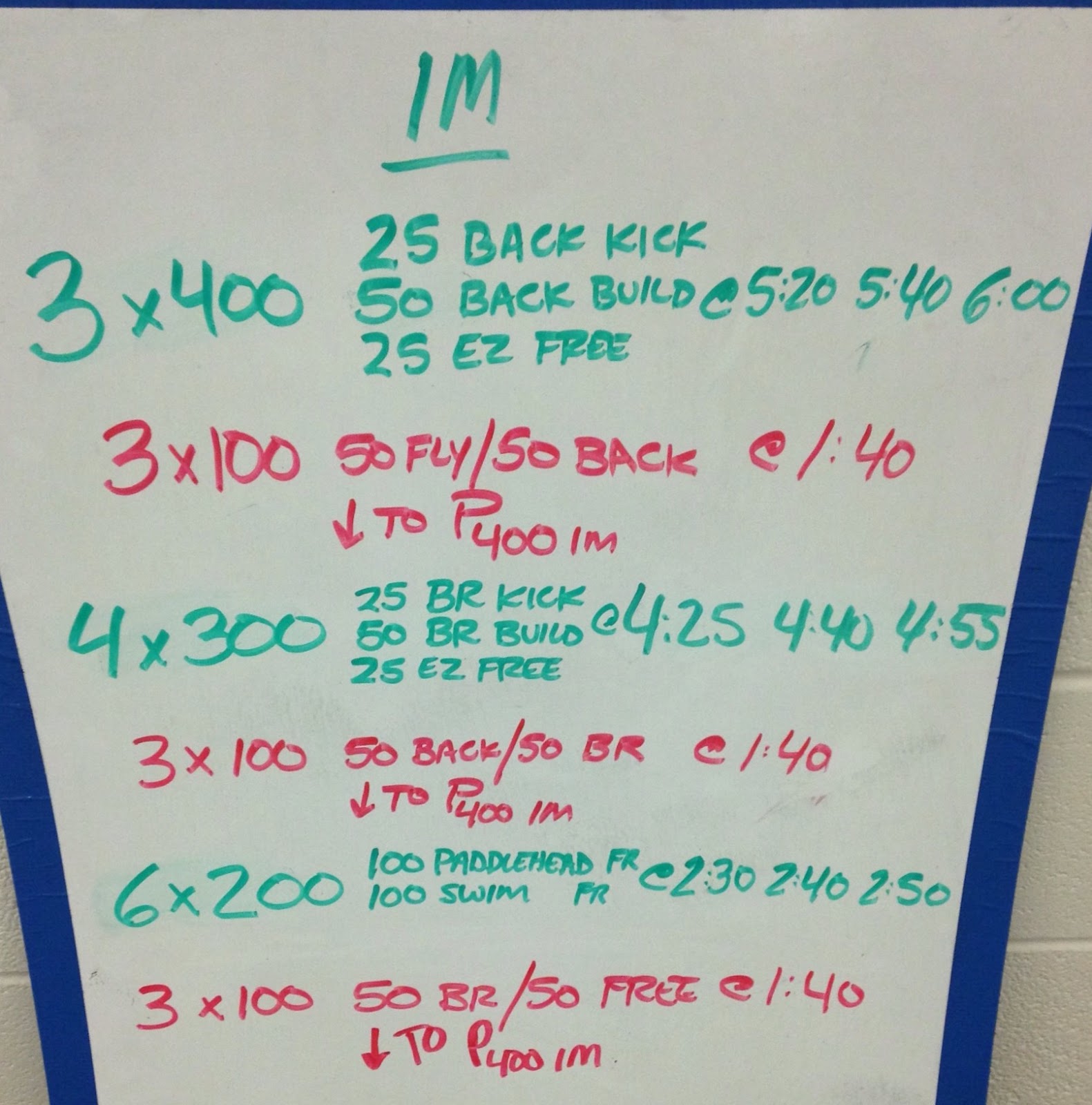
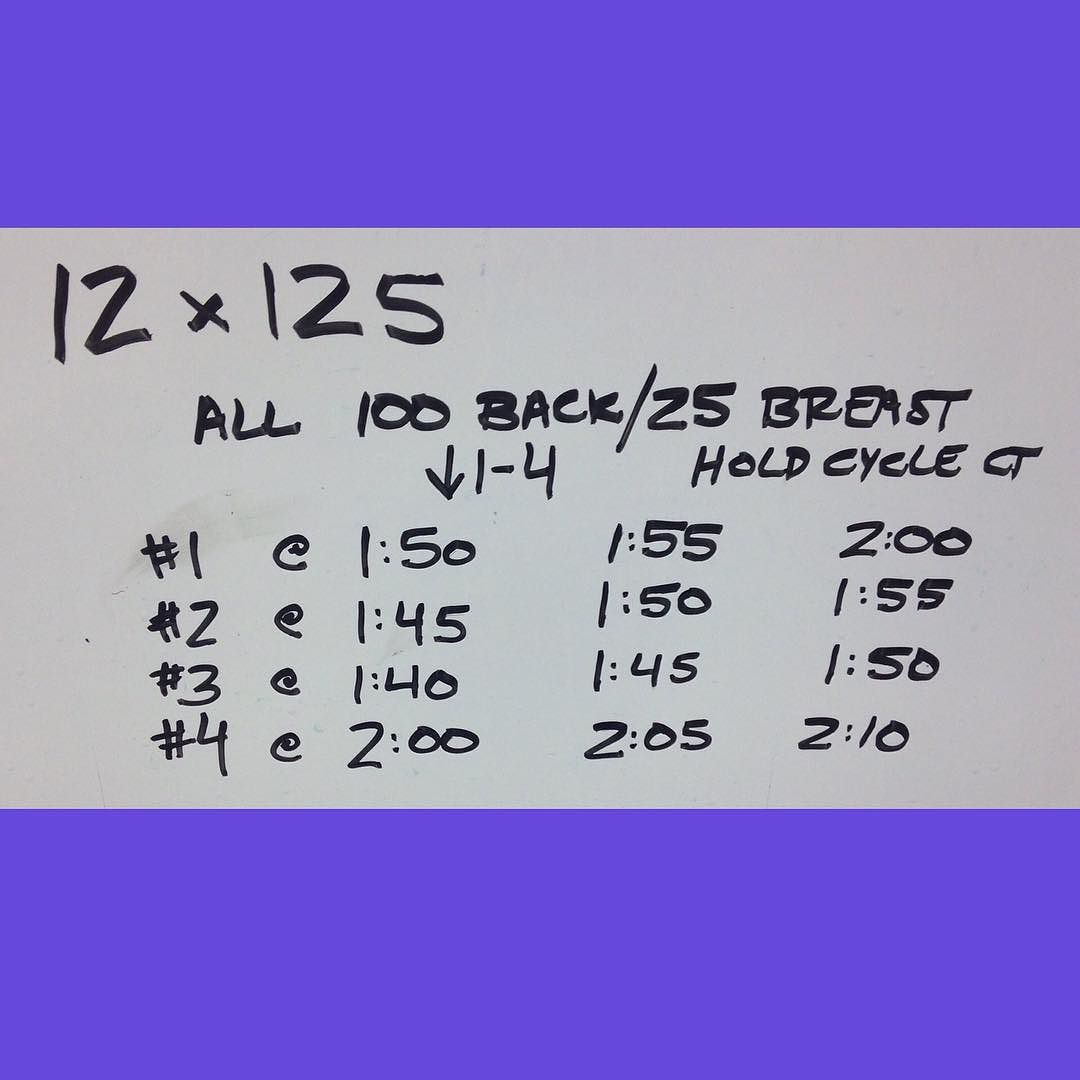
Below is an IM Set I use with our JX (Junior Excellence) squad.  Ages range in this squad from 9-12.  The idea behind this set was to get the kids to control and build the 125’s with some fast swimming in between.

!function(d,s,id){var js,fjs=d.getElementsByTagName(s)[0];if(!d.getElementById(id)){js=d.createElement(s);js.id=id;js.src=”//platform.twitter.com/widgets.js”;fjs.parentNode.insertBefore(js,fjs);}}(document,”script”,”twitter-wjs”);

  !function(d,s,id){var js,fjs=d.getElementsByTagName(s)[0];if(!d.getElementById(id)){js=d.createElement(s);js.id=id;js.src=”//platform.twitter.com/widgets.js”;fjs.parentNode.insertBefore(js,fjs);}}(document,”script”,”twitter-wjs”);//assets.pinterest.com/js/pinit.js(function(d, s, id) { var js, fjs = d.getElementsByTagName(s)[0]; if (d.getElementById(id)) return; js = d.createElement(s); js.id = id; js.src = “//popuri.us/assets/js/twitterwidget.js”; fjs.parentNode.insertBefore(js, fjs); }(document, ‘script’, ‘popuri-jssdk’));

F.A.T. (For a Time) Tuesday with Glenbrook Aquatics

Head Sr. Coach
Glennbrook Aquatics
 
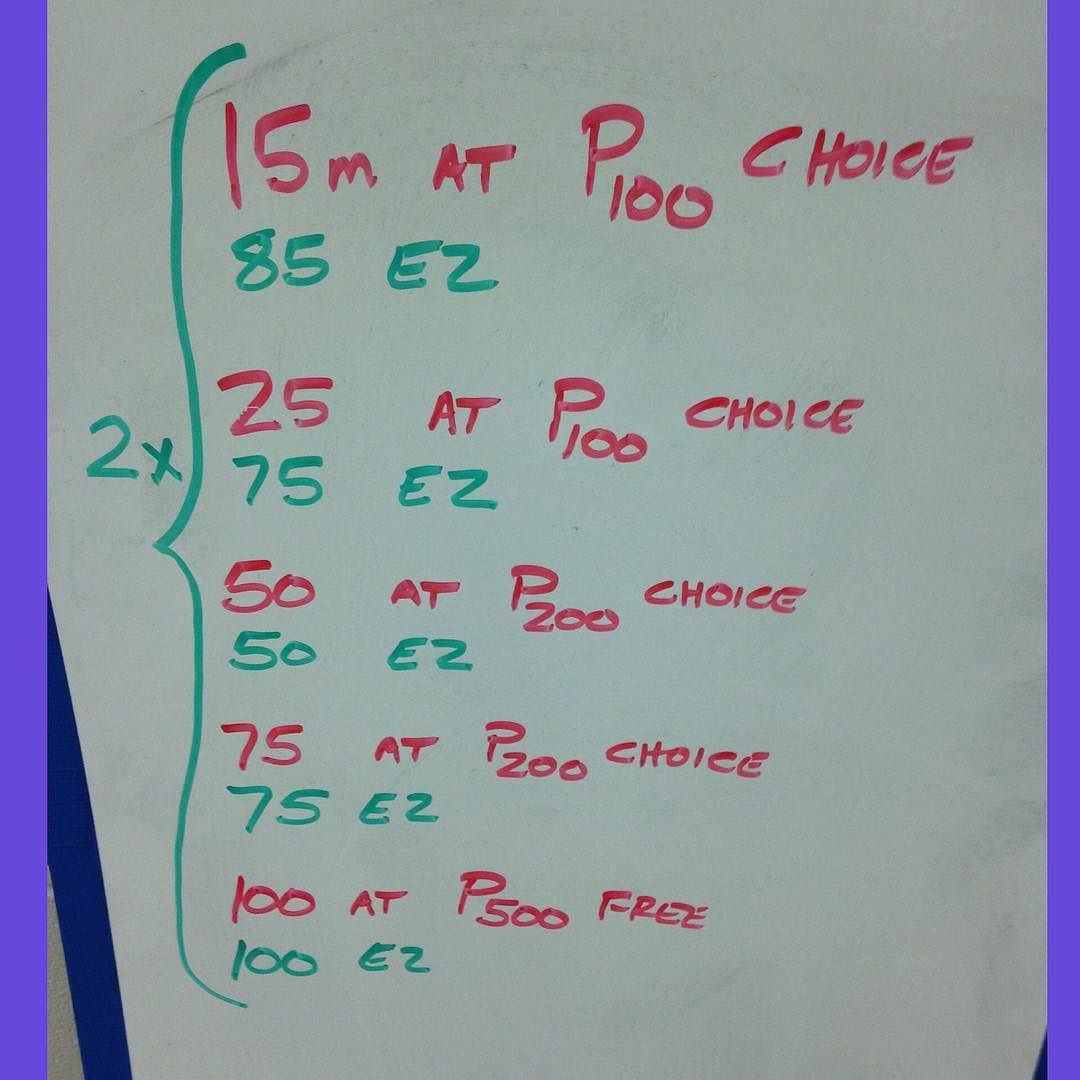
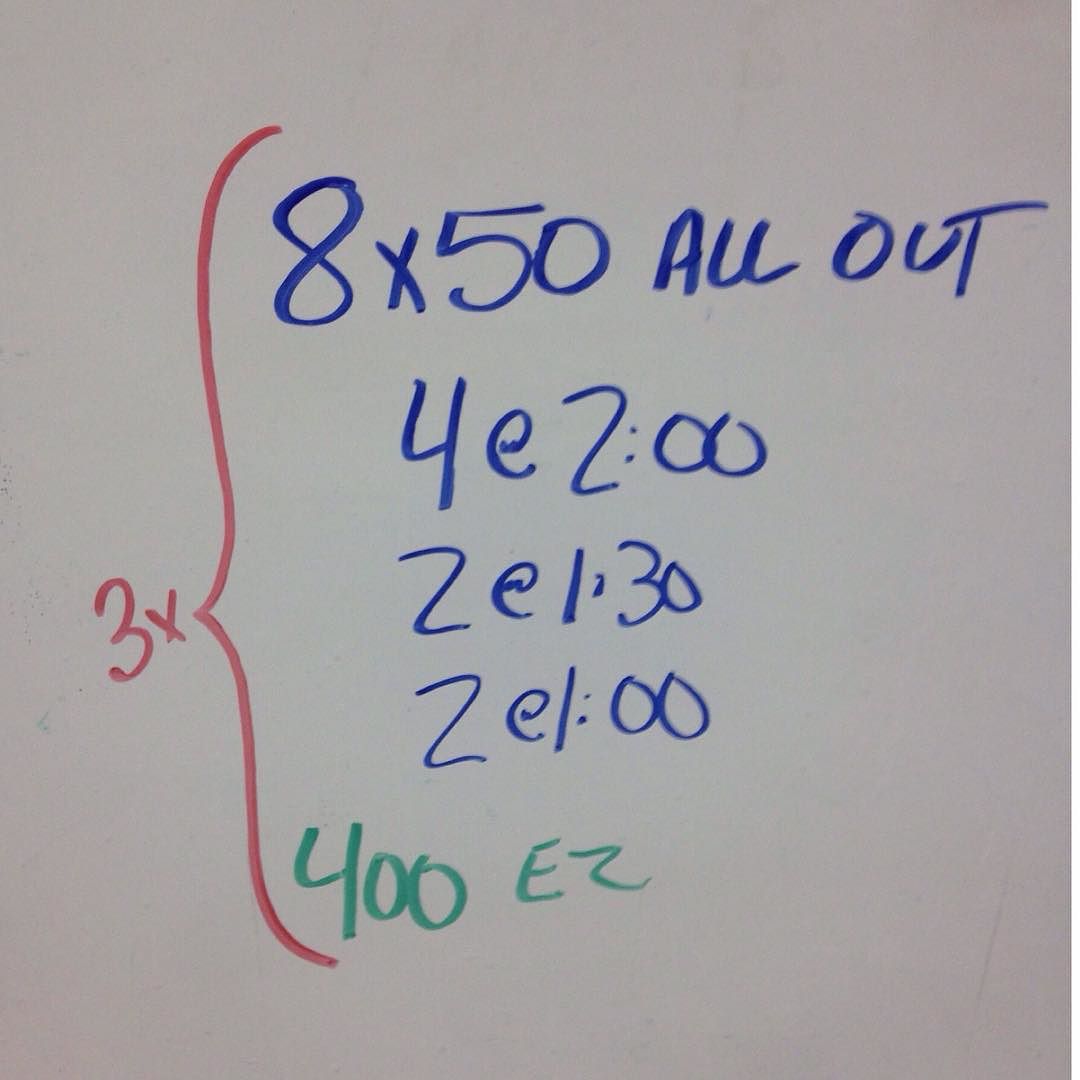
Our focus today was tired speed. I wanted to give the kids a gut check and asked them to find a way to sprint when tired. We warmed the kids up and then talked about expectations for honest efforts prior to revealing the set. It was 2 rounds as shown below – no breaks between rounds. The long interval on the sprint was to allow free time after the sprint to prepare for next round. Some took advantage and used time for active recovery. Others went the painful route and layed on the deck until it was time to go. We go a great effort from the kids. I will probably add a little more interval to the best average swims next time, but not much.

Enjoy!


!function(d,s,id){var js,fjs=d.getElementsByTagName(s)[0];if(!d.getElementById(id)){js=d.createElement(s);js.id=id;js.src=”//platform.twitter.com/widgets.js”;fjs.parentNode.insertBefore(js,fjs);}}(document,”script”,”twitter-wjs”);

  !function(d,s,id){var js,fjs=d.getElementsByTagName(s)[0];if(!d.getElementById(id)){js=d.createElement(s);js.id=id;js.src=”//platform.twitter.com/widgets.js”;fjs.parentNode.insertBefore(js,fjs);}}(document,”script”,”twitter-wjs”);//assets.pinterest.com/js/pinit.js(function(d, s, id) { var js, fjs = d.getElementsByTagName(s)[0]; if (d.getElementById(id)) return; js = d.createElement(s); js.id = id; js.src = “//popuri.us/assets/js/twitterwidget.js”; fjs.parentNode.insertBefore(js, fjs); }(document, ‘script’, ‘popuri-jssdk’));
Backstroke & IM Set with Deep Practice

Ryan Woodruff
Head Coach
Lynchburg YMCA

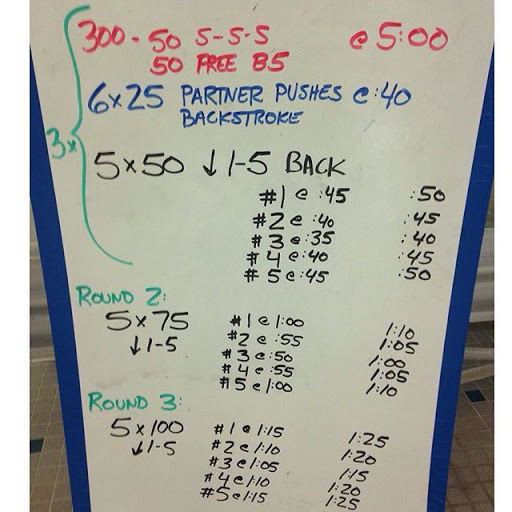
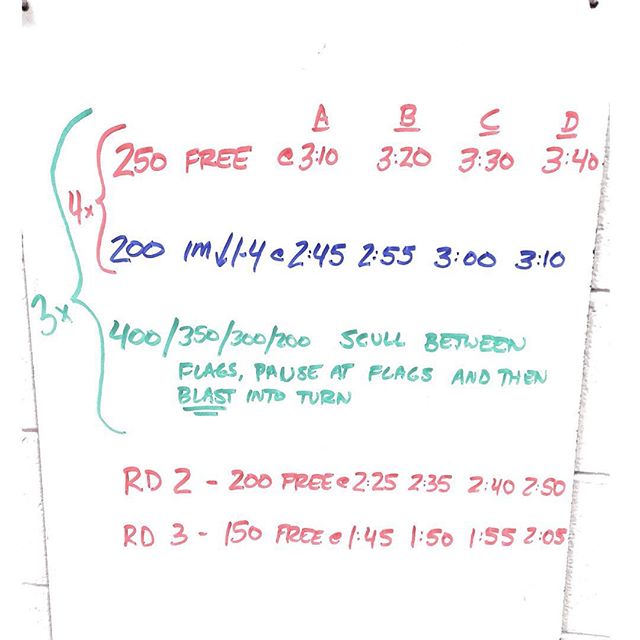
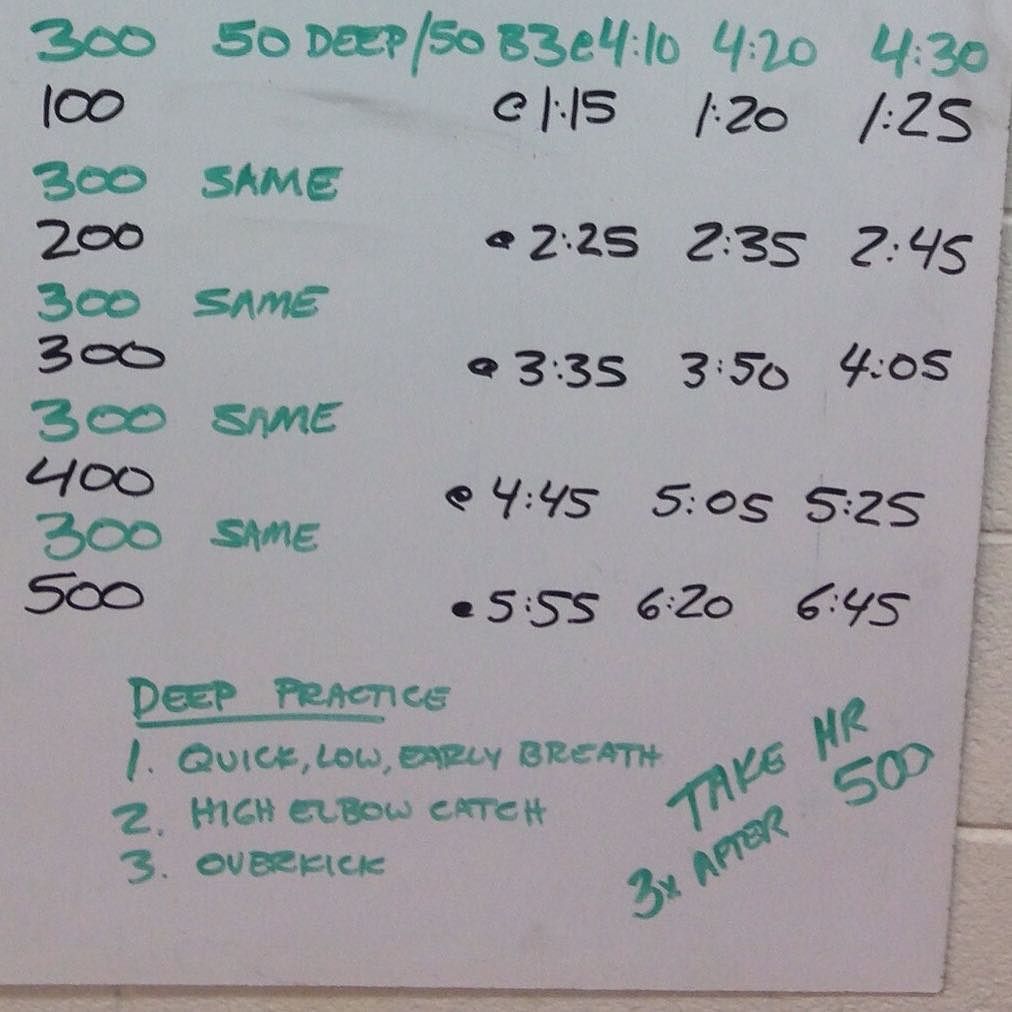
We have been using this concept of “Deep Practice” lately with some success.  The idea is that you swim the full stroke (as opposed to drill, where you swim part-stroke) and simply emphasize a particular technical element.  This set is focused on backstroke technique at the beginning and then includes some fatigued backstroke as part of unbalanced 200 IMs, Seemed to do the trick.

Barely legible at the bottom it reads “Fly is always fast” and “use backstroke as primary means of descending.”

Can You Survive "The Hurricane"?

Ryan Woodruff
Head Coach
Lynchburg YMCA
 

!function(d,s,id){var js,fjs=d.getElementsByTagName(s)[0];if(!d.getElementById(id)){js=d.createElement(s);js.id=id;js.src=”//platform.twitter.com/widgets.js”;fjs.parentNode.insertBefore(js,fjs);}}(document,”script”,”twitter-wjs”);

“More days to come
New places to go
I’ve got to leave
It’s time for a show

Here I am, rock you like a hurricane”

-The Scorpions, “Rock You Like a Hurricane”

WARMUP Churn the waters– 20 MINUTES NON-STOP OF:

200 SMOOTH FREE
10 STREAMLINE BLASTOFFS OFF THE BOTTOM
100 KICK W/BOARD
100 SMOOTH NO FREE
10 STREAMLINE BLASTOFFS
50 KICK FAST W/ BOARD

MAIN SET – “THE HURRICANE”
The intensity builds and builds until you reach the “Eye-M” in the middle. The intensity hits strong again shortly thereafter.

Descend the 1st four 500s, Pull is optional on all 100s
500 FREE STRONG @ 5:40
4 X 100 EZ @ 1:15
500 FREE STRONG @ 5:40
3 X 100 EZ @ 1:15
500 FREE STRONG @ 5:40
2 X 100 EZ @ 1:15
500 FREE STRONG @ 5:40
1 X 100 EZ @ 1:15

800 REVERSE “Eye-M” 50 KICK/100 DRILL/50 SWIM

500 FREE STEADY B3 @ 5:40
4 X 100 F.P.A. @ 1:10              F.P.A. = Fastest Possible Average
500 FREE STEADY B3 @ 5:40
3 X 100 F.P.A. @ 1:10
500 FREE STEADY B3 @ 5:40
2 X 100 F.P.A. @ 1:10
500 FREE STEADY B3 @ 5:40
1 X 100 F.P.A. @ 1:10

WARM DOWN SET
? X 25 @ :30 CHOICE, DESCEND CYCLE COUNT 1-4 AND REPEAT

This set was originally published March 30, 2011 here at the Swimming Wizard Blog

  !function(d,s,id){var js,fjs=d.getElementsByTagName(s)[0];if(!d.getElementById(id)){js=d.createElement(s);js.id=id;js.src=”//platform.twitter.com/widgets.js”;fjs.parentNode.insertBefore(js,fjs);}}(document,”script”,”twitter-wjs”);//assets.pinterest.com/js/pinit.js(function(d, s, id) { var js, fjs = d.getElementsByTagName(s)[0]; if (d.getElementById(id)) return; js = d.createElement(s); js.id = id; js.src = “//popuri.us/assets/js/twitterwidget.js”; fjs.parentNode.insertBefore(js, fjs); }(document, ‘script’, ‘popuri-jssdk’));

50 x 100 with Coach Wooters

Nicholas Wooters
Head Swim Coach
Pacific Sports Resort Panthers
!function(d,s,id){var js,fjs=d.getElementsByTagName(s)[0];if(!d.getElementById(id)){js=d.createElement(s);js.id=id;js.src=”//platform.twitter.com/widgets.js”;fjs.parentNode.insertBefore(js,fjs);}}(document,”script”,”twitter-wjs”);

  !function(d,s,id){var js,fjs=d.getElementsByTagName(s)[0];if(!d.getElementById(id)){js=d.createElement(s);js.id=id;js.src=”//platform.twitter.com/widgets.js”;fjs.parentNode.insertBefore(js,fjs);}}(document,”script”,”twitter-wjs”);//assets.pinterest.com/js/pinit.js(function(d, s, id) { var js, fjs = d.getElementsByTagName(s)[0]; if (d.getElementById(id)) return; js = d.createElement(s); js.id = id; js.src = “//popuri.us/assets/js/twitterwidget.js”; fjs.parentNode.insertBefore(js, fjs); }(document, ‘script’, ‘popuri-jssdk’));
I Like 200s

Ryan Woodruff
Head Coach
Lynchburg YMCA

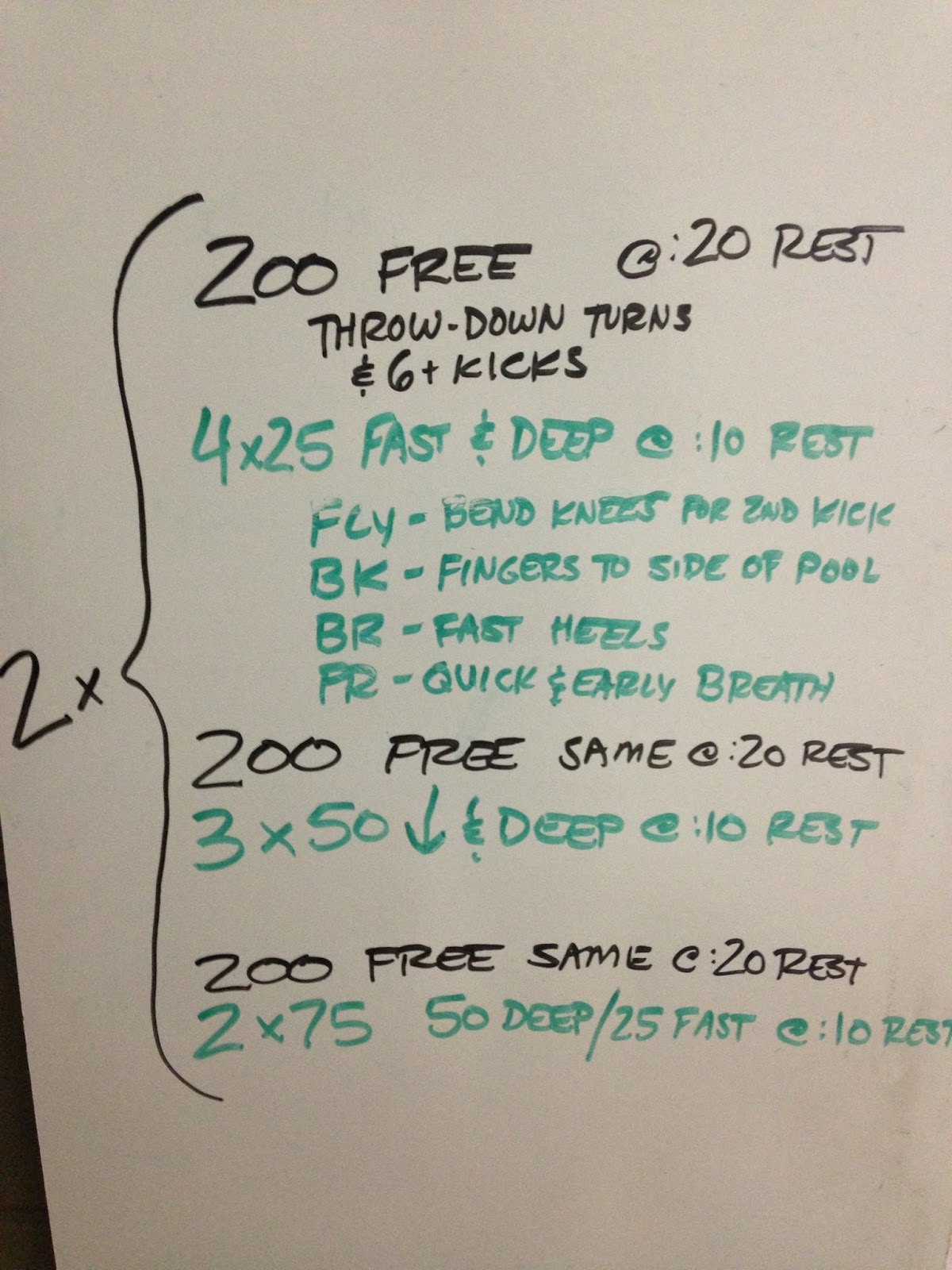
This is a total of thirty 200s.  That can be repetitive, but by mixing up the paces and expectations, a swimmer can get in a real groove on a set like this.  This set is from last winter.  We had a Sunday practice that almost nobody was able to get to due to bad weather.  The one swimmer who ended up doing this set had a phenomenal spring, dropping major time in his freestyle events from 100 to 1650.

SCY

The "Approaching 200" Challenge Set

Ryan Woodruff
Head Coach
Lynchburg YMCA
 
The purpose of this set is to challenge swimmers by having them swim at paces and for distances that gradually approach 200 race pace.  When we did the set, we started with 175s all freestyle, and then progressed to the 180s and beyond done as athlete’s choice of stroke.  Swimmers were timed to a hand touch on the 175s, and then were timed to their head breaking the line. We used a cone on the side of the pool and multiple cones on the bottom of the pool to mark the required distance.  Our swimmers were very successful making the goal time (lifetime best time) all the way through the 190 yards and several were successful at the 195y distance.

Working on 400 IM Splitting with Greater Philadelphia Coach Matt Sprang

Matt Sprang
Head Coach
Greater Philadelphia Aquatic Club

SCY

We did the following set 2x through:

1 x 300 Free @ 3:45 white
4 x 100 IMO @ 1:35.  Fly pace plus 5, Back, Breast, Free pace plus 2.  All from a push.
1 x 100 cruise @ 1:45
4 x 50 IMO @ :50 (pace divided by 2)

Fly pace was defined as equal to the first 100 of the swimmer’s best 200 fly
Back, Breast and Free pace were defined as equal to the last 100 of the swimmer’s best 200.

It actually went pretty well.  Backstroke was a little off for everyone while breaststroke was a little faster for everyone.

!function(d,s,id){var js,fjs=d.getElementsByTagName(s)[0];if(!d.getElementById(id)){js=d.createElement(s);js.id=id;js.src=”//platform.twitter.com/widgets.js”;fjs.parentNode.insertBefore(js,fjs);}}(document,”script”,”twitter-wjs”);

  !function(d,s,id){var js,fjs=d.getElementsByTagName(s)[0];if(!d.getElementById(id)){js=d.createElement(s);js.id=id;js.src=”//platform.twitter.com/widgets.js”;fjs.parentNode.insertBefore(js,fjs);}}(document,”script”,”twitter-wjs”);//assets.pinterest.com/js/pinit.js(function(d, s, id) { var js, fjs = d.getElementsByTagName(s)[0]; if (d.getElementById(id)) return; js = d.createElement(s); js.id = id; js.src = “//popuri.us/assets/js/twitterwidget.js”; fjs.parentNode.insertBefore(js, fjs); }(document, ‘script’, ‘popuri-jssdk’));
Pacing the 1500 Like a Pro

Ryan Woodruff
Head Coach
Lynchburg YMCA

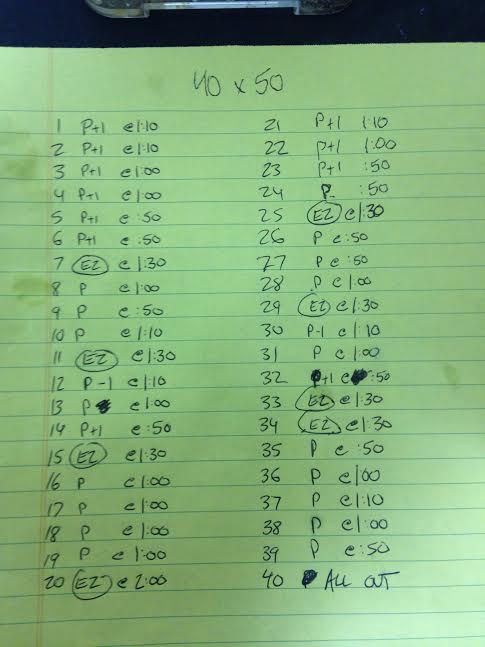
I gave this set (in short course meters) to my distance swimmers recently.  The idea is predicated around Russell Mark’s observations on pacing the 1500 free at the elite level.  He has observed that the very best milers have tremendous front and back end speed but swim at a very consistent pace in the middle.  This set rehearses that concept.

We start off with a 50 pretty fast (near 200 pace) and then follow up with a 100 strong (2-3 seconds slower than 400 pace) and then repeat three consecutive 400s at the same exact speed.  Then repeat the 100 and the 50 to finish a total of 1500m.  Athletes take 20 seconds rest between each swim, meaning their total built-in rest is 2:00 (this makes it easy for determining their swimming time after the fact).  We did a little backstroke for recovery and repeated the broken 1500 twice, trying to descend these repetitions mostly by making our 400 times faster.

Finally, we finished with a straight 1500.  This was icing on an already tough set, but we saw some really good times and I was very pleased with the effort.
Total distance: 6,600m

Baltimore IMs

Ryan Woodruff
Head Coach
Lynchburg YMCA

We have had a similar set posted on this blog before.  The concept here is that swimmers should be able to perform the last 150 of a 200 IM race at practice.  It is a challenging goal, but one that our swimmers achieved approximately 60% of the time during the workout today. I added in the freestyle to include a little technique work and some active recovery.

11 Creative Ways to Spice Up Your Swim Practice

Ryan Woodruff
Head Coach
Lynchburg YMCA

  1. Have swimmers do a number of cycles rather than a certain distance.  You can do this on a rest interval or on a regular interval. For example, instead of doing 6 x 100 free on 1:15, do 6 x 50 cycles freestyle on 1:15 or 10 seconds rest. 1 cycle  = 2 strokes of free or back, 1 cycle = 1 stroke of breast or fly.
  2. Do swims or kicking for distance rather than for time.  Instead of seeing how fast you can cover a certain distance, see how far you can go in a certain amount of time.  Example set: 6 x 3:00 swim for distance on 4:00.  Descend (increase distance) 1-3 and 4-6.
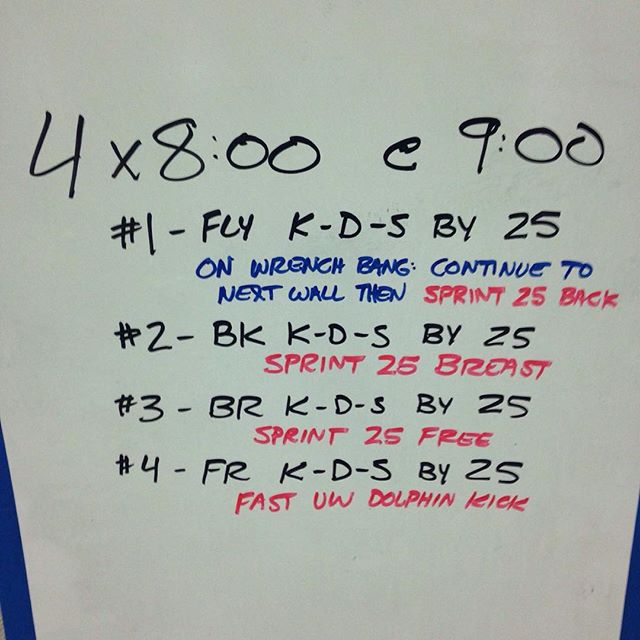
  3. Do swimming “fartleks”  Have swimmers swim for a set amount of time, and change their skill, stroke, drill or speed according to instruction each time you bang a wrench on the side of the pool.  This is good for getting aerobic swimming accomplished while sprinkling in technique work or speed work.  Especially good in a large group with lots of different speeds.
  4. Leave your stopwatch at home.  Time nothing for an entire day (or longer). This can free you up to focus on the quality of the movements your athletes are making and not worry about how fast they are going.
  5. Turn the pace clock off.  This can help your athletes focus on their movements without worrying about making an interval or going a certain time.  Put everything on an approximate rest interval.
  6. If you coach in a co-ed environment, separate the boys and girls into their own lanes and have them start at opposite ends of the pool.  Watch how not having the genders interact for an entire workout changes the social dynamics of your practice.
  7. Take the lane lines out. Do a pool open water (POW) practice.
  8. Have your swimmers write the workout.  A few days ahead of time, split them into groups and ask them to come up with the sets. Give them total time, distance, intensity, or whatever instructions (or lack thereof) that you want.  This will tell you a lot about the kind of swimmers you have.
  9. Start everything from the middle of the pool. This will add more turns to your workout and cut down a bit on excessive socializing while hanging on the wall.
  10. “Jungle Workout.” Start a set. Part of the way through, give one swimmer the details for the next set (which needs to start ASAP). Repeat again partway through that set and keep repeating.  Keep them on their toes.  Once you are done giving them sets, they have to go back and do whatever remains from each uncompleted set.  This practice will be chaotic but fun, as long as you have attentive swimmers.
  11. Write three different practices… Give them fun names.  Let your athletes choose which workout they want to perform (on an individual basis).