YOTA Kick-Out Sticks

Note: These “Kick-out Sticks” or “Streamline Sticks” have been a topic of discussion since Streamline Sticks was published. Coach Onken has the best design we’ve seen so far presented below.

Chad Onken, YMCA of the Triangle Area (YOTA)

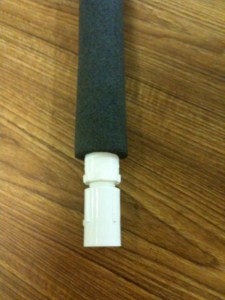
Picture #1 – pic of the end of the PVC pipe, with the male end super glued onto the edge of the PVC pipe. A divot was drilled into the male end to allow a slit where the lane rope cord will be.

Picture #2 – pic of the female end (male/female part is bought together)

Picture #3 – the three components of the kick-out stick: the PVC insulation (black), the female piece which is threaded to fit the male piece that is super glued to the top of the PVC pipe.

Picture #4 – picture of the female/male pieces screwed on together (with PVC insulation around the rest of the PVC pipe

Picture #5 – the final product at work (very close to the wall).

What makes this (soon to be patented – hahaha) product so great is that it allows for two way swimming in and out of walls and it is also completely moveable to different differences from the wall. You can make it as easy/challenging as you want it. The sticks are designed to take a beating, we have a few kids that consistently run into them all the time. And the best part is that they are very cheap – we were able to buy the supplies needed for a 6 lane pool for around $16.



The Rocket Tower

Ryan Woodruff, North Carolina Aquatic Club
coachryan@ncacswim.org

Check out the Rocket Tower:

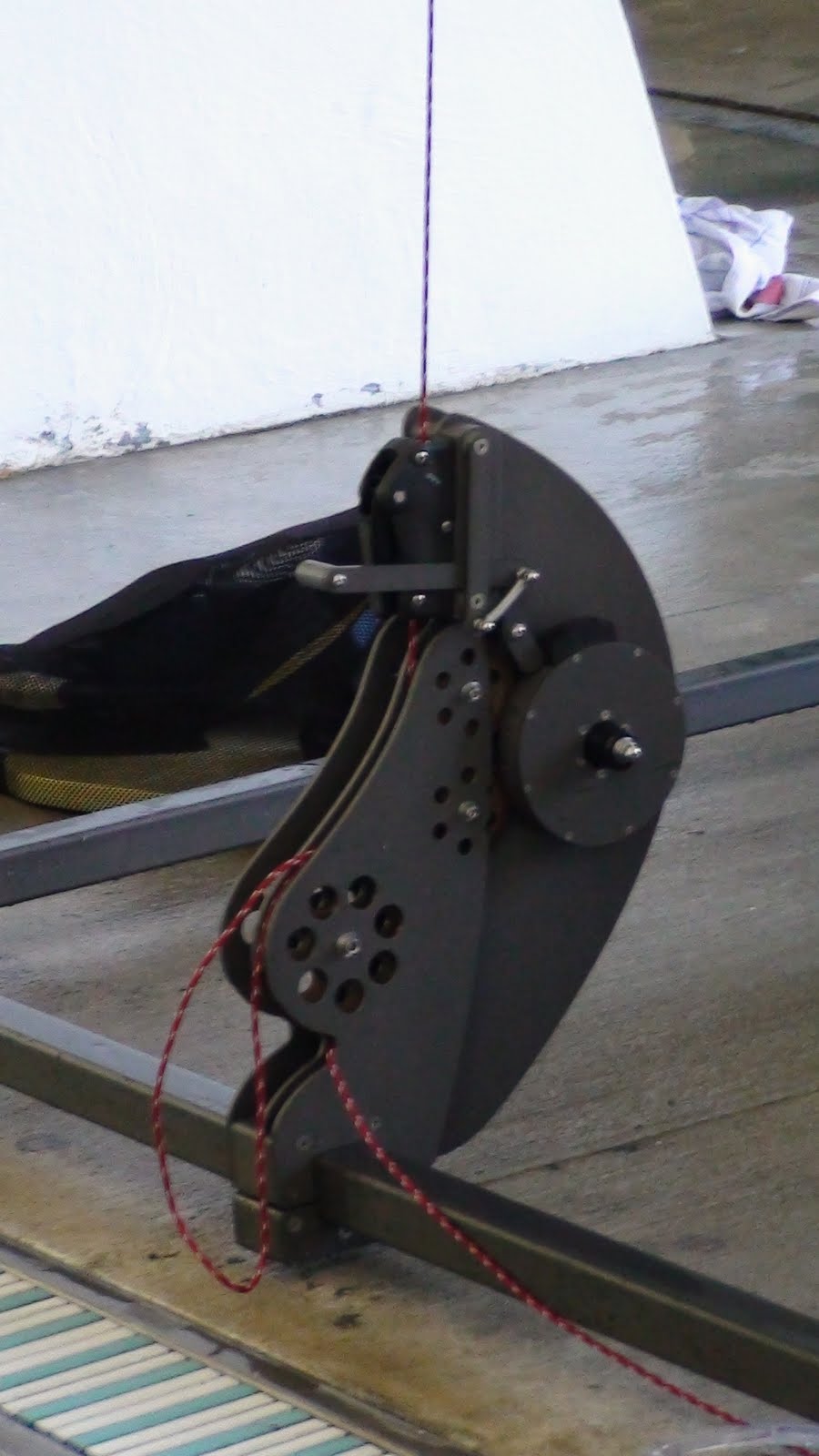
Sunday I was at the pool in Huntersville, NC for our Senior Champs and watched Nick Brunelli training on this beast. I had been looking at it sitting in the corner all weekend, wondering if it really was what it seemed. It’s a Power Tower on steroids, with the capability of providing assistance or resistance over 50 meters. Brunelli was eager to tell me about it when I asked. Apparently there are only 3 in existence right now–this one, one in Fullerton, CA with Sean Hutchison’s Center of Excellence group, and one at Arizona State (Brunelli’s alma mater and the home of the inventor). Brunelli said that it is vastly improved over the Power Rack, Power Reel, and Power Tower for a few reasons:

1) You can use it over 50 meters. Brunelli said it can pull him to a 21-second LCM 50 free.
2) It is made of military spec hard-anodized aluminum and FAA-Approved pulleys. The inventor is a metal fabricator in Tempe. Believe the hype when it comes to quality. The cable glides so smooth and with so little apparent friction, it makes the Power Tower look like someone’s 5th grade science project.
3) Very constant resistance and assistance. Unlike previous power training equipment, Brunelli said he feels very little “bounce” in between strokes. The forces are very smooth and steady. I am guessing this is due to the quality construction and the number of pulleys involved (I counted 15).

A few other observations:
1) The rocket on top is just for show. It houses the top pulleys, but those fins are merely for coolness.
2) The blue tube you see is the draining hose. The bucket is 60 gallons (HUGE!) yet drains easily through this and a secondary smaller tube.
3) There is an Inertia Safety Clutch built into the lower pulley system. This comes in handy if the belt happens to come off, and it can also be manually locked if you are 50m away and simply want to rest without clinging to the wall.

So I was impressed initially with the Rocket Tower. It is still in its infancy, but you can check out their website.

The Swimming Calculator

Coach Ryan Woodruff

Ever wonder how much faster your swimmer would be if he would just fix his turns? Curious about the combination of tempos and cycle counts that will lead to the fastest time for your swimmer?

This is the tool for you.

The Swimming Calculator (click to download the excel sheet)

Toy around with it a bit and let me know what you think. I am interested to hear any suggestions, and if anyone knows how to set this up in an html format, I would love to be able to put it on the web to eliminate the cumbersome excel download.

The Swimming Calculator can also henceforth be found in the Tools for Coaches section in the menu above.

Time Bomb Blastoffs

Louis Cavadini

Here’s one more modified wizard set we did last week–another version of blast-offs (See The Shallow End Kick Set)

In the deep end of the pool we did blast-offs but here is the twist: They are time controlled. The group starts together and goes to the bottom on the Coach’s “go”. They stay down for about 5 seconds and then blast up, catch a breath as they come out and then fall straight back to the bottom. We repeated this about 5 times and then took a break. We didn’t start the watch until everyone had returned to the bottom of the pool.

5x (5x :05 under deep-end blast-offs)

If I had kids that spent too much time above water after each one, I sprayed them with the hose in order for them to get back under quickly. After a couple rounds, we did the final one a bit different…adding 5 seconds per dive, going till the last person couldn’t go any longer:

1x :05 under deep-end blast-off
1x :10 under deep-end blast-off
1x :15 under deep-end blast-off
1x :20 under deep-end blast-off
1x :25 under deep-end blast-off
1x :30 under deep-end blast-off
(that’s as long as they could go)

The Guessing Game (For Sprinters)

Ryan Woodruff, Lynchburg YMCA

The concept here is similar to yesterday’s post – The Guessing Game. For a sprint or non-freestyle version of the Guessing Game, I like to do 50s, and have the swimmers guess within a 0.2-second range. They also have to be within a certain range (like 4 seconds) from P200. I use the same points system as in the regular Guessing Game.

I actually had a swimmer recently who guessed his 50 time to the one-hundredth of a second exactly on his first one. He was thus done with practice and the rest of his teammates seethed.

Give it a try and let me know how it goes!

Twenty Ways to Do 20 x 25 – #13

Ryan Woodruff, North Carolina Aquatic Club
coachryan@ncacswim.org

#13 – The Cookie Cutter Set

? x 25 Any stroke @ :30

Keep doing them until you achieve 20 in five successful sets of 4. The coach times each 25 to the tenth of a second. To perform a successful set of 4, all swims must be in a range of .2 seconds. Try to do everything the same each time – same streamline, same underwater kicks, breakout, cycles, and finish. If one of your 4 swims falls outside the range, those do not count. Start a new set of 4. You are done when you have achieved five sets of four.

The Blind Results Workout

Ryan Woodruff
Lynchburg YMCA

This workout is very similar to The Blind Goal Workout but has a single important difference: the athletes may see their respective coach-determined goals, but they do not get to hear their results. The coach may tell the group how many points they have achieved, but may not say who achieved them or what times the swimmers swam.

Follow the same format as in the Blind Goal Workout. It will be interesting to see how your group’s motivation ebbs and flows throughout the set. Steer them to being positive and supportive, then just watch what they can do!

Lemon I.M.s

Ryan Woodruff, North Carolina Aquatic Club
coachryan@ncacswim.org

Here’s a fun way to do some IM swims. I call them “Lemon I.M.s” because you are squeezing the strokes together.

For instance, a 200 IM could look like this:
175 fly, 8 back, 8 breast, 8 freestyle (for simplicity’s sake, we’ll equate 8 yards to 1/3 of a pool length). The swimmer simply changes strokes rapidly mid-pool.

Or a 200 IM could look like this:
8 fly, 8 back, 8 breast, 175 freestyle.

You get the idea… “Squeeze” two or three strokes together into a 25 or a 50, and leave one stroke out to swim the majority of the distance. It provides some variety for the swimmers, and those mid-pool transitions are really something to watch!

Kick for Distance – Part 2

Ryan Woodruff, North Carolina Aquatic Club
coachryan@ncacswim.org

This is a follow-up to the 15-minute Kick Test Set.

5x:
:30 vertical kick w/ a snorkel
1 x 100 drill @ 2:00
3:00 kick for distance @ 5:00. Measure and remember distance to the nearest yard.

Use the athlete’s results from the 15-minute Kick Test Set to set a baseline goal for the 3:00 kick for distance.

(15-minute distance)/5 = Goal time for 3:00 kick for distance.

Freedom Fridays

Ryan Woodruff, North Carolina Aquatic Club
coachryan@ncacswim.org

Do you want your swimmers to take more personal ownership of their swimming? Do they need a better understanding of exactly what it is that they do to become fast? Here’s a solution for you.

I call it Freedom Fridays. Ask your swimmers: “If you had 20 minutes at practice to do whatever you thought would make you a better swimmer, what would you do?” Have them write down their own set (no copying from teammates) on a 3 x 5 note card. It can be anything they want, but must involve 1)being in the water 2)becoming a better athlete and 3)take about 20 minutes. The set can be easy or hard, require a coach’s help or not, but it MUST be directed toward getting better and they should be able to explain what they are doing.

Collect the cards and then allocate time each week to do their set. We do it on Friday and call it “Freedom Friday.” It is a great way to end the week. Freedom Fridays promote critical thinking on the athlete’s part, foster a sense of ownership of their training, and are just plain fun too. Give it a try with your Senior kids. I think you will like the results