Ryan Woodruff
Head Coach
Lynchburg YMCA

Free Swimming Workouts, Sets, Ideas, and Dryland Exercises from Professional Coaches Around the World
Ryan Woodruff
Head Coach
Lynchburg YMCA
Ryan Woodruff
Head Coach
Lynchburg YMCA

Ryan Woodruff
Head Coach
Lynchburg YMCA
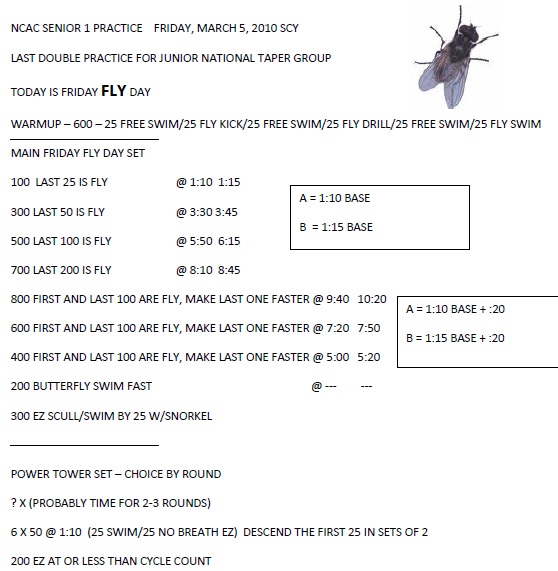
I can’t wait for our season to start on Monday, so to keep the blog going until then, I am reaching back into the archives a bit. This workout is from my days at the North Carolina Aquatic Club in 2010. This is a SCY workout that we did about two weeks before we attended Junior Nationals.
Ryan Woodruff
Head Coach
Lynchburg YMCA
This practice has a simple structure, with instructions modified for three different levels of swimmers within a group.

Ryan Woodruff
Head Coach
Lynchburg YMCA
This workout goes back to 2009. It was written for SCY for an athlete who was an Trials-caliber backstroker and IMer. The focus was on underwater kicking and backstroke strength. The “yellow” parachute was rather small and the “1st black buoy” refers to 15m mark from the opposite end of the pool.

Ryan Woodruff
Head Coach
Lynchburg YMCA
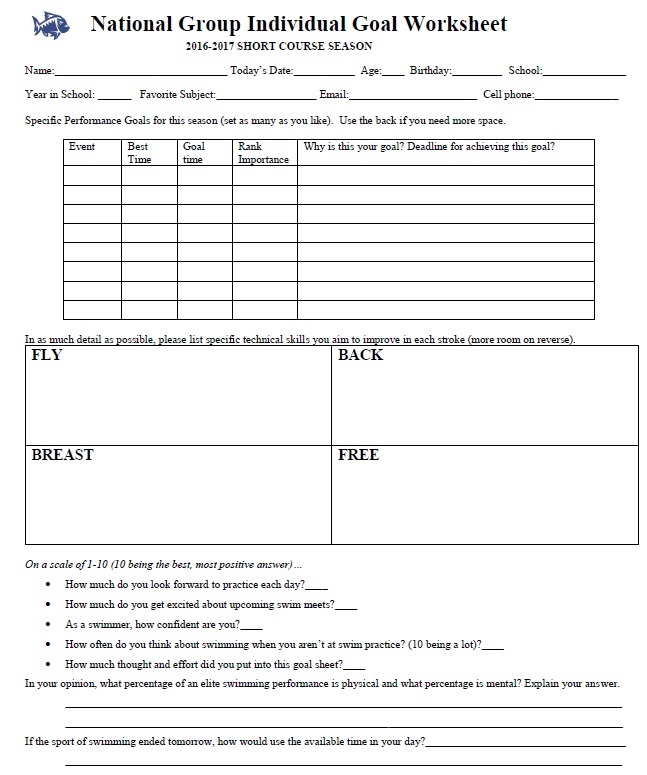
Our team is currently on a break, so I haven’t been writing any workouts to post lately. I hope you have enjoyed the different posts over the last few days. Here is another one that isn’t a “workout” exactly, but I hope you will find it helpful nonetheless.
Here is a copy of the goal sheet I have given my swimmers for the upcoming season. Over the years, I have seen coaches use a variety of approaches to goal setting. My approach has changed a bit from year to year as well. If you are willing to share your process, I would love to hear how you and your team do it.
Here are some of our recent posts that will put a unique twist on your workouts:
1. The Deck of Cards Practice
2. The Best Idea I Ever Had (or Stole)
3. The Hot Lava Set
4. Asking for Feedback
5. The “Wet-land” Challenge Set
6. The M & M Set
7. Blind Goal Workout
8. Stopwatch Roulette
9. Let’s Get Funky
10. The ? Set
And just in case…
Here are some of our recent most popular distance workouts…
1. Open Water Preparation with Coach Tyler Fenwick
2. Not Sure If They Liked It, But It Was Good For Them
3. Big Set with Coach Mathieu Leroy, France
4. Just A Glorious Little Distance Set
5. Working 500 Pace with the Twin River YMCA
6. Can you survive “The Hurricane”
7. Pacing the 1500 Like a Pro
8. Lucky Sevens
9. They Said I Should Instagram This One
10. CAUTION! For Milers Only
Ryan Woodruff
Head Coach
Lynchburg YMCA
See yesterday’s post for #1-10
Ryan Woodruff
Head Coach
Lynchburg YMCA
1. 15-minute Kick Test Set
2. Find Your Threshold Tempo
3. Working 200 Race Pace
4. Triple Crown Set
5. Underwater Kicking Test Set
6. Baltimore IMs
7. The Armada IM Set
8. The Blind Results Workout
9. The Blind Goal Workout
10. How Low Can You Go?
More coming tomorrow..
Ryan Woodruff
Head Coach
Lynchburg YMCA

Ryan Woodruff
Head Coach
Lynchburg YMCA
Ryan Woodruff
Head Coach
Lynchburg YMCA
Ryan Woodruff
Head Coach
Lynchburg YMCA
20 x 25 fly
odds kick @:30
evens fast swim @:20
100 easy free @ 2:00
10 x 50 fly
odds drill @1:00
evens fast swim @:40
100 easy free @2:00
6 x 75 fly
all fastest possible average @ :10 rest
200 easy choice 25 scull/25 swim
Ryan Woodruff
Head Coach
Lynchburg YMCA
Ryan Woodruff
Head Coach
Lynchburg YMCA
We do this set in a SC pool, but it could work in a LCM pool as well. Have swimmers partner up, with each partnership getting a stretch cord. One person wears the belt and is in the water. The other person stands on deck and holds the cord, letting it out gradually to provide resistance. It is sort of a “poor man’s Power Tower.” The person in the water does:
4 fast underwater dolphin kicks (then gets towed back to the wall) then immediately pushes off into:
6 fast underwater dolphin kicks (same)
8 fast underwater dolphin kicks (same)
10 fast underwater dolphin kicks (same)
12 fast underwater dolphin kicks (unhook the belt) and immediately push off into
1 x 25 all out sprint choice with max underwater kicking (at full speed, not necessarily max distance)
1 x 25 ez and trade places.
Repeat as many times as you wish.
Ryan Woodruff
Head Coach
Lynchburg YMCA
Ryan Woodruff
Head Coach
Lynchburg YMCA
Ryan Woodruff
Head Coach
Lynchburg YMCA
Try this one for a little variety. Instead of writing specific sets, have swimmers draw playing cards from a deck to determine what stroke, distance (with instructions), and number of repeats to do. One swimmers draws the three cards, then the group does the set. Repeat as long as you wish.
The first picture below is the layout for the conditions of the card picking. The second picture explains the sets that we ended up doing in about an 80 minute practice.
The likelihood of getting 3 aces is about .018%, or 1 in 5,555. But there is still a chance.


Ryan Woodruff
Head Coach
Lynchburg YMCA
My swimmers have recently been obsessed with flipping water bottles. They toss them up in the air, trying to get them to land on the base. We have spent countless hours at meets and even time at practice in between sets trying to successfully flip bottles. Maybe you have seen the video sensation on youtube.
So we decided to make it part of a workout. We did a relay. Before each swimmer dove in, someone on his or her team had to successfully execute the water bottle flip. It made for a fun event.
Ryan Woodruff
Head Coach
Lynchburg YMCA
Ryan Woodruff
Head Coach
Lynchburg YMCA
Ryan Woodruff
Head Coach
Lynchburg YMCA
Ryan Woodruff
Head Coach
Lynchburg YMCA
Ryan Woodruff
Head Coach
Lynchburg YMCA
LCM. Just an ordinary kick set. If done with extraordinary focus and intent, it can be a great set.
Ryan Woodruff
Head Coach
Lynchburg YMCA
Ryan Woodruff
Head Coach
Lynchburg YMCA
Ryan Woodruff
Head Coach
Lynchburg YMCA
Ryan Woodruff
Head Coach
Lynchburg YMCA
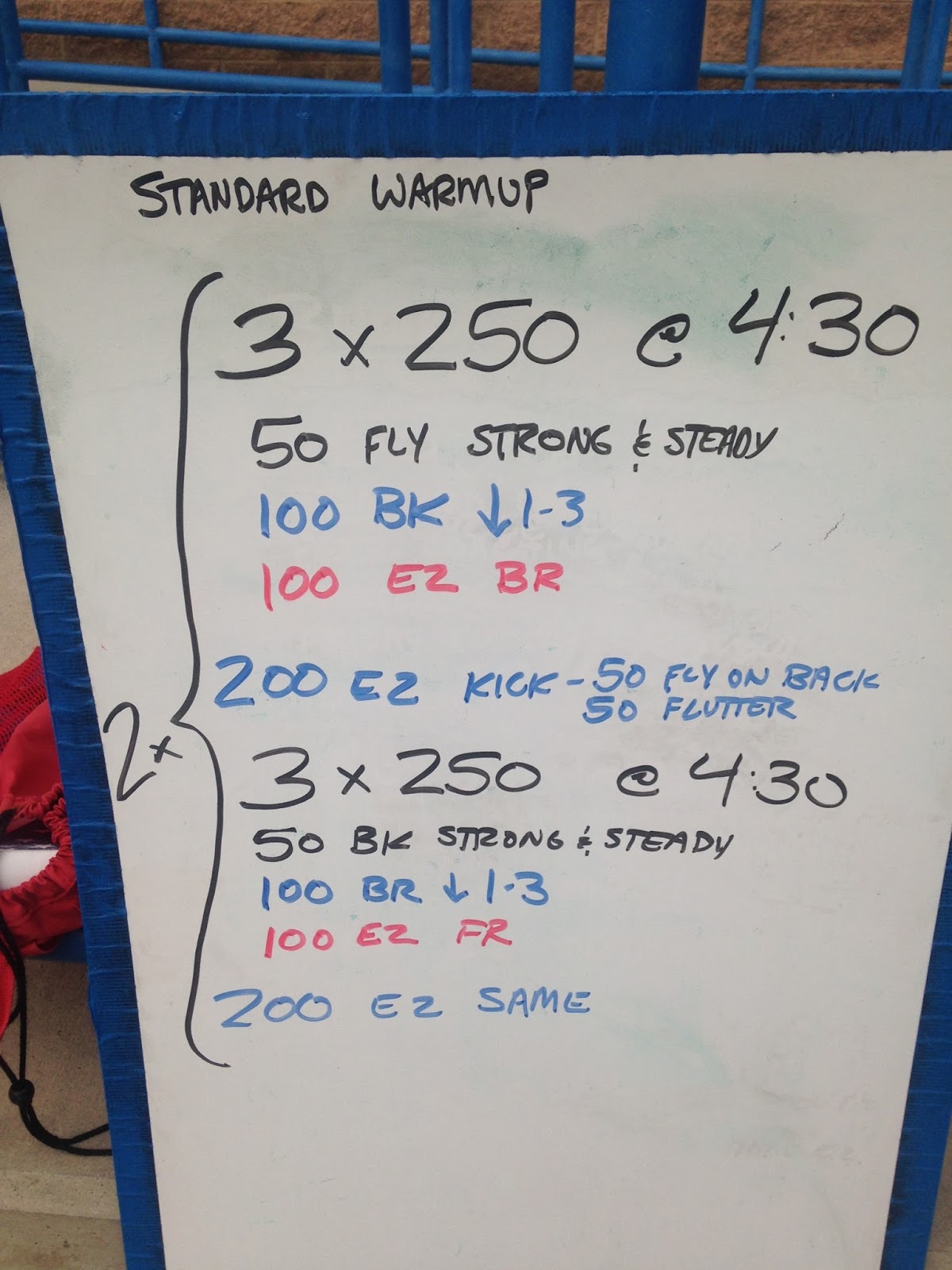
Standard Warmup
Pre-Set 4 x 100 choice @ :20 rest. Fast turns and 4+ dolphin kicks
Main Set (go to a hand touch on everything and keep an eye on the clock):
4 x 75 at P200+6 seconds @ 1:20
200 ez @ 3:00
3 x 75 at P200+4 seconds @ 1:20
200 ez
4 x 50 at P200+2 seconds @ 1:00
150 ez @ 2:20
3 x 50 at P200+1 seconds @ 1:00
150 ez @ 2:20
2 x 50 at P200 @ 1:00
150 ez @ 2:20
1 x 50 at P200-1 @ 1:00
1 x 25 at P100 @ :40
100 ez @ 1:40
2 x 25 at P100 @ :40
100 ez @ 1:40
3 x 25 at P100 @ :40
100 ez @ 1:40
4 x 25 at P100 @ :40
 The Swimming Wizard