Ryan Woodruff
Head Coach
Lynchburg YMCA
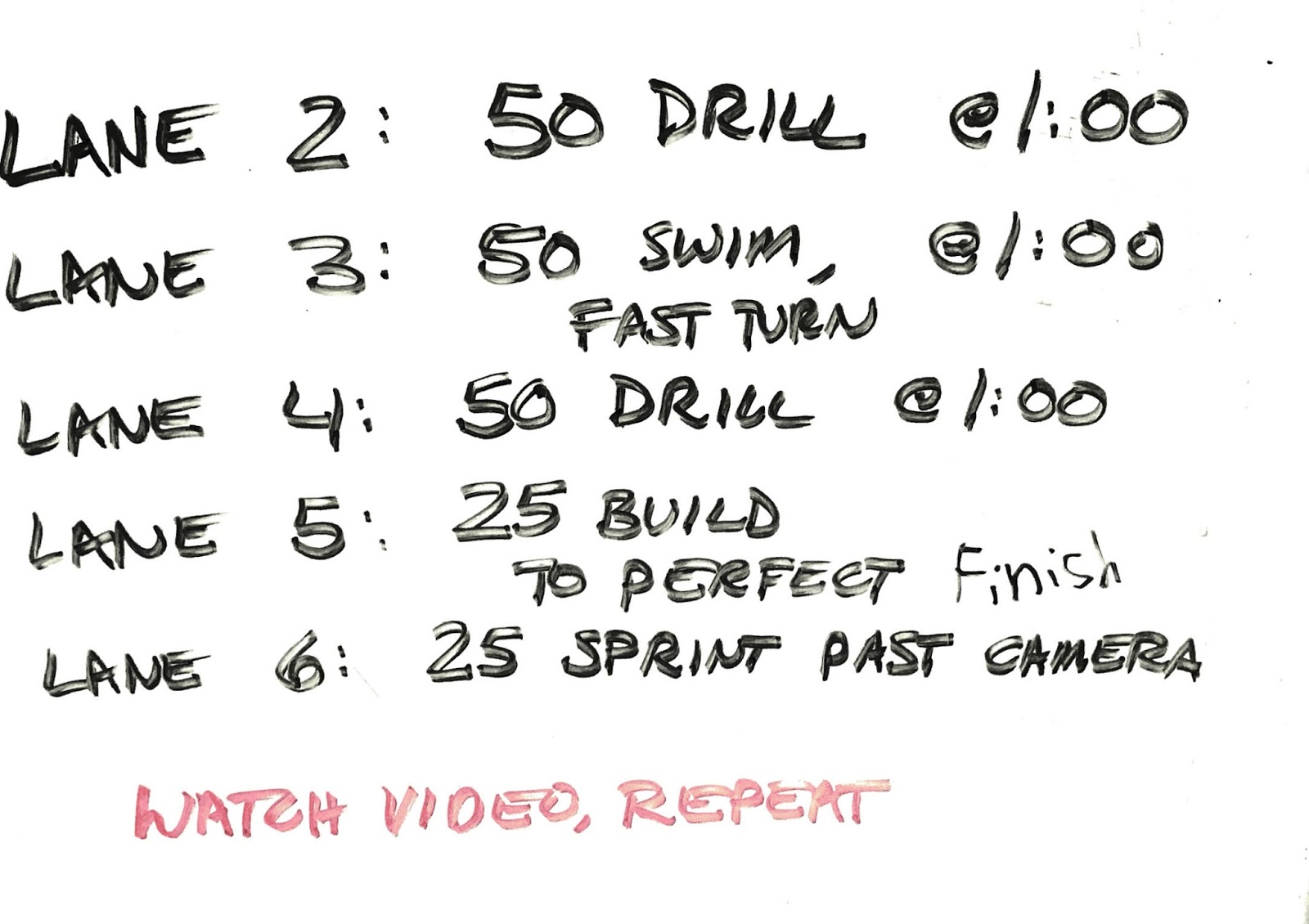
This set was a corollary to yesterday’s post, and was more for our mid/sprint folks.
Free Swimming Workouts, Sets, Ideas, and Dryland Exercises from Professional Coaches Around the World
Ryan Woodruff
Head Coach
Lynchburg YMCA
This set was a corollary to yesterday’s post, and was more for our mid/sprint folks.
Ryan Woodruff
Head Coach
Lynchburg YMCA
SCY
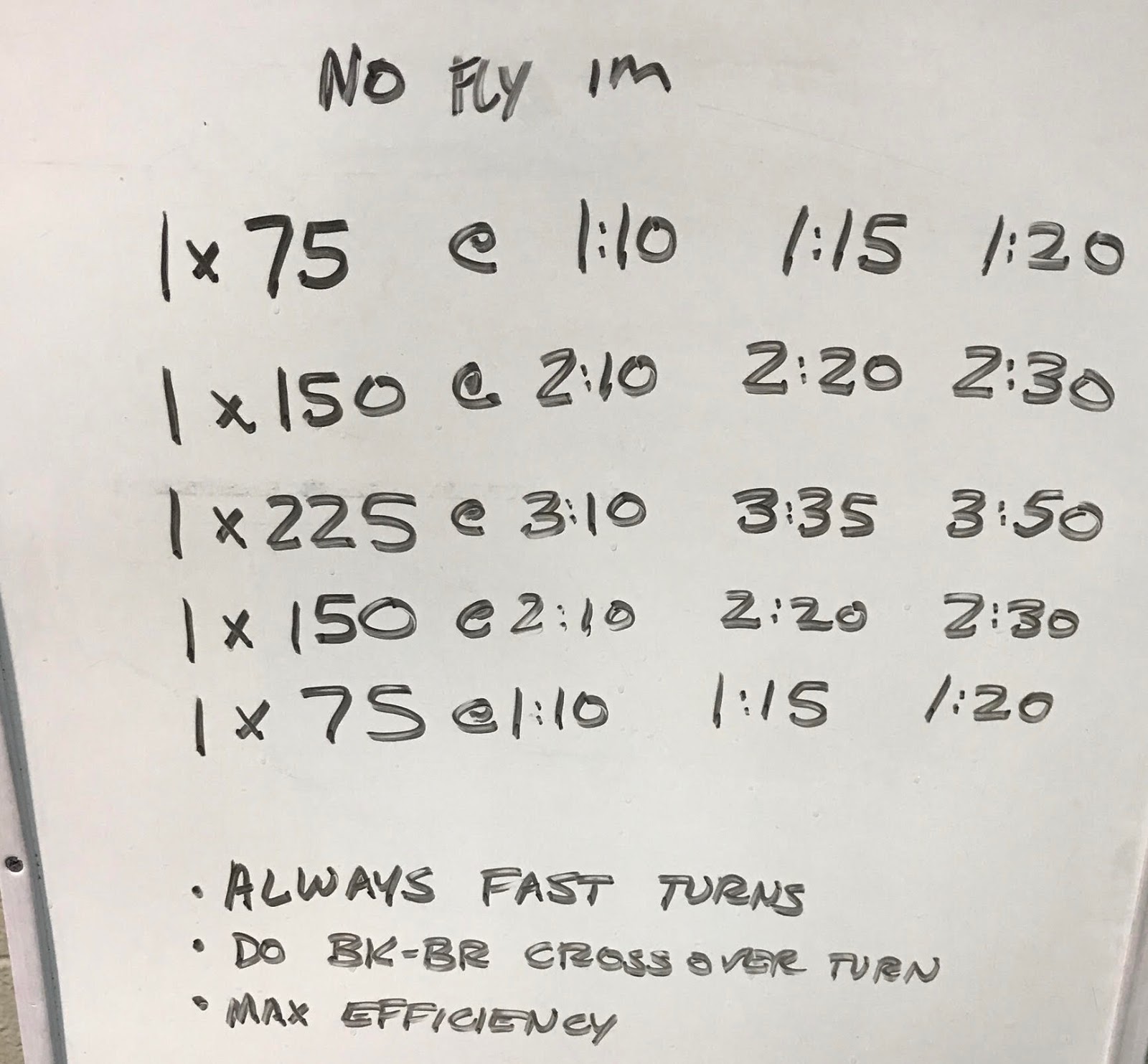
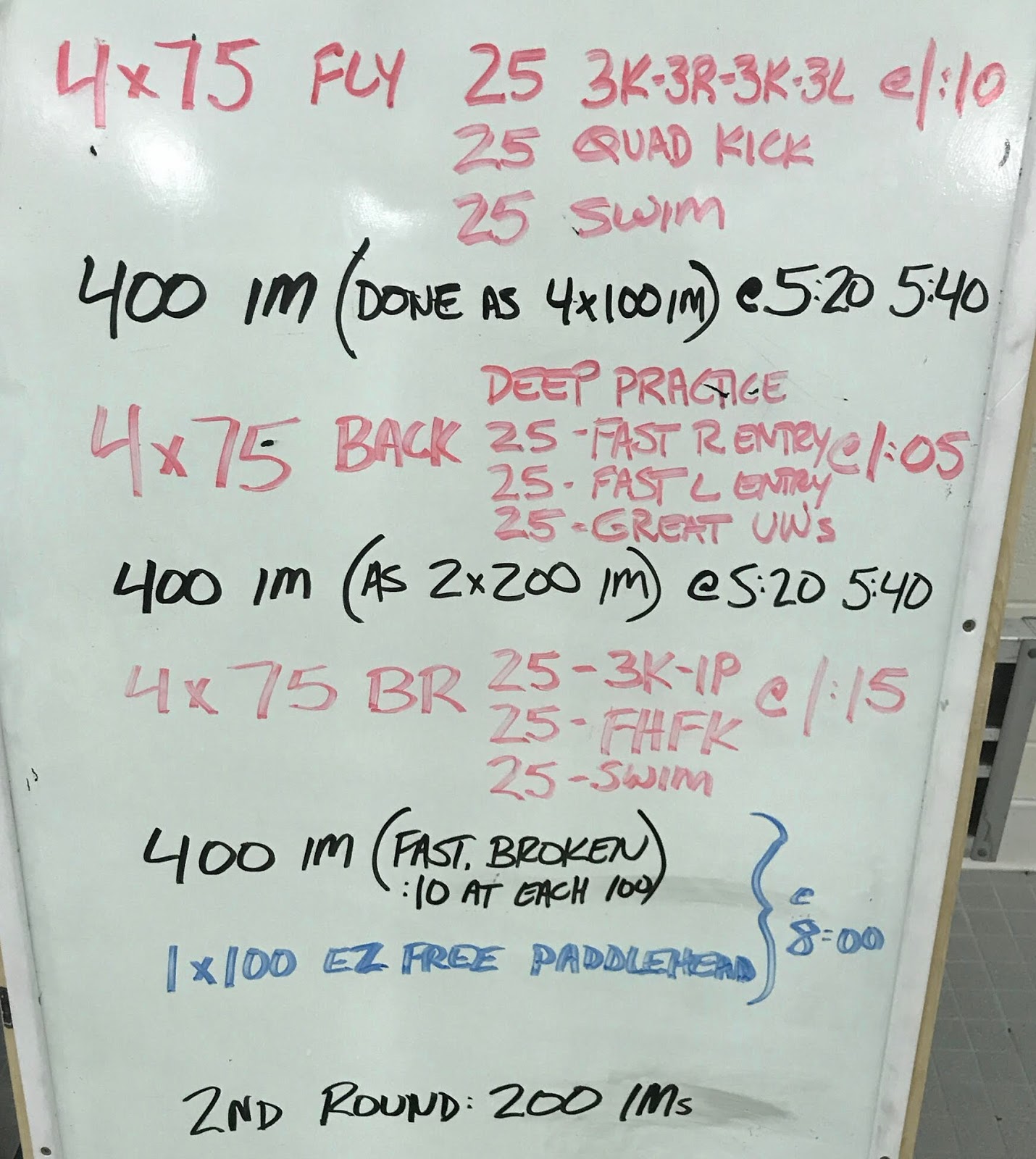
We were able to get some excellent results on this IM set. The intent is for the 400 IMs and 200 IMs to each descend 1-3.
4 x 75 Fly @ 1:10
25 – 3 kicks on side/3 R arm strokes/3 kicks on opp side/3 L arm strokes
25 – 4-kick drill
25 – fly swim
1 x 400 IM (done as 4 x 100 IM) @ 5:20 5:40
4 x 75 Back @ 1:05
50 – focused on connecting finish to entry
25 – awesome UW kicks
1 x 400 IM (done as 2 x 200 IM) 5:20 5:40
4 x 75 Breast @ 1:15
25 – 3 kicks/1 pull drill
25 – FHFK (Fast Hands Flutter Kick Drill)
25 -Swim
1 400 IM Fast, Broken :10 rest at each 100
+ > @ 8:00
1 x 100 EZ Free
***ROUND TWO – CHANGING 400s to 200s****
4 x 75 Fly @ 1:10
25 – 3 kicks on side/3 R arm strokes/3 kicks on opp side/3 L arm strokes
25 – 4-kick drill
25 – fly swim
1 x 200 IM (done as 2 x 100 IM) @ 2:40 2:50
4 x 75 Back @ 1:05
50 – focused on connecting finish to entry
25 – awesome UW kicks
1 x 200 IM @ 2:40 2:50
4 x 75 Breast @ 1:15
25 – 3 kicks/1 pull drill
25 – FHFK (Fast Hands Flutter Kick Drill)
25 -Swim
1 200 IM Fast, Broken :10 rest at each 50
+
1 x 100 EZ Free
Ryan Woodruff
Head Coach
Lynchburg YMCA
The purpose of this set was to challenge our athletes from a technical standpoint in all strokes. For the first 75, they swam with a tennis ball in each hand. As we have posted in the past, this essentially removes the hand as a propulsive surface, encouraging use of the forearms, the kick, and the core for propulsion. Setting the tennis balls down, we sprinted the first 25 (on a tight interval), paying attention to our cycle count and enjoying the sensation of having use of the hands again. We followed that up very quickly with a 25 of the same stroke, demanding excellent efficiency and stroke length by asking for the 25 to be performed with 2 fewer cycles than the previous 25.
Ryan Woodruff
Head Coach
Lynchburg YMCA
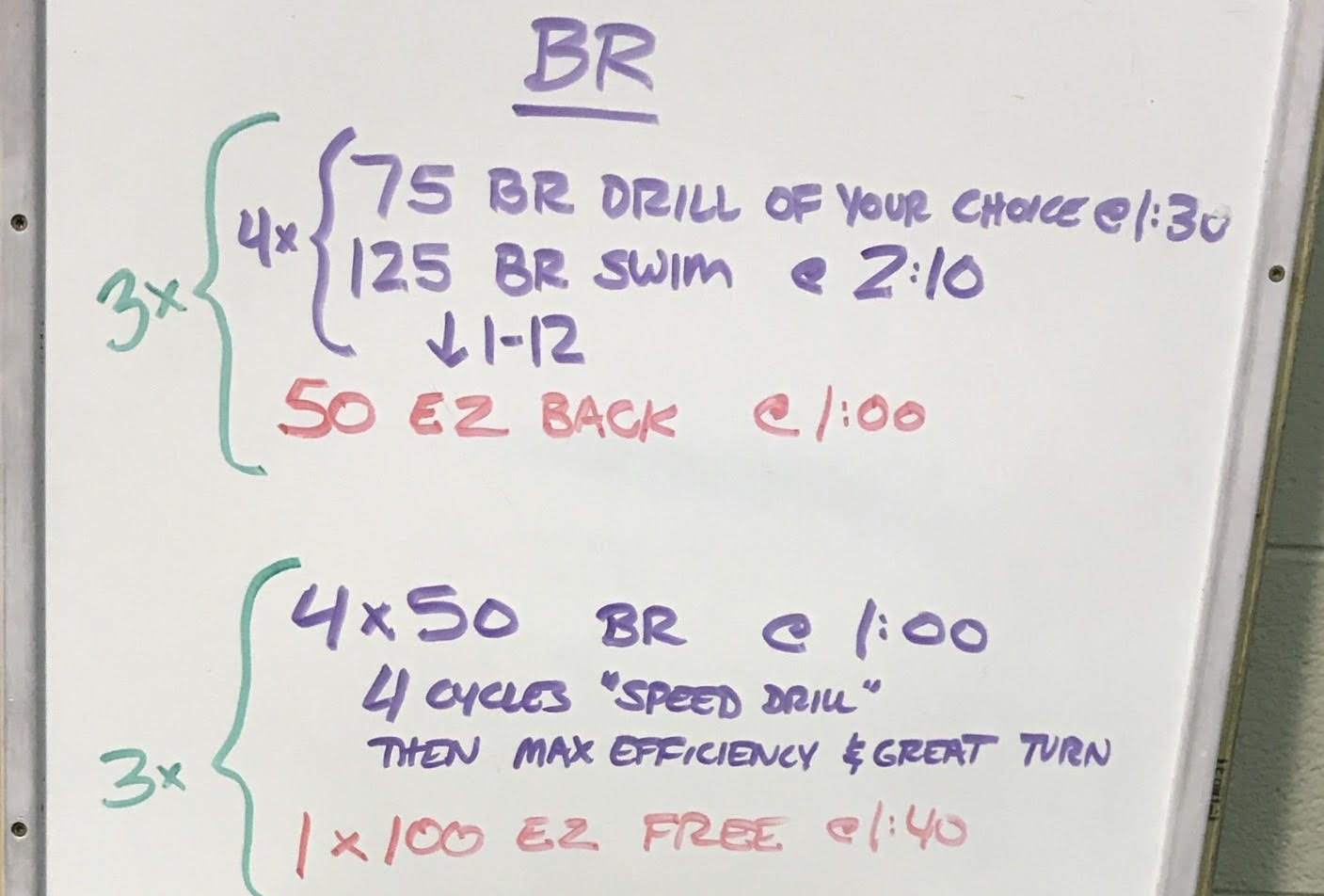
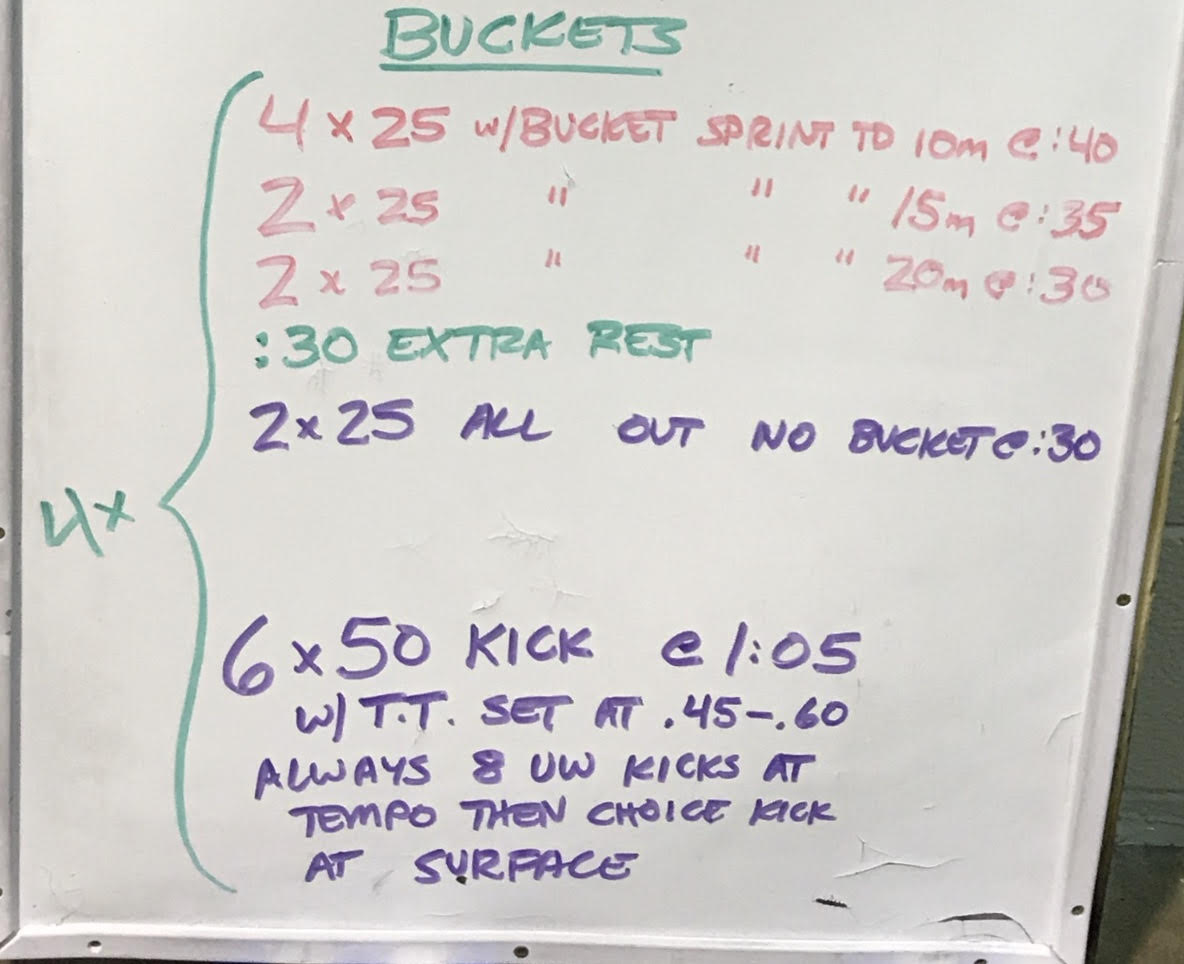
Most of the time, sets that coaches share (including the ones I post to this blog) are ones that were at least modestly successful. This isn’t one of those sets. Instead, this is a set that didn’t work how I was hoping. I am posting to share what I learned.
This was originally intended to be just a breaststroke set, and I tried to make it work for a few butterfly specialists who didn’t fit into the backstroke/freestyle set that we were doing at the same time. It was fine for the fly, but for breaststroke it just didn’t work.
Swimmers reported that during/after this set they felt that their timing was off and they felt sluggish. In hindsight, the 6 x 50 kick with the bucket was probably too much. The volume made the 50s too slow and probably diminished any power-training effect. The rest of the set probably would still work (FPA = Fastest Possible Average), but it might be better to do 1-2 50s or 2-3 x 25s instead, and include more drill before the FPA.
See other recent breaststroke sets here.
Ryan Woodruff
Head Coach
Lynchburg YMCA
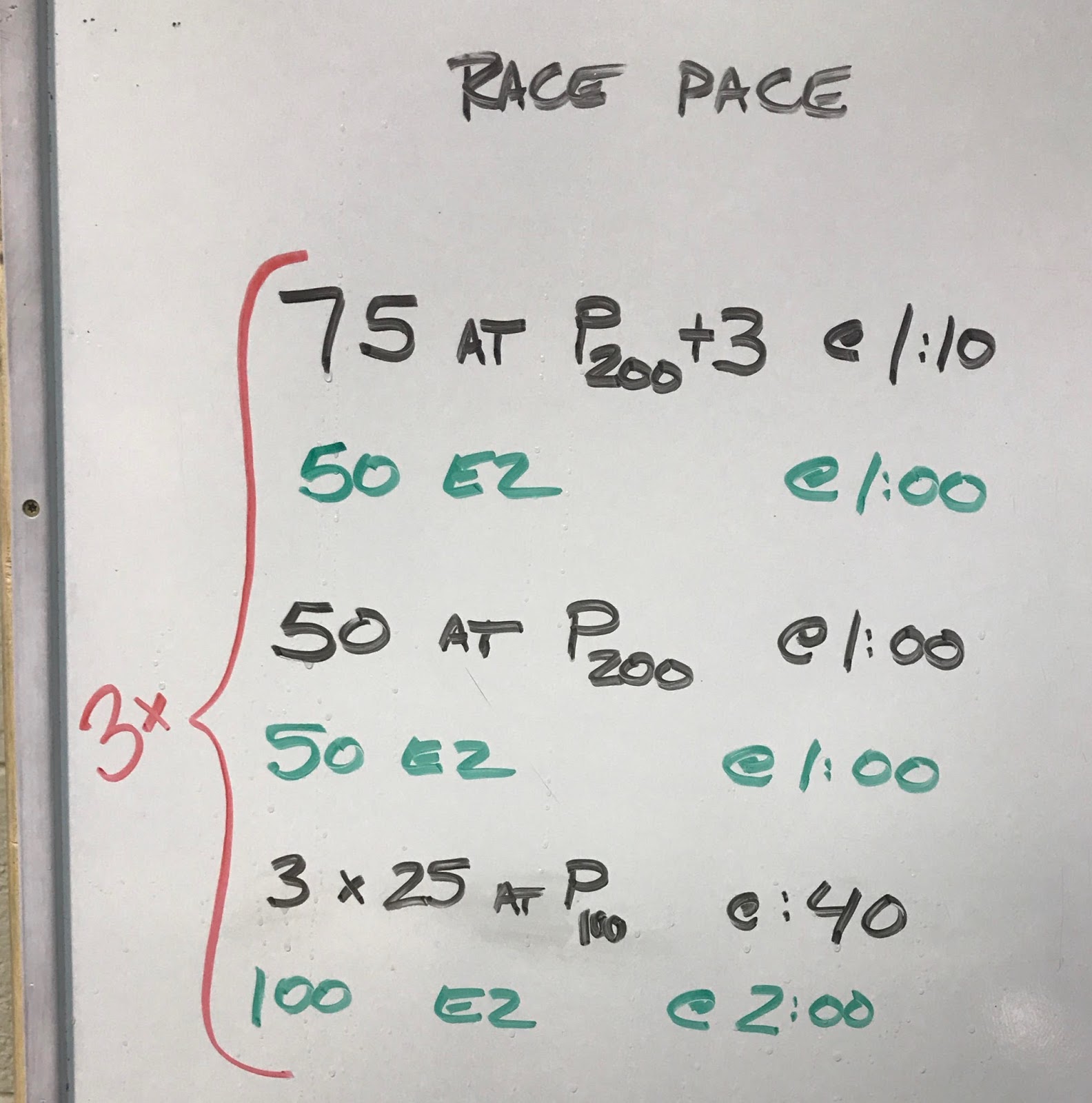
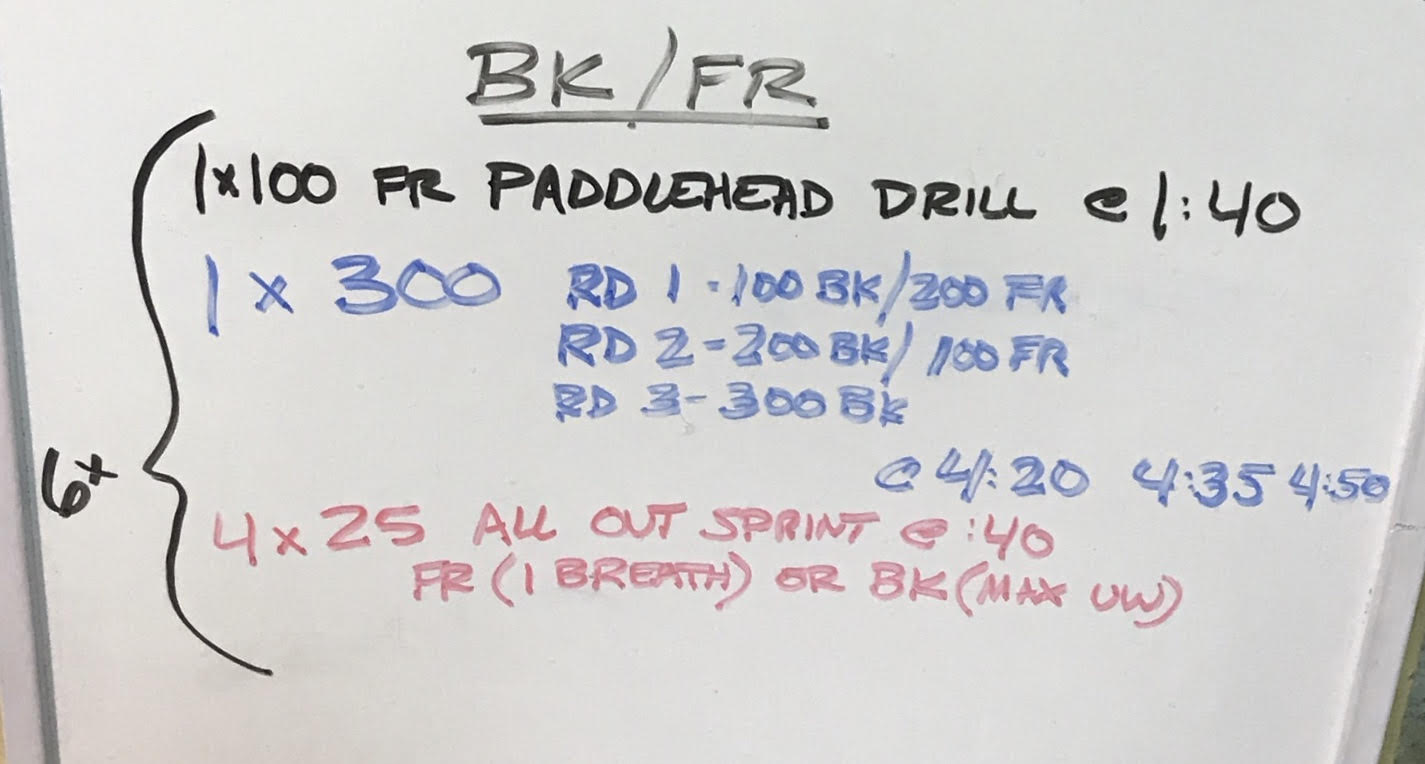
We had our backstroke/freestylers (both sprint and distance) do this set recently. Most liked it and said they felt smooth and strong during the set. This was good news as we did this set before we performed the Race Pace Set for Well-Oiled (Team) Machine.
Ryan Woodruff
Head Coach
Lynchburg YMCA
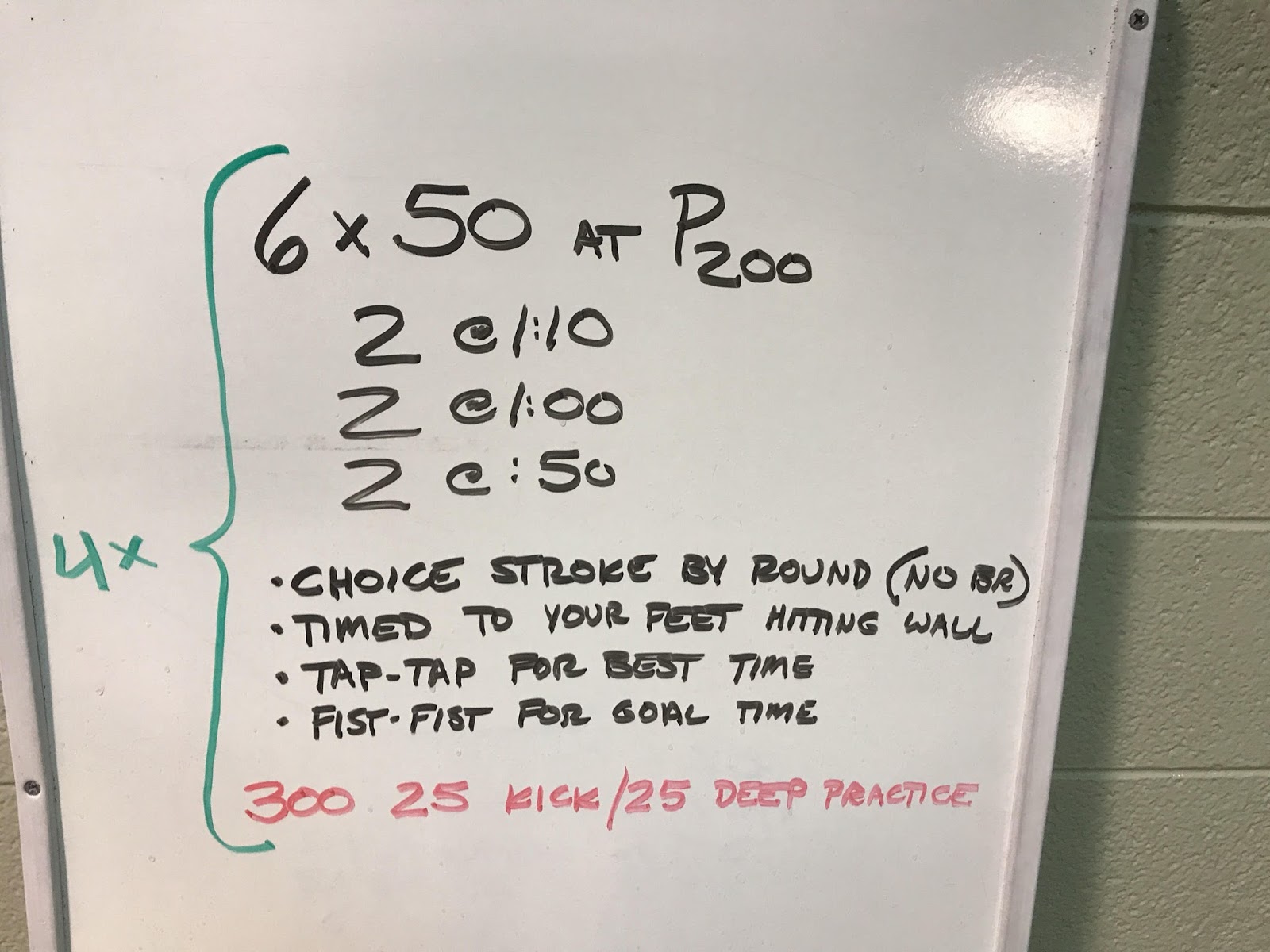
This set is a really simple one, variations of which have appeared on this blog multiple times. I am sharing/re-sharing it today to further explain how we execute this set.
Recently, we moved several swimmers up into our top group, so I have taken that as an opportunity to re-emphasize our procedures. I like to run a very clean, efficient practice, one where every swimmer knows what he or she should be doing and what the expectations are.
For this set, we had 4 or 5 swimmers per lane across 5 lanes. The aim of the set is to swim at 200 race pace on EVERY 50, but I instructed them to be mindful of taking it one-at-a-time. The early interval gives them good rest to be able to achieve that pace (and build some confidence for later), and then we tighten it up and get a REAL test on #5 and #6.
I typically solo coach 15-25 athletes in a given practice, so in order for things to function efficiently on this set, we do the following:
That’s just one coach’s example of how we keep practice humming right along… what strategies do you use?
Mike Cook
Mason Makos
We did this yesterday as we came off a big meet and get ready for our mile swim after the holidays.
Warm up
200 swim 200 kick
66x 25 free @30 with snorkels. Stay focus and long
33×50 free to back @1:00. Build to fast flip with good dolphins off each turn
16×100 free odds @1:20 evens @1:10
1×50 all out free
66×25 kick with fins. Every 6th one underwater dolphin to 15 meter @ 35
Breaking 2 by National Geographic (Youtube documentary)
William James on the Psychology of the Second Wind and What Enables Us to Transcend Our Limits by Maria Popova of The BrainPickings Blog
My Favorite Tweets of the Year
When we say “hard work” we should be referring to an entire process:-preparation
-grind
-step away
-fine tune
-recover and reflect
— Brad Stulberg (@BStulberg) November 14, 2017
https://platform.twitter.com/widgets.js
The worst thing you can ever do is think you know enough. pic.twitter.com/uqpLhyvM8P;
— Sean Hutchison (@ikkosCEO) October 17, 2017
https://platform.twitter.com/widgets.js
When youre good, you study the competition.When youre great, the competition studies you.
When youre unstoppable, there is no competition.
— Tim S. Grover (@ATTACKATHLETICS) September 29, 2017
https://platform.twitter.com/widgets.js
;
— Olympics (@Olympics) April 5, 2017
https://platform.twitter.com/widgets.js
Bullseye hit.There is no fancy gadget or new technology that can inspire & ignite an athlete quite like a coach is capable. pic.twitter.com/FGtmiHPrgG
;
— Jonathan J. Marcus (@jmarpdx) November 25, 2017
https://platform.twitter.com/widgets.js
“I wonder if coaches’ careers shouldn’t be measured by wins & losses as much by number of weddings & christenings invited to.” Dave Silk USA— Wade Gilbert (@WadeWgilbert) November 1, 2017
A good one to show your athletes — what will you do when you “get a flat” and hit some adversity? — FIND A WAY!
https://platform.twitter.com/widgets.js
When your team car is far behind but your adrenaline says “keep going!” 😂😂😂 pic.twitter.com/i31jNG9wRR;
— Cycling Today (@CyclingTodayEn) November 8, 2017
Ryan Woodruff
Head Coach
Lynchburg YMCA
We all know that I.M. is a great way to put some variety into your training. Here are some ways to put a little variety into your variety.
#1 – Reverse I.M. A commonly used version, simply swim the strokes in reverse order.
#2 – Free I.M. Good for masters swimmers who are fly-reluctant or for any time that you want to get good back, breast, and free training without the butterfly. Simply substitute freestyle in for the butterfly portions of the I.M.
#3 – Inside-out I.M. Swim the strokes in the order Back-Fly-Free-Breast
#4 – Fat I.M. – Do these for lengths that are 25% longer than your standard I.M.-125s, 250s, 500s, etc. Double up on one of the strokes (this is the Fat stroke). A 250 Fat I.M. (Back) would thus be 50 Fly/100 back/50 breast/50 free.
#5 – Lemon I.M.
#6 – Emily I.M.- For swimmers with knee injuries/pain or whose breaststroke is not a focus of your efforts for improvement. Swim backstroke double the normal distance and leave out breaststroke altogether. Yes, this is named after a swimmer.
#7 – Baltimore I.M.s
#8 – Skinny I.M. This is the opposite of Fat I.M.s Swim distances like 175s, 350s, etc. Cut the distance of one stroke in half.
#9 – Gator I.M. Alternate stroke and free. A 300 Gator I.M. would be 50 fly/50 free/50 back/50 free/50 breast/50 free.
Do you have any other interesting or creative ways of training I.M.?
This post was originally published to this blog in February 2010.
Ryan Woodruff
Head Coach
Lynchburg YMCA
Ryan Woodruff
Head Coach
Lynchburg YMCA
Ryan Woodruff
Head Coach
Lynchburg YMCA
The purpose of this set is promote kinesthetic awareness and a better “catch” in all strokes combined with a bit of speed. We used tennis balls held in the palm of the hand to take away the ability to pull with the hand surface. Swimmers enjoyed the effect of the tennis balls when they went back to an open hand.
24 x 50
#1-5 are with tennis balls, excellent technique
#6 – no tennis balls, SPRINT!
6 fly @:50
6 back @:50
6 breast@1:00
6 free @:50
Ryan Woodruff
Head Coach
Lynchburg YMCA
Ryan Lee
Shawnee Mission Northwest High School
Gregory A. Johnson
Head Age Group Coach
Greater Pensacola Aquatic Club
Ryan Woodruff
Head Coach
Lynchburg YMCA
Our club doesn’t have the luxury of having power towers to use (yet), so we substitute by having swimmers hold a stretch cord for the their teammates, giving them resistance for short sets such as the one below. One swimmer is tethered in the water and performs this set, and then they switch roles. No rest except where indicated.
1 x 8 all out UW kicks and then get pulled back to wall
1 x 8 all out UW kicks + 1 sprint cycle and then get pulled back to wall
1 x 8 all out UW kicks +2 sprint cycles and then get pulled back to wall
1 x 8 all out UW kicks +3 sprint cycles and then get pulled back to wall
:10-:15 rest, unhook from tether, leave on coach’s “go”:
1 x 25 all out sprint for time
1 x 25 ez swim and trade places with partner
Ryan Woodruff
Head Coach
Lynchburg YMCA
Coach Ryan Lee
Shawnee Mission Northwest High School
60secs in-between rounds
Phil Kraus
Head Coach/CEO
Greater Pensacola Aquatic Club
Ryan Woodruff
Head Coach
Lynchburg YMCA
Ryan Woodruff
Head Coach
Lynchburg YMCA
Ryan Woodruff
Head Coach
Lynchburg YMCA
Ryan Woodruff
Head Coach
Lynchburg YMCA
Coach Mathieu Leroy
Chartres, France
Today it’s quality workout:
Ryan Woodruff
Head Coach
Lynchburg YMCA
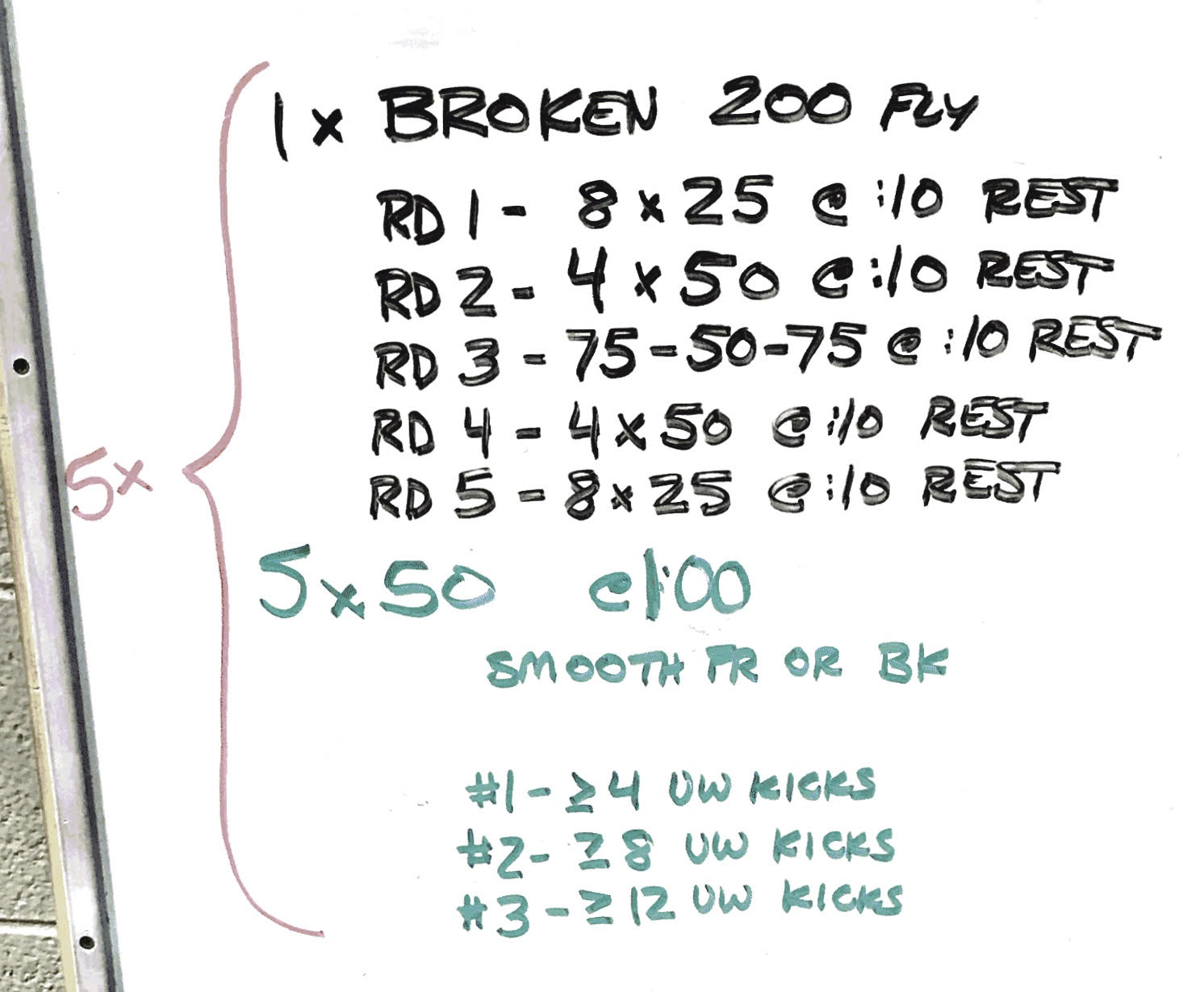
We did this fly set recently (SCY). The different instructions for A, B, and C groups were determined based on swimmers’ ability to maintain the integrity of their stroke technique over time.