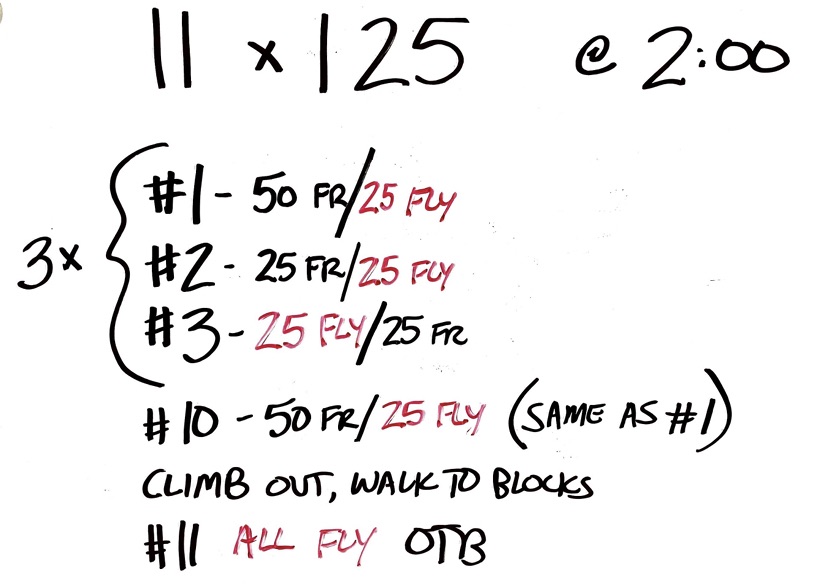
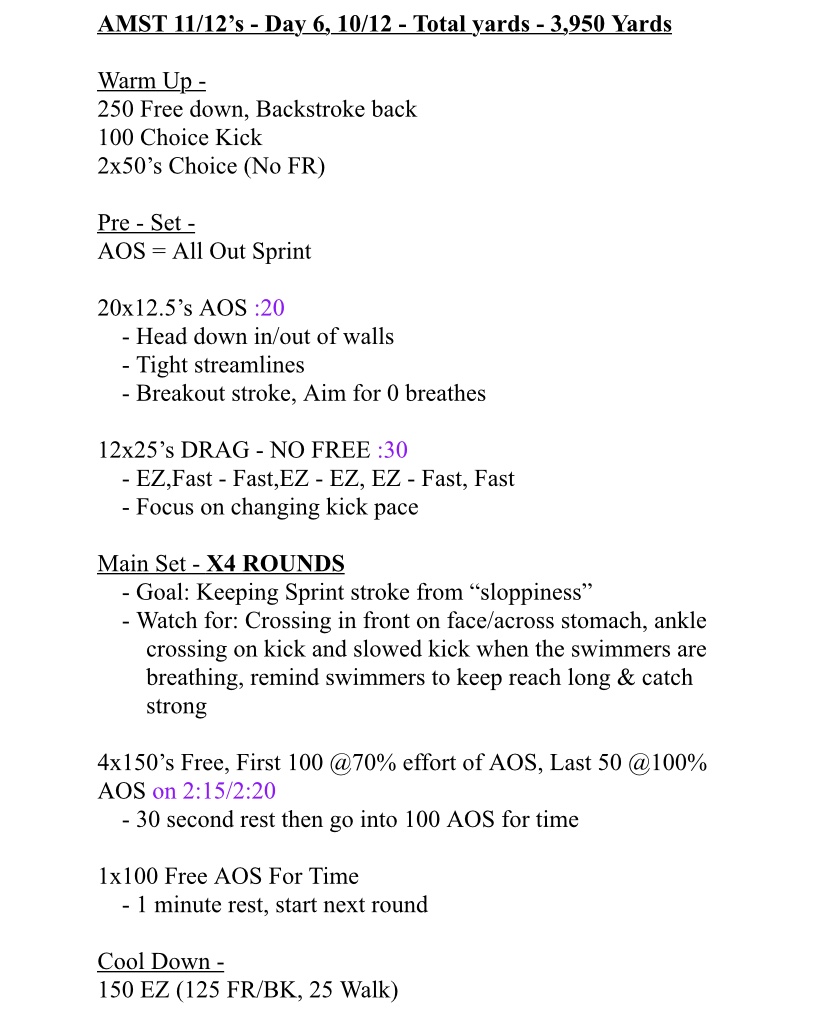
This is the sort of workout that could work well in the context of many high school practices. We had 5 lanes (lanes 2 through 6 in our pool). Swimmers dive off the blocks in lanes 3,4, and 5 for an all out 25. Their next instruction was depends on what lane they were in – either a 15m underwater kick, 5 push-ups/10 squats, or a 15m sprint. Get back behind the blocks and do it again!
How a coach presents a set can have large implications in how it lands for the swimmer. In this particular case, the way the set is revealed is key. This set was given to the team in parts. At first, I told them just about the 10×100 and 1 x 150. Then, after we calculate their paces, I gave them the second part and challenge them to go faster. We did the second part, then we calculated their paces and revealed the 3rd part and challenged them AGAIN to go even faster. We could keep going, but the slow reveal effect starts to go away after the 3rd part. In total, this was an excellent set for our crew in terms of pushing themselves to go faster than they thought they could.
We have had many posts on this blog using the “Golf” concept (adding seconds swum and cycles taken over a distance and aiming for a lower score). Here is a twist to that concept focusing on underwater dolphin kicking
6x (1x 100 back, fly, or free + 1 x 50 EZ) @ 3:00
On the 100s, get your time and then SUBTRACT the total number of dolphin kicks that you took in the 100. Calculate your score during the EZ 50. Give a high level of effort on the 100 and aim for a lower score each time.
Example:
Swimmer goes 1:08 in the 100 back and took 7 dolphin kicks off each wall (28 total), the golf score would be 40.
Some old-fashioned distance work today. This was for two of our distance swimmers who are about 30 seconds apart in their best times. One went 500s and the other went 450s. Worked out pretty well for both on this set. Base paces for each distance are in parentheses.
A few coaching-related reflections at the end of the year that I thought might be helpful to share.
Keep in touch with your colleagues and elders in the sport. Especially those who coached or mentored you. They won’t be around forever.
There is no such thing as over-communication. It is best to operate on the assumption that people don’t understand how you think. Always explain the “why” even if you think they already know.
Strive to teach, not just tell. Teaching communicates so much more.
Writing is the best means of clarifying and developing your own ideas.
Sharing your ideas will lead to the multiplication of your ideas.
“As the island of knowledge grows, so does the shoreline of ignorance.” The more I learn, the more I discover I still don’t know.
There is more than one path to high performance. Each swimmer has a different path. Each coach has a different method.
The kids who need your coaching the most may be the ones who are most difficult to coach.
Your coaching makes a difference. Much of your impact will not be known until far into the future. Make peace with this.
Take time off for yourself and have a life away from coaching. You will be a better coach and person for doing so.
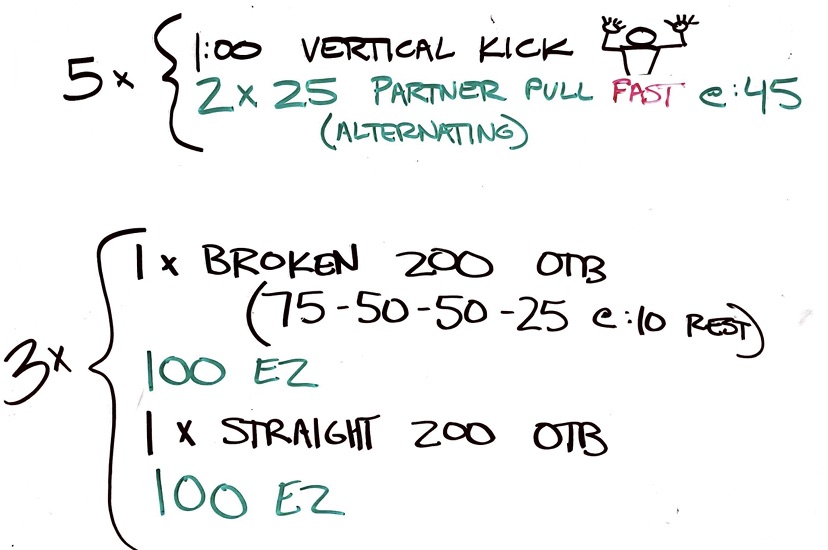
We finished out the year with a little partner work and some broken and not broken (straight) 200s off the blocks. We had some excellent results. Excited about what we can do in 2024!
Progress through the sets 1 through 6 in order with the extra :30 rest after each set. The interval pattern in this set is suitable for an athlete with a threshold pace around 1:00.
We did this set in a 25m pool. Swimmers on this interval had best times range from 1:51-2:00 in the 200 yard IM. They got 3-5 seconds rest on the 150s and were getting :50-1:00 rest on the 200 IM in each round.
We did this set in a 25m pool with an eye toward our 200 free best times in SCY.
The goal on all the 150s (in meters!) is to be faster than our best SCY 200 free times. That was not a major challenge on the 1 x 150 and 2 x 150, but it becomes a significant challenge by the time you get to 4 x 150 and 5 x 150.
We did three different intervals, with swimmers’ best time indicated at the top. Swimmers with best times under 1:45 went on 2:00. Swimmers with best times between 1:45 and 2:00 went on 2:10, and swimmers with bests slower than 2:00 went on 2:20.
In between, we did 3 x 100 the same way each time – #1 holding a tennis ball in each hand, #2 doing “Paddlehead” drill, and #3 using paddles, holding them against our forearms.
At the end of the set, we did an easy 100 and finished with a SURPRISE challenge – a fast 175m freestyle swim with fins and paddles with a goal of beating our best 200 yard times.
Overall, the set was highly successful. Most of our swimmers were making the 150s under their best, and a handful made the 175 goal. High levels of effort were pretty common across the group.
We had a very full pool for this workout , with many of our collegiate swimmers home for the holidays. This set allowed us to get in some work that works for everyone. Intervals were spacious and allowed for some solid descending work. Saw some good speed on the final 100 off the block.
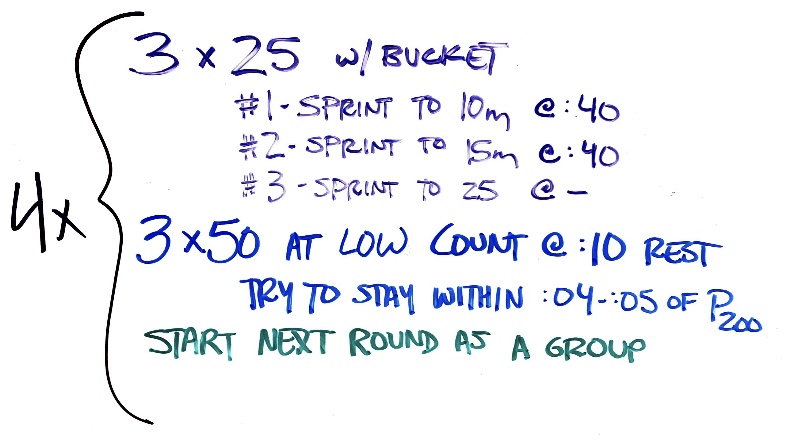
I liked this set that combined some resisted sprints followed immediately by some speed-controlled low cycle count work.
On the 3rd 25 with the bucket (1-gallon bucket on a rope tied to a waist belt), the swimmers got only enough rest to take off the bucket before starting the 50s.
Did this one for a set that allowed swimmers of varying abilities flexibility to choose their level of difficulty. Kept everyone on the same interval. This works best with three or fewer swimmers in a lane.
For this set, we divided the group into swimmers with more of a distance focus and other who are more sprint/stroke-focused. The set provided a good challenge and kept things simple with a consistent interval.
You may have heard about the Golden Race that debuted at the World Cup meet in Budapest recently. The race pitted the winners of the individual 100s against each other in a time-handicapped prize race. It’s an interesting twist on racing that we modified a bit to use at practice.
We were 2 days post-meet, so we have some recent fresh meet results.
3 x 100 Golden Race @ 7:00
We put 1 swimmer up on each block for a choice 100. Coach starts counting backwards with a stopwatch… 1:20…1:19…1:18…1:17 and so on. Each swimmer dives off the block for the 100 when they hear the time that they swam at the meet this past weekend. The winner is the one who finishes the 100 first. Essentially, the 100 is handicapped to their recent race results.
Swimmers enjoyed it and swam faster than expected. They could choose their stroke for each 100, and swimmers formed themselves into heats irrespective of speed.
The stopwatch that I started with the countdown can also be used to time the swimmers. Since I started counting down at 1:20, if the stopwatch reads 1:27.2 when the swimmer touches, then he swam approximately 7.2 slower than his meet time. This information allows swimmers to be racing the clock AND each other.
Next time I might try assigning swimmers to teams and awarding points for 1st, 2nd, 3rd, etc.
2x 2×25 fast Fly A-20 B-20/25 C-25 1×50 BK A/B/C-50 3×25 1×50 4×25 1×50 3×25 1×50 2×25 1:00R Focus on the fly was holding the same distance and speed underwater and staying within a 1 cycle range on top of the water
They did a short recovery and went to the blocks for:
8x 100 FL on 1:30 with fins focusing on coordination at lower tempo Fins came off Hopped on the blocks and went a broken 50 25FR/25FL with :10R at the 25 on 1:30
I thought I’d share my favorite freestyle sprint set. We usually do the 200’s in groups to allow swimmers a bit more rest. Short course yards, 1800 yards total.
One of the most difficult technical changes to make in swimming is getting rid of a habit of crossing over behind the head during backstroke hand entry. This set is a progression that we used to rectify that problem using overcorrection.
Credit to Andrew Sheaff for inspiring this post with a recent post of his own. I highly recommend you check him out www.coachandrewsheaff.com
Imagine the hand entry positions as times on a clock face: