Ryan Woodruff, Lynchburg YMCA
Strong on the IM swims. JMI on the free swims.

Free Swimming Workouts, Sets, Ideas, and Dryland Exercises from Professional Coaches Around the World
Ryan Woodruff, Lynchburg YMCA
Strong on the IM swims. JMI on the free swims.
Ryan Woodruff, Lynchburg YMCA
Ryan Woodruff, Lynchburg YMCA
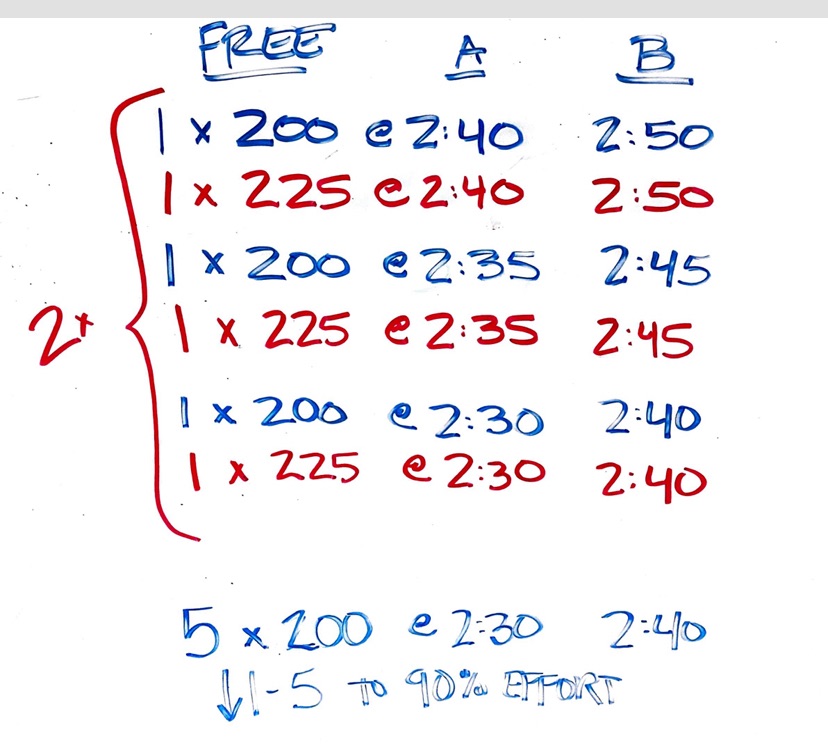
P200 = Race Pace for a 200 event
EZ = easy

Ryan Woodruff, Lynchburg YMCA
SCM
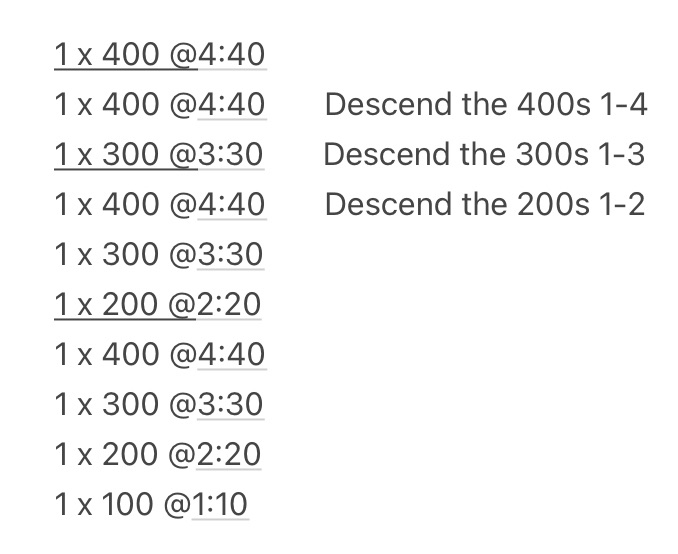
We did this set recently and our group accepted the challenge pretty well! We used an approximately 1:1.5 work:rest ratio and recorded the times on a dry erase board for all to see during the workout. Swimmers were able to do a 100 EZ after the 400, 300, and 200 each time.

Ryan Woodruff, Lynchburg YMCA

B5 = breathing every 5 strokes
In & Outs = Climb out, jump back in
Push-ups with flutter kick are done with the feet in the water, hands on the edge of the pool.
🐸 jumps = on the deck, squat down until fingertips touch the ground, jump up until feet leave the ground.
Ryan Woodruff, Lynchburg YMCA
SCY
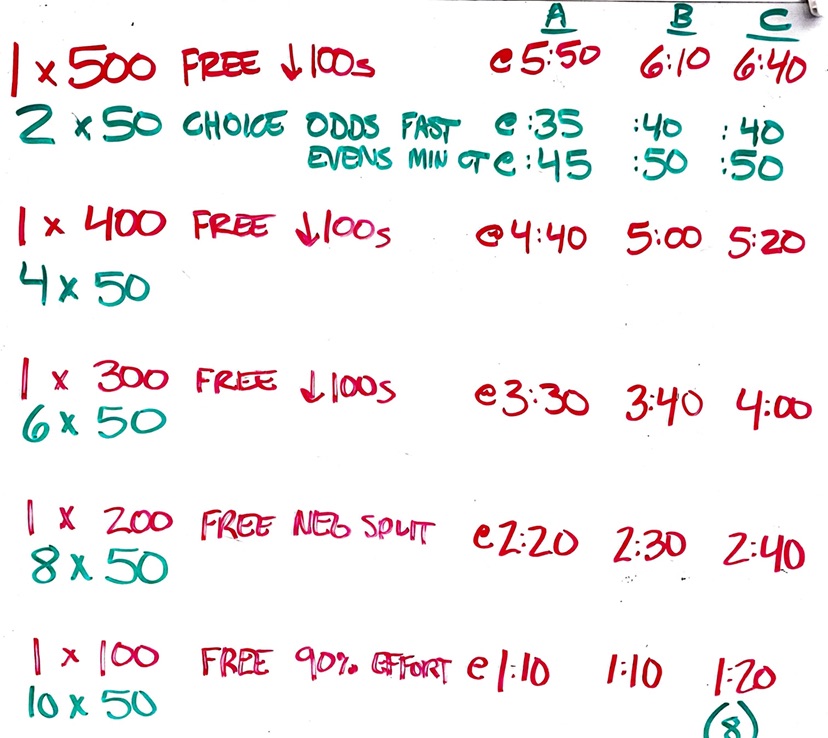
This was our biggest set on a recent Saturday morning. The instructions were the same for the 50s all the way down through the set. The A-B-C intervals represent different lanes/levels of swimmers in our practice. “MIN CT” = minimum cycle count.
Ryan Woodruff, Lynchburg YMCA
SCY
We did the vertical kick in the deep end with hands held out of the water. The 10 high-knee jumps happened in a 4-foot shallow end. The 10 squats were done on the deck.

Ryan Woodruff, Lynchburg YMCA
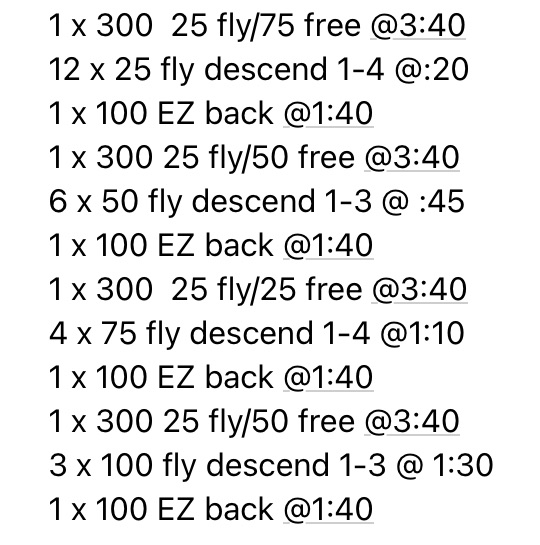
This is a full workout for a first long course course practice of the season focused on butterfly. This is after a 15-20min warmup:
Pre-Set
9 x 100 @:20 rest
#1 Dolphin kick on side
#2 8 Dolphin kicks on side, 1 cycle fly
#3 6 diolphin kicks on side, 2 cycles fly
Main Set
2x:
4 x 150 @ :15 rest, 10 cycles strong fly then steady free each 50
6 x 100 @ :10 rest 14 cycles strong fly then steady free each 50
8 x 50 @ :50
Round 1: All fly Descend 1-4 and 5-8
Round 2: #1,3,5,7,8 are FPA fly, #2,4,6 are free B5
Kick Set with Freestyle
6 x (75 fast kick try to best best 100 LCM time + 25 EZ kick ) @2:20
1 x 200 freestyle descend cycle count by 50
4 x (75 faster + 25) same as above
1 x 200 freestyle descend cycle count by 50
2 x (75 faster + 25) same as above
1 x 200 freestyle descend cycle count by 50
Warm down
by Ryan Woodruff
I had the good fortune to meet Dudley Duncan in 2015 when I moved to Virginia. Having only observed his team from a distance previously, I enjoyed conversations on the pool deck with him until his retirement in 2019. The title of his book spells out his philosophy — that swimming well is an art and learning how to compete is figuring out the game that is happening within every race.

My favorite thing about this book is that it reads as though one is having an informal conversation with the author. If you have ever wanted to pick the brain of a master coach but are too afraid to ask, this is the book for you. Coach Duncan tells stories from his career and explains every step of his 51-year coaching journey. He delves into the business side of owning a swim team and a pool facility (very informative!) and advocates for more coaches to control their business destiny. He doesn’t sugarcoat the realities of ownership, even detailing the difficult schedule he had to keep to turn his vision into a reality. Sure, there is a chapter on technique (humbly titled “A Way”, not The Way), but the real gold nuggets in this book for me were the chapters on Team Consciousness and The Mental Game. Duncan describes his process for elevating a group to next-level performance and how to most effectively communicate with different personalities.
Coach Duncan’s ideas have caused me to reflect on my own coaching process and re-framed my thoughts on how I lead and guide a group. Though he is writing from the club coach’s perspective and very much aiming at helping the career club coach, there are lessons here for anyone interested in becoming a better swimming coach. “The Art of Swimming and the Game of Racing” is available in paperback ($19.99), on Kindle ($12.99), or as an audiobook ($17.99). Get it and read it twice or listen to it while you drive back and forth to practice. It will be a valuable addition to your coaching library.
You can purchase the book or read the reviews on Amazon.
Editor’s note: I received zero compensation for this review other than a copy of the book.
Ryan Woodruff, Lynchburg YMCA
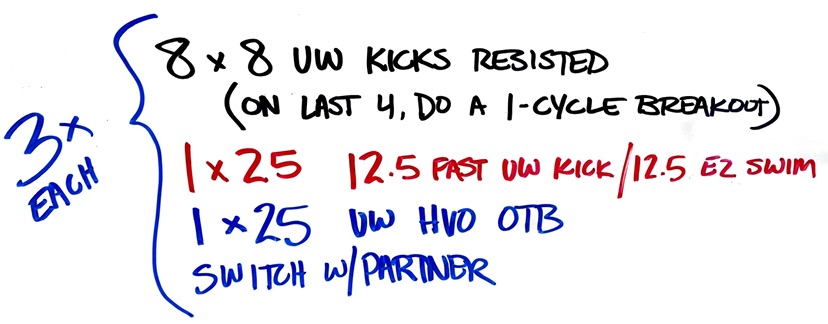
The blue 25m is underwater kick off the blocks for time.
Ryan Woodruff, Lynchburg YMCA
SCY
Ryan Woodruff, Lynchburg YMCA
SCY.
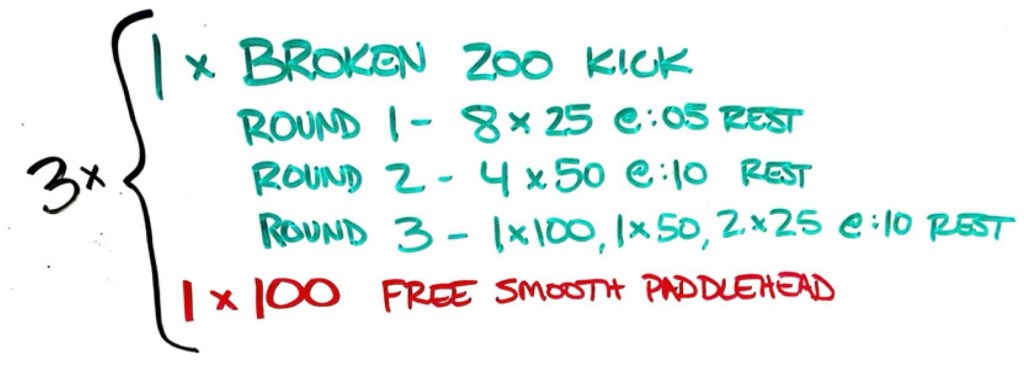
On the 200s, steady medium effort with focus on underwater kicks. On the red descend parts, stick with a stroke for 3 swims in a row.

Ryan Woodruff, Lynchburg YMCA
SCY
This set is swimmer’s choice of stroke, though I mostly encouraged back or breast.
Golf = add swimmer’s time and cycle count for the 50, aim for a lower score.

Ryan Woodruff, Lynchburg YMCA
SCY

This month’s issue is here.

Subscribe to get it delivered straight to your inbox on the first of the month!
Ryan Woodruff, Lynchburg YMCA
SCY
Ryan Woodruff, Lynchburg YMCA

Ryan Woodruff, Lynchburg YMCA
SCY
Golf = cycle count + time (in seconds). Aim for a lower overall score

Ryan Woodruff, Lynchburg YMCA
SCM
Within each descend set, we aimed to descend to a slightly faster time each time.

Ryan Woodruff, Lynchburg YMCA
The broad aim of this set was to give our group (that has a wide range of speeds for middle-distance swims) a challenge to push themselves on the 400 while still getting some recovery/drill/technique work in. We timed the 400s and then swimmers would start right into the fartlek (continuous swimming). After 5-7 minutes of the fartlek, I would verbally stop the group and we would rest a minute before starting the next 400. FPA = fastest possible average. K.O.S. = Kick on Side

Ryan Woodruff, Lynchburg YMCA
SCM
The 400s here got down to a challenging interval by the last one. The sets of 4 x 100s in between were on moderate interval. Just getting good work in. The two columns represent an A and B interval within our group.

Ryan Woodruff, Lynchburg YMCA
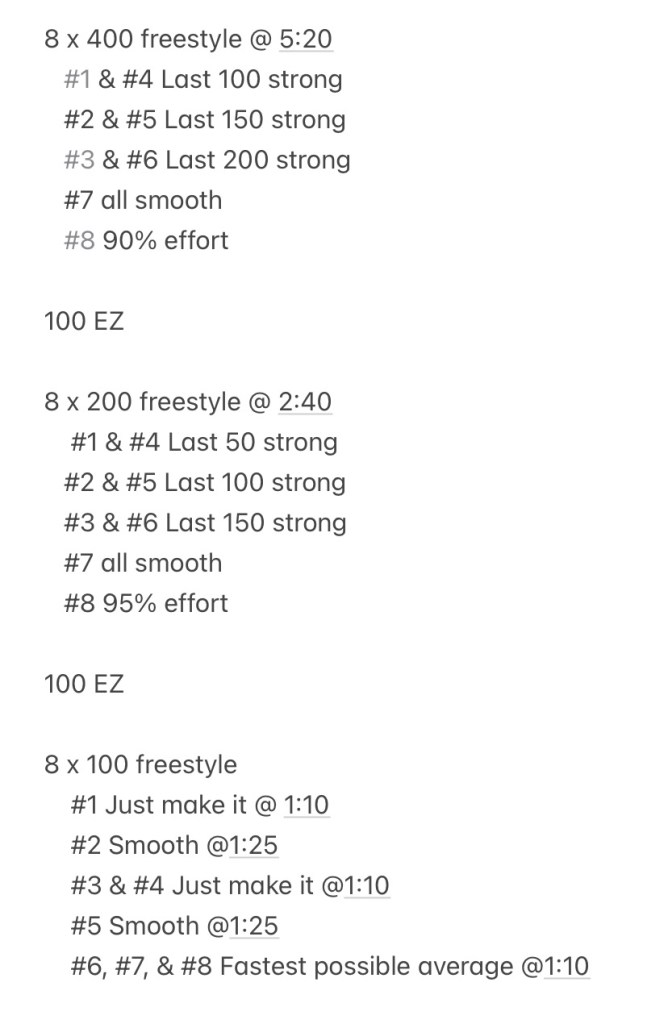
SCM. For the 400s and 200s, swimmers were instructed to do an open turn before the “strong” part to check the clock and get their split. The emphasis is always on being fast at the end of each repeat and the end of the set.
Ryan Woodruff, Lynchburg YMCA
SCM

Ryan Woodruff, Lynchburg YMCA
SCM. This one worked great for our group. “UWK” equals “underwater kick”. Be sure to only do this type of set with mature swimmers who understand how to safely work on this skill. No hyperventilation permitted – ever!

Ryan Woodruff, Lynchburg YMCA
SCY
Ryan Woodruff, Lynchburg YMCA
We love using vertical kicking to work the legs and practice alignment of the body. The :30 vertical kick is done with the hands out of the water. The :20 is with head on hands (a little more difficult), and the :10 is done in a streamline position (most difficult). There are endless variations and permutations one could make to this structure.

Ryan Woodruff, Lynchburg YMCA.
We did this set on a day where we had less pool space than ideal and needed to get a good solid set for the various different specialties in our group.
This set was in a 25m pool. Intervals were the same for everyone.

Ryan Woodruff, Lynchburg YMCA
SCM
Ryan Woodruff, Lynchburg YMCA
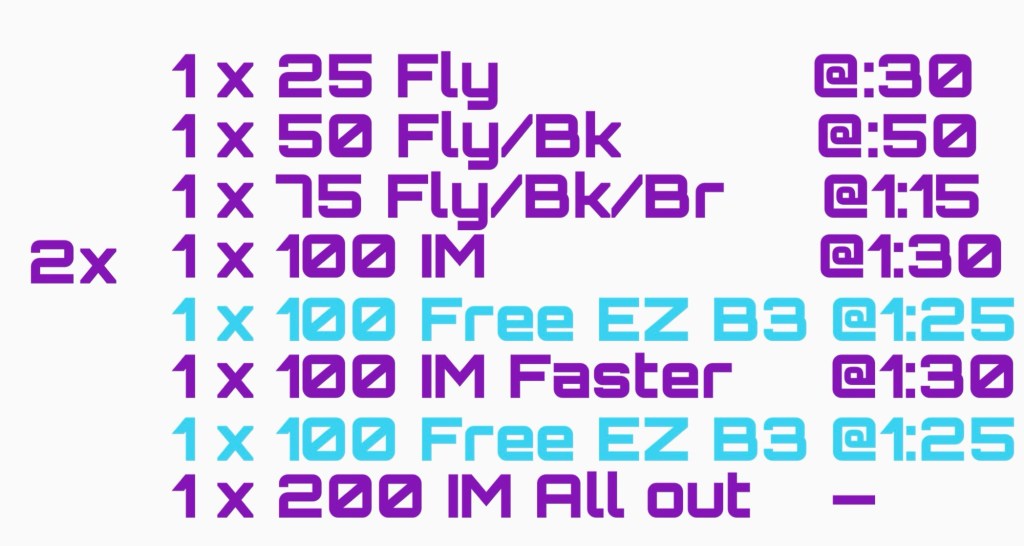
This is the sort of workout that could work well in the context of many high school practices. We had 5 lanes (lanes 2 through 6 in our pool). Swimmers dive off the blocks in lanes 3,4, and 5 for an all out 25. Their next instruction was depends on what lane they were in – either a 15m underwater kick, 5 push-ups/10 squats, or a 15m sprint. Get back behind the blocks and do it again!

 The Swimming Wizard