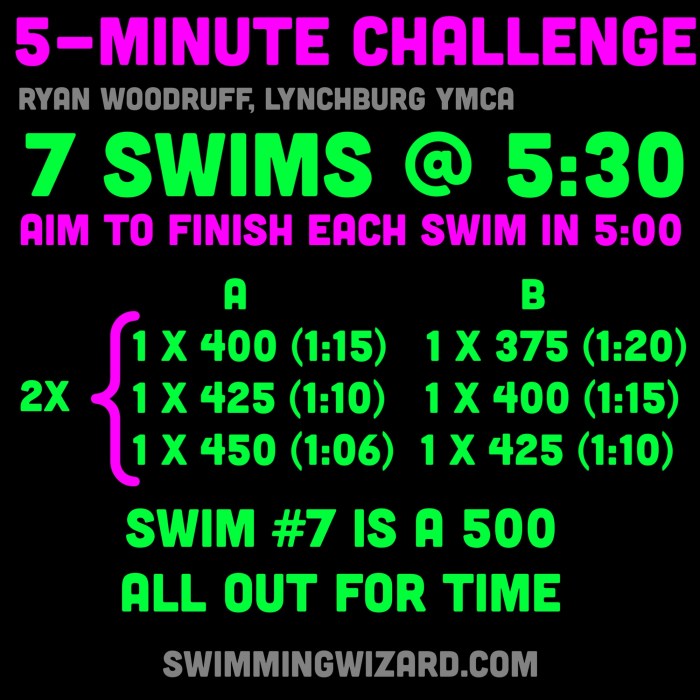
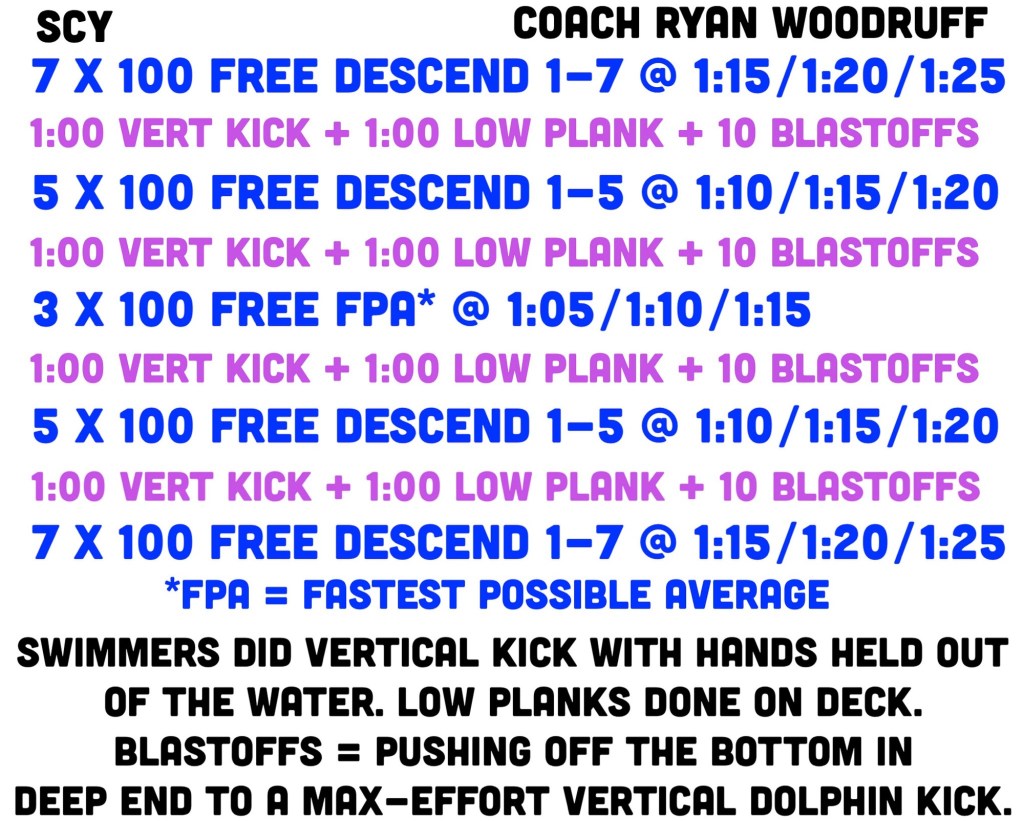
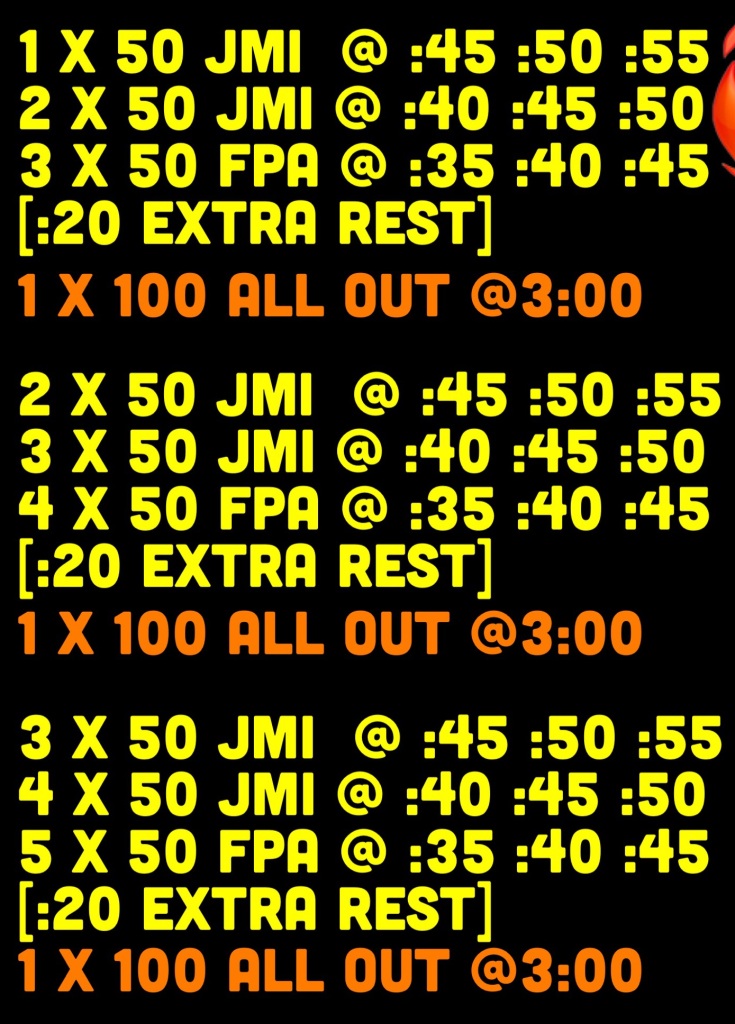
The three columns of intervals (SCY)here represent an A/B/C option for different levels of swimmers. Ideally, the fastest interval should push the swimmers a bit on the first 3 rounds and be a significant challenge at the end of the set. This was a good finisher for a recent practice of ours. The last set of 6 got spicy for sure.
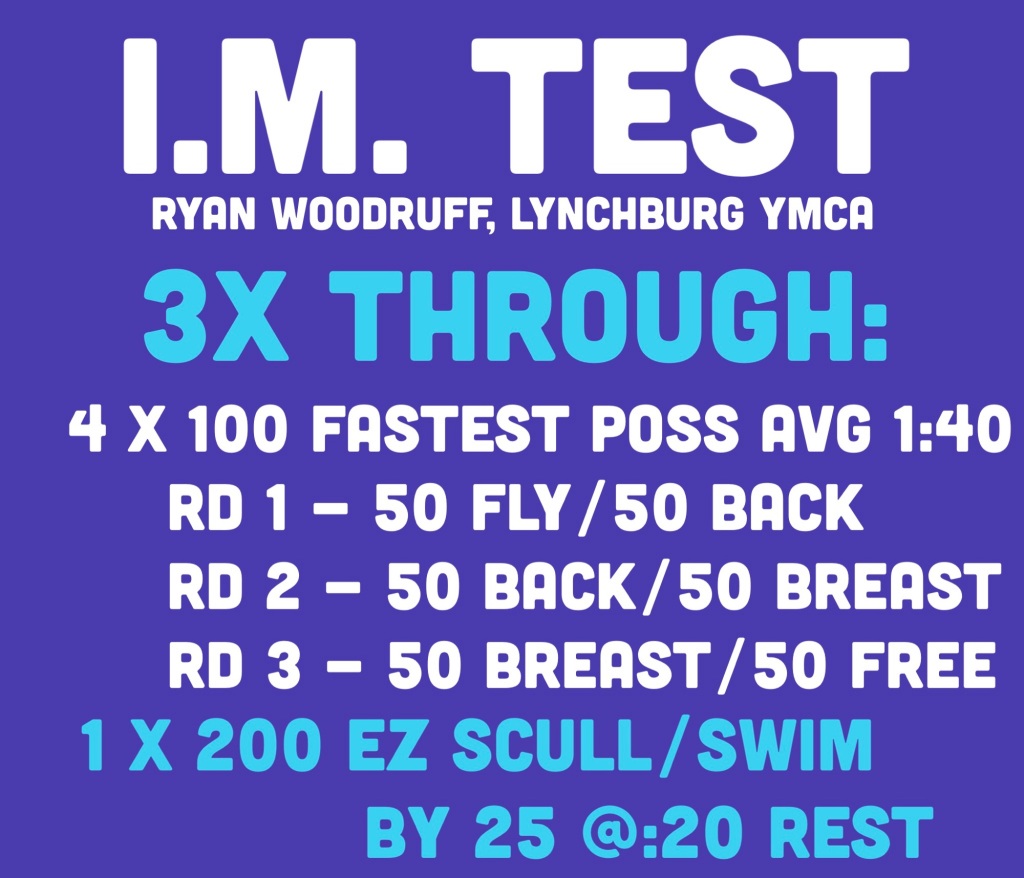
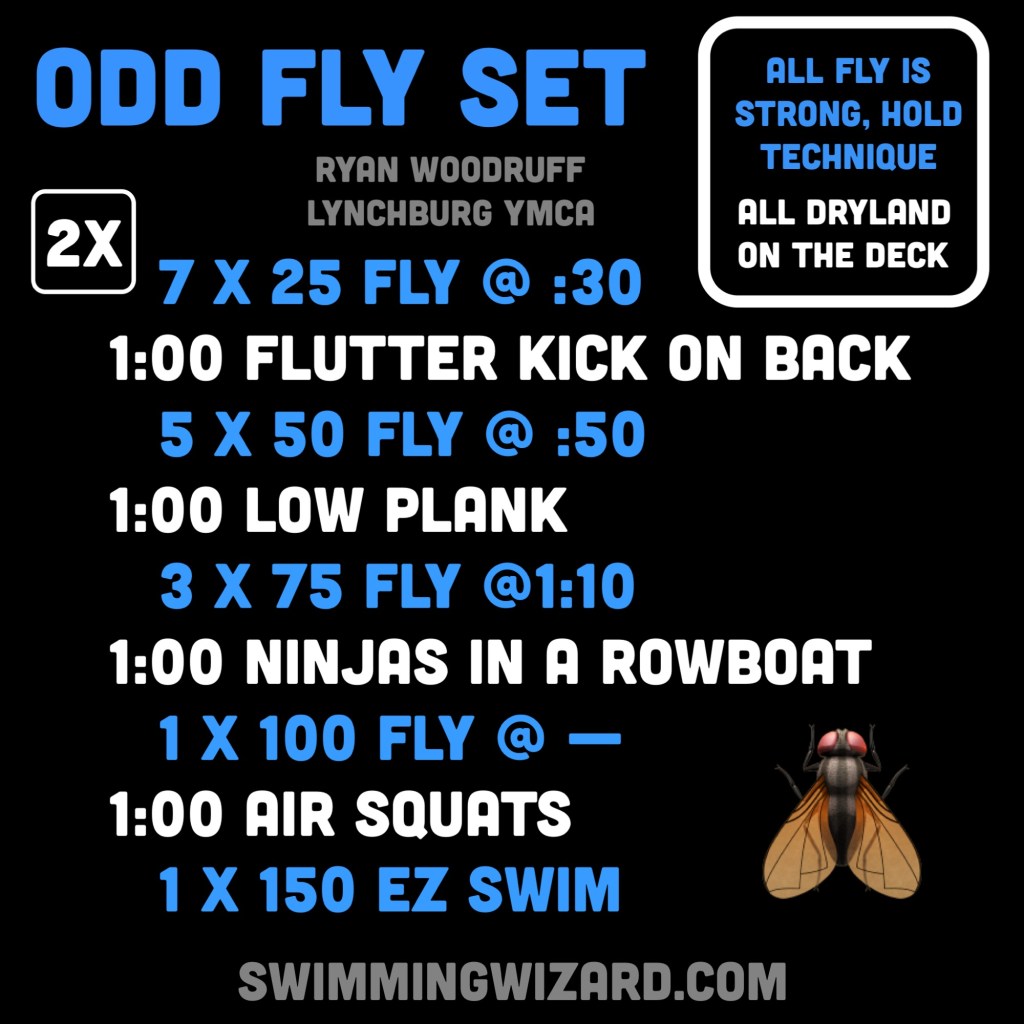
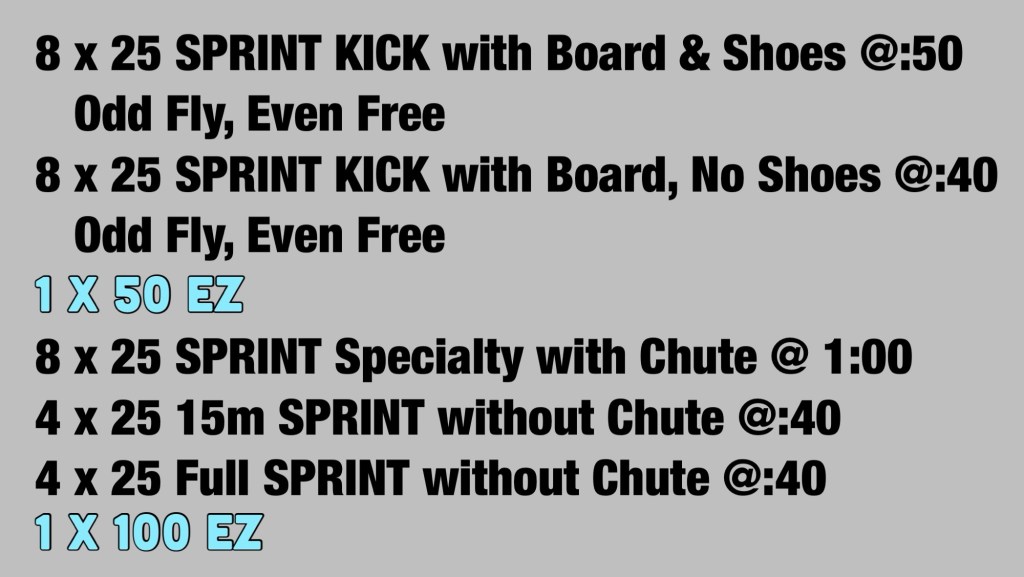
We did this one recently for some good butterfly work on a day when we had more swimmers present than could train effectively in the space available. We split into two groups – one group would do the swimming set while the other group did dryland set on the deck, and then they switched. The dryland exercises always takes less time, so that allows for some rest before starting the next fly set.
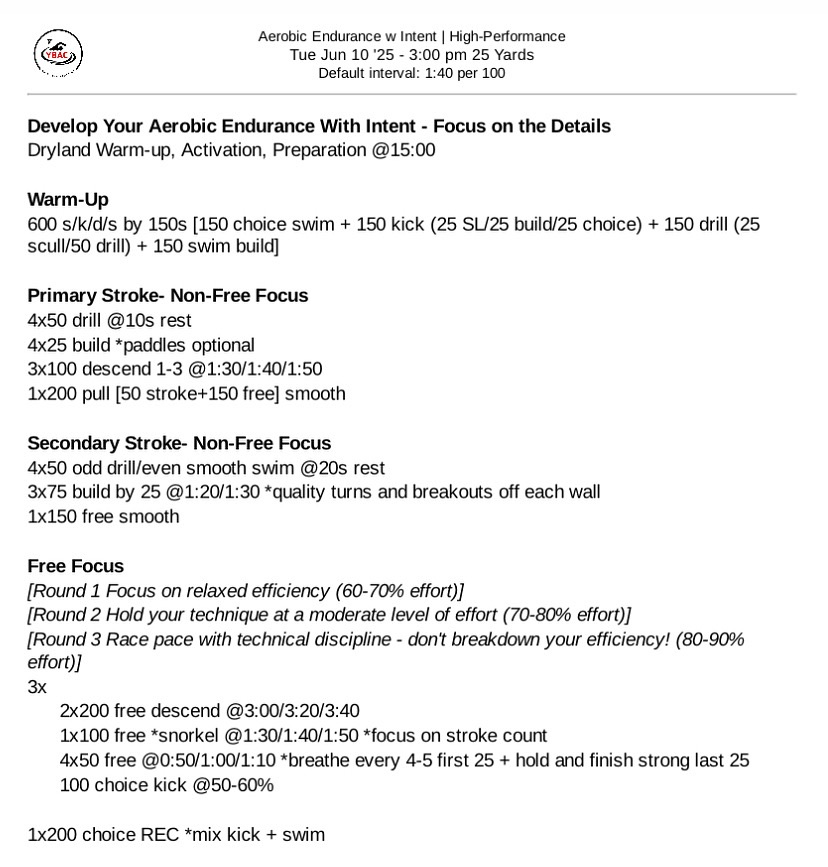
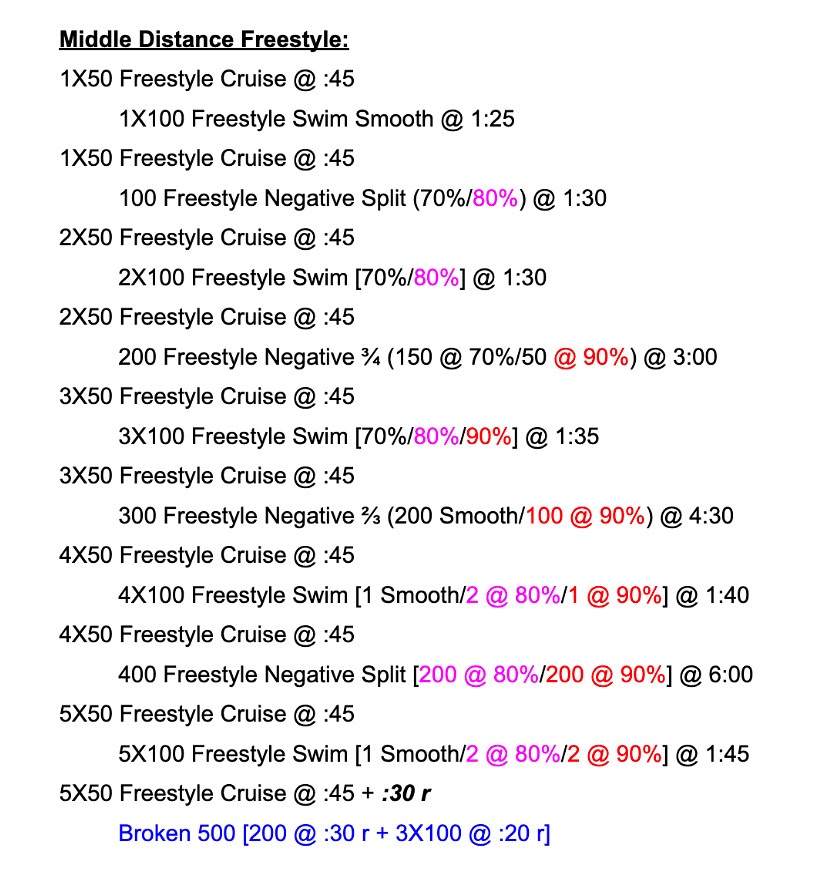
Today’s focus was threefold: we worked on steady-state cruising, negative pacing, and descending. All the 50s were on :45 (LCM) and served as active recovery while maintaining a moderate heart rate. As the number of descending 100s increased, so did the rest—allowing swimmers to actually achieve a descending effort.
Since negative splitting is essentially an even split, I decided to go all in on fractions and include 3/4 and 2/3 splits as well. Additionally, the longer straight swims were on a consistent interval base of 1:30.
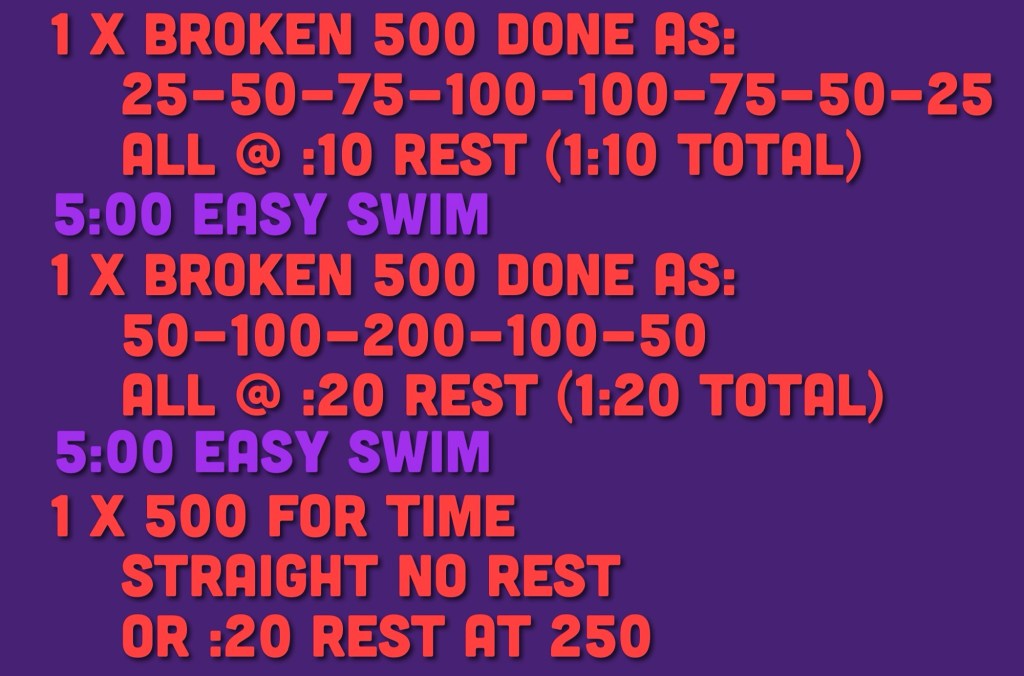
We wrapped up with a broken 500, with the goal of holding a near-200 effort throughout—not necessarily an all-out sprint, but also not paced like a typical 400/500/800 distance swim. It was challenging, but it kept them moving and got them in a good training rhythm.
This isn’t the most creative set ever, but it gets the job done for a cool 4,000 yds of aerobic work. The instructions for our crew were to negative split the long swim, and then make both of the shorter swims faster than half of the long swim. The intervals listed represent the A interval for our group, on a 1:10 per 100 base.
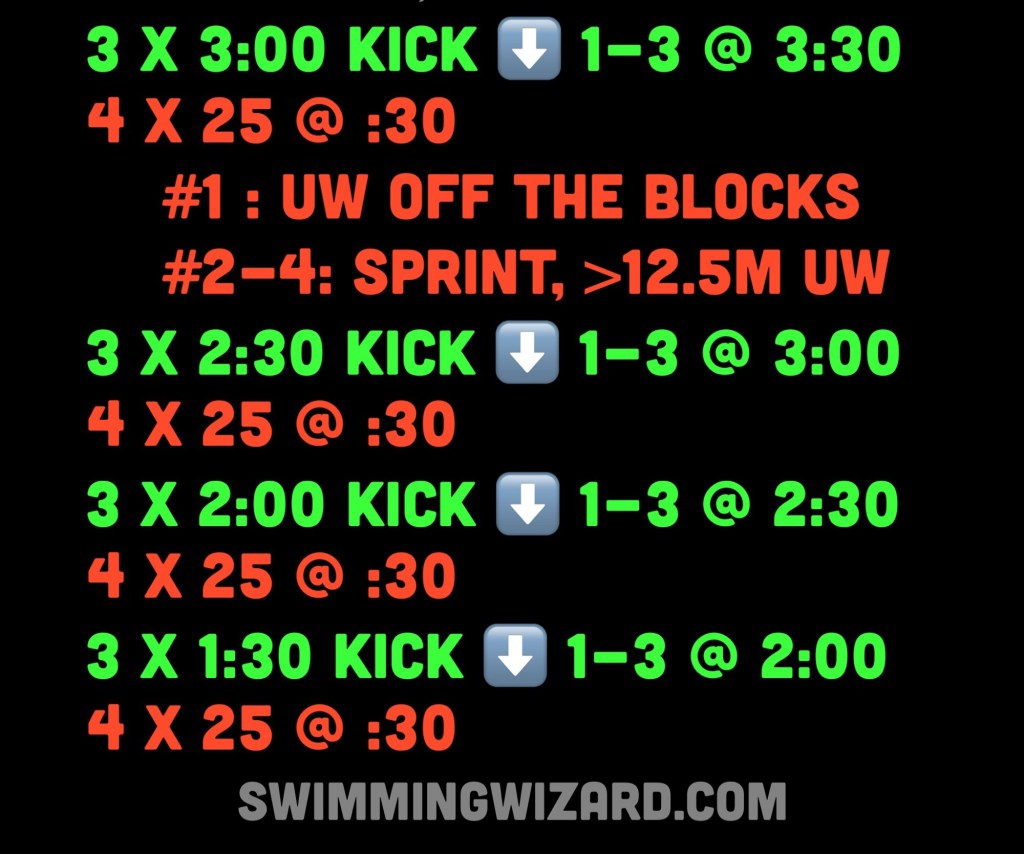
Some training just has to be done. Because it is good for you. Even if you don’t love it.
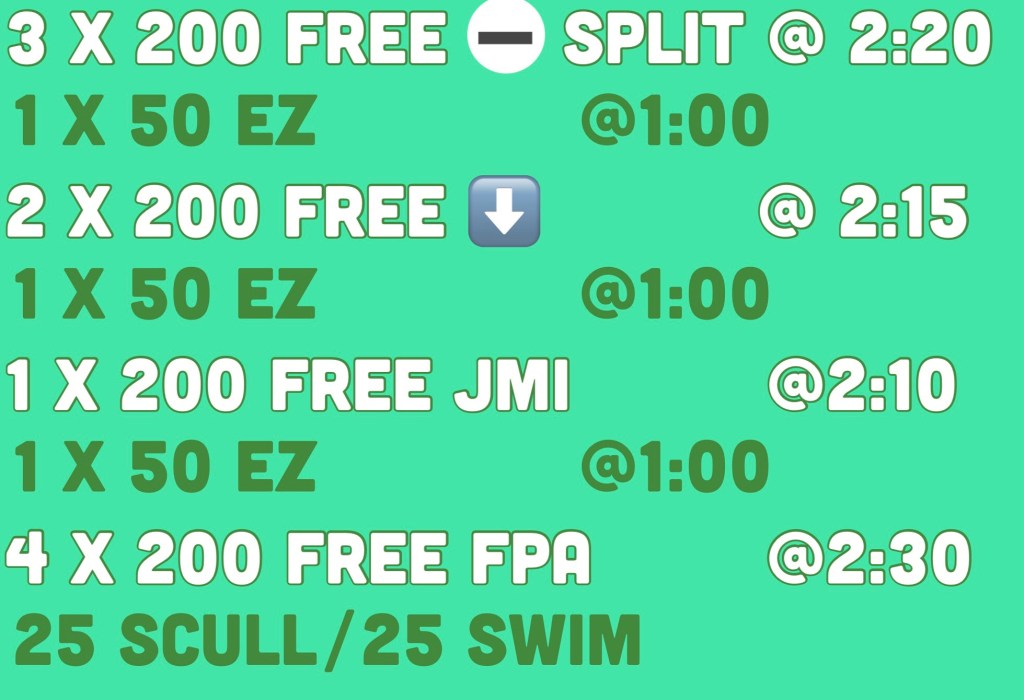
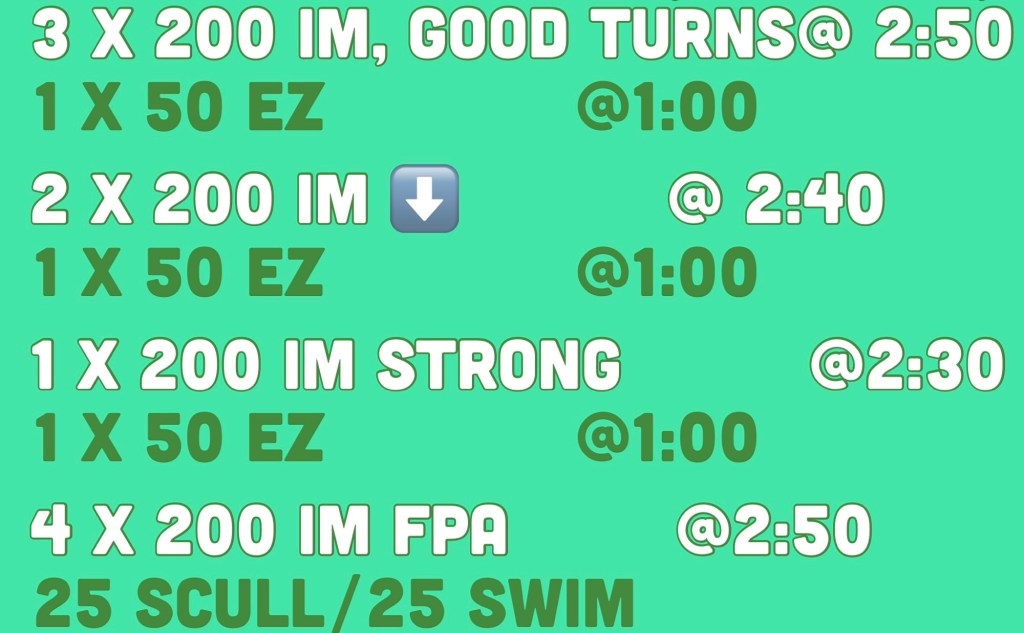
Today’s set is in 2 parts. The first part is primarily freestyle, and the 2nd part is primarily IM. At the end of each round we did some open-ended scull/swim by 25, which allows for some recovery and re-grouping.
FRIM (I say it as FreeIM) and Paddlehead drill. Paddlehead drill is swimming freestyle with a hand paddle position on the front of the swimmer’s head, with nothing holding it in place except the oncoming water.
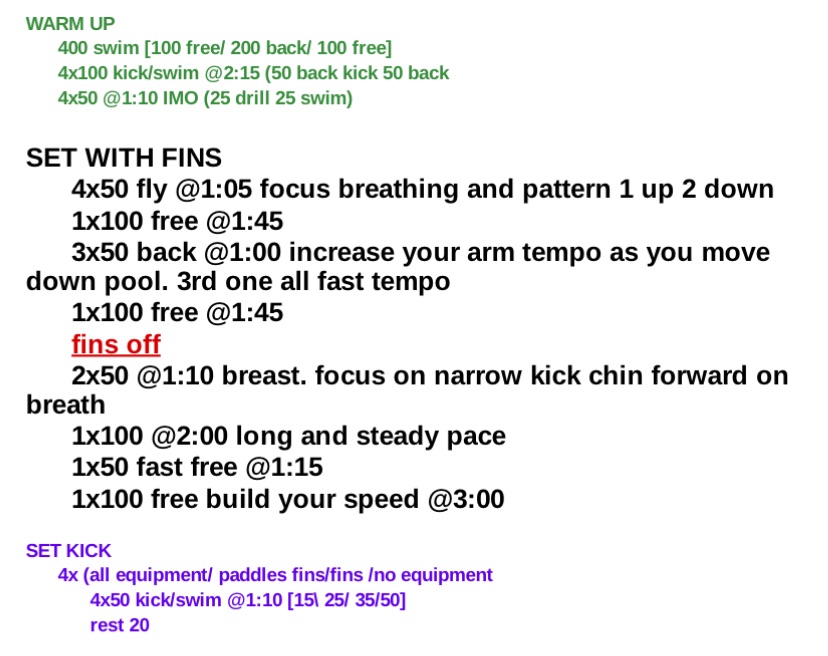
We are just getting back into training, and this one served as a bit of technical work with some decent-quality fly. We are still training short course meters.
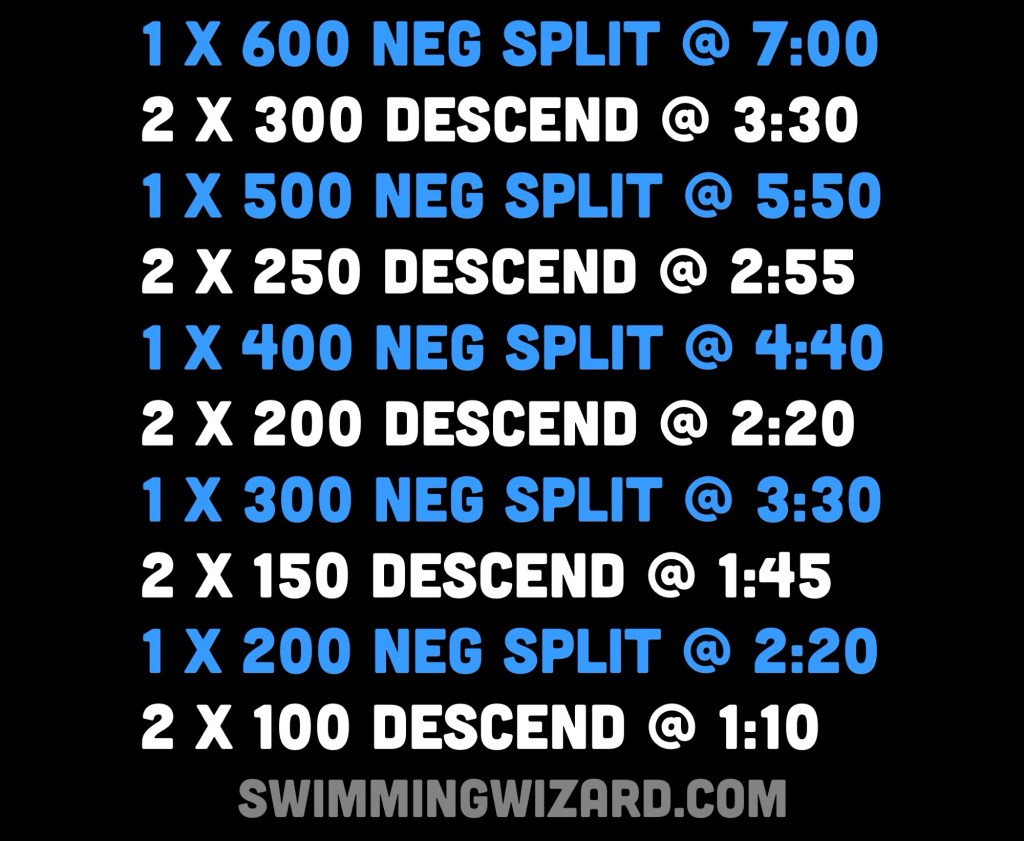
This set was seeking a very specific pattern of pacing on each 600, as indicated by the line graph for each one. Failure to split it correctly meant repeating that 600. To interpret… 1 – 300 at a consistent pace, 300 at a faster pace, also consistent 2 – 3 x 200 descend, each one at a consistent pace 3 – 2 sets of 3 x 100 descending 4 – 4 x 100 descend + 200 fast and consistent 5 – 3 x 100 descend + 300 fast and consistent 6 – 2 x 100 descend + 400 fast and consistent The second picture shows how it turned out for our swimmer, with splits written next to each graph. We had to do the first 600 twice due to some early set rusty-ness. Splits for the first of those two are not included.
“Had a great 200IM practice with the team… I loved the finisher. Essentially a broken 400IM minus a 25 FL and 25 BR. Wanted to see where they might be once you minus the 1:00 worth of rest from the time they go. And then you could easily add the missing 25’s pace into the time to give the hypothetical 400 IM.
Finisher: I put the set on a rest based to help get the guys into a that feeling of the race once they reached the 1×75 BR and 125 FR. Had multiple guys push 1:10 at the end for the 125 and one pushed a 1:08. Had two Pre-Sets before I sent them into this.”








 The Swimming Wizard